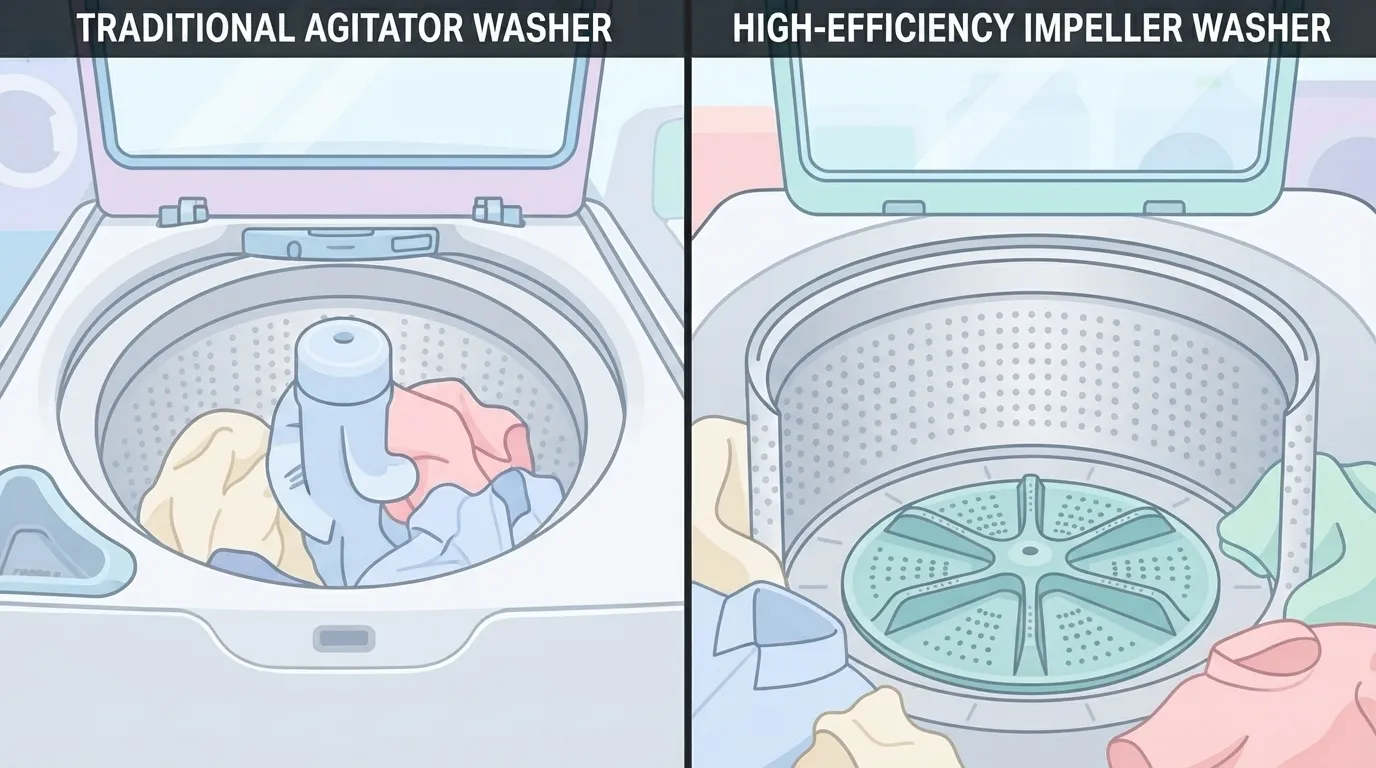
An agitator is a washing machine part with a tall center post and fins that twist clothes back and forth. An impeller is a low profile disc or cone that spins at the bottom of the tub, moving clothes around it instead of twisting through the middle.
I spent an entire Saturday afternoon standing in a washing machine aisle, staring at two nearly identical looking top load washers, completely stuck. One had a tall center post inside the tub, the other had a low flat disc. The salesperson said one word that changed everything, agitator versus impeller.
If you have ever shopped for a washing machine, you have probably run into this exact same confusion. Both types clean clothes, both sit inside a top load washer, and both get described using technical terms that manufacturers rarely bother to explain clearly.
This mix up costs people real money and real laundry headaches, since the wrong choice can mean rougher treatment of delicate fabrics or a machine that struggles with heavily soiled loads.
This guide breaks down exactly what separates an agitator from an impeller, how each one actually cleans your clothes, and which type fits your specific laundry needs best. By the end, you will walk into that appliance aisle with total confidence.
Let us break it down.
Agitator or Impeller: Quick Answer
An agitator is the tall spindle shaped post that sits in the center of a top load washing tub, equipped with fins or vanes that twist back and forth to physically rub clothes against each other and force water through the fabric.
An impeller is a low profile cone or disc, usually positioned at the bottom of the tub, that spins to create strong water currents which move and tumble clothes around the tub without the twisting motion of an agitator.
For example, a traditional top load washer with a center post uses an agitator, while a newer high efficiency top load washer with a flat spinning disc at the bottom uses an impeller.
The Origin and Background of Agitators and Impellers
The agitator design dates back to some of the earliest electric washing machines developed in the early twentieth century. Engineers modeled the twisting center post after the manual scrubbing and wringing motion people had used by hand for generations, mechanizing a familiar cleaning action into a repeatable, motorized process.
For decades, the agitator remained the standard design across nearly every top load washing machine sold in North America, largely because the technology was simple, reliable, and effective at handling everyday loads of laundry.
The impeller design emerged much later, gaining real popularity in the early two thousands as manufacturers pushed to develop more water efficient and energy efficient washing machines. Removing the bulky center post freed up significantly more tub space, allowing larger loads while using considerably less water per cycle.
This shift coincided with growing regulatory pressure in several countries to reduce household water and energy consumption, pushing manufacturers to innovate beyond the traditional agitator design that had dominated the market for the better part of a century.
Early impeller models faced some skepticism from long time agitator users who worried the gentler motion simply could not match decades of trusted cleaning performance. Manufacturers responded by improving cycle times, water temperature control, and detergent dispensing systems to help impeller machines close that performance gap over successive product generations.
By the time impeller washers reached widespread adoption, independent testing organizations had already documented competitive cleaning results between well designed impeller and agitator models, provided owners followed recommended load sizes and used appropriate detergent formulations suited to high efficiency machines specifically.
Agitator Explained: Key Differences and Variations
Understanding how each design actually moves your clothes helps explain their real world performance differences.
| Feature | Agitator | Impeller | Context or Result |
| Location in tub | Tall center post | Low disc or cone at bottom | Agitator takes up tub space |
| Cleaning motion | Twisting, rubbing action | Spinning water current | Agitator is more physically aggressive |
| Fabric wear | Higher wear on delicate items | Lower wear, gentler overall | Impeller favors delicate fabrics |
| Water usage | Generally higher | Generally lower | Impeller favors efficiency |
| Load capacity | Smaller due to center post | Larger, more open tub space | Impeller fits bulkier loads |
That center post is really the heart of the difference, its presence or absence changes everything about how the machine handles your laundry from start to finish.
Which One Should You Choose?
Your ideal choice depends heavily on your specific laundry habits and household needs.
For households dealing with heavily soiled work clothes, sports gear, or thick towels, an agitator often provides more thorough cleaning thanks to its stronger physical scrubbing motion against tough stains and grime.
For households prioritizing delicate fabrics, larger load capacity, or lower water and energy bills, an impeller is usually the better fit, since it treats clothes more gently while accommodating bulkier loads like comforters and bedding.
Then For families balancing both needs, many impeller machines now include specialized cycle settings designed to boost cleaning power for heavily soiled loads, narrowing the performance gap that once clearly favored agitators for tough stains.
And For anyone renting or living in an older home with limited water pressure, checking manufacturer specifications matters more than the agitator versus impeller debate alone, since water pressure requirements can vary noticeably between models.
Common Mistakes People Make With Agitators and Impellers
Shoppers and even some appliance salespeople get details wrong here regularly. Here are the most frequent mix ups.
Mistake 1: Assuming impeller machines cannot clean well Wrong belief: “Impeller washers barely clean anything since there is no agitator.” Correct understanding: Impeller machines rely on strong water currents and often longer wash cycles to achieve comparable cleaning results, especially when paired with proper detergent amounts and appropriate cycle settings.
Mistake 2: Assuming agitators always damage clothes Wrong belief: “Agitators shred every piece of clothing you own.” Correct understanding: Modern agitator designs have improved significantly, and normal loads of sturdy fabrics like jeans or towels typically show minimal wear under regular use.
Mistake 3: Confusing impeller washers with front load washers Wrong: “That impeller washer is basically a front loader.” Correct: Impeller washers are still top load machines, simply without the traditional center post, while front load washers use an entirely different horizontal drum design.
Mistake 4: Overloading an impeller machine because it looks more spacious Wrong: Stuffing the tub completely full since there is no center post blocking space. Correct: Even impeller machines have recommended load limits, and overloading reduces cleaning performance regardless of design, since clothes need room to move through the water current.
Mistake 5: Ignoring water hardness when choosing between the two Wrong: Assuming design alone determines cleaning results everywhere. Correct: Water hardness and detergent type significantly affect performance for both agitator and impeller machines, so local water conditions deserve consideration alongside the mechanical design itself.
Agitator and Impeller in Real World Examples
Seeing these terms used naturally clarifies exactly how each one fits into everyday conversation and documentation.
Professional email, appliance retailer: “Our best selling impeller model offers a larger tub capacity while using noticeably less water per cycle than comparable agitator units.”
News headline, consumer report style: “Impeller Washers Gain Market Share As Shoppers Prioritize Water Efficiency Over Traditional Designs”
Social media post: “Finally switched from an old agitator washer to an impeller model, honestly did not expect the difference in load size to be this noticeable.”
Formal document, product specification sheet: “This model features a low profile impeller design engineered to reduce fabric wear while maintaining strong overall cleaning performance.”
Each example shows how naturally these terms fit into shopping, reviews, and technical descriptions once you understand what they actually mean.
Agitator and Impeller: Data, Trends and Usage
Search interest for both terms spikes heavily during major shopping periods, particularly around appliance sales events, showing a strong commercial search intent from people actively comparing washing machine models before making a purchase.
Impeller related searches have grown steadily over the past decade, closely tracking rising consumer interest in energy efficient and water saving home appliances, along with growing environmental awareness among shoppers.
Agitator related searches remain steady among households specifically seeking maximum cleaning power for tough, heavily soiled laundry, often searching terms like best agitator washer for stains or heavy duty top load washer.
This distinction matters significantly for appliance retailers and reviewers, since clearly explaining the difference helps shoppers make confident purchasing decisions rather than guessing based on price or brand recognition alone.
Retail sales staff often mention that customers arrive with strong opinions formed entirely from a previous machine they owned years earlier, sometimes without realizing washing technology has changed considerably since then. A shopper who struggled with an old, poorly performing impeller model a decade ago might unfairly dismiss newer, significantly improved versions without giving them a fair comparison.
Consumer review platforms now frequently break down ratings by wash type specifically, allowing shoppers to filter and compare agitator and impeller models side by side based on real owner feedback, cleaning performance scores, and reported reliability over time.
Comparison Table: Agitator vs Impeller
| Term or Variant | Meaning | Region or Context | Best Used When |
| Agitator | Center post that twists clothes | Traditional top load washers | Heavily soiled loads needing strong scrubbing |
| Impeller | Low disc that spins water currents | Modern high efficiency top load washers | Larger loads, delicate fabrics, water efficiency |
| Front load | Horizontal drum, no agitator or impeller | Front loading washers | Maximum efficiency and gentlest fabric care |
| High efficiency | General term for water saving washer designs | Both impeller and some agitator models | Reduced water and energy consumption |
Frequently Asked Questions
Q: What is the difference between an agitator and an impeller? A: An agitator is a tall center post that twists clothes physically, while an impeller is a low spinning disc that moves clothes using water currents instead of direct twisting motion.
Q: How do you know if a washing machine has an agitator or impeller? A: Look inside the tub. A tall post rising from the center means agitator, while a flat, low profile disc at the bottom means impeller.
Q: Agitator vs impeller, which one cleans clothes better? A: Agitators typically clean heavily soiled items more thoroughly thanks to stronger physical scrubbing, while impellers offer gentler, more water efficient cleaning suited to larger and more delicate loads.
Q: Is an impeller washer worth the higher price compared to an agitator model? A: For many households, yes, especially those prioritizing water savings, larger load capacity, and gentler fabric care, though heavily soiled laundry may still benefit more from an agitator design.
Q: Which washing machine type is correct for delicate fabrics, agitator or impeller? A: Impeller machines are generally the better choice for delicate fabrics, since they avoid the direct twisting and rubbing motion that agitators use.
Q: Where did the agitator washing machine design come from? A: The agitator design dates back to early twentieth century electric washing machines, which mechanized the traditional hand scrubbing motion people had used for generations before.
Q: Can an impeller washer handle large loads like comforters? A: Yes, impeller washers typically offer more open tub space without a center post, making them especially well suited to bulky items like comforters and bedding.
Final Thoughts
Agitators and impellers represent two completely different approaches to the same basic goal, getting your clothes clean. One relies on physical twisting force, the other on powerful water movement.
Remember these key takeaways. Choose an agitator for tough, heavily soiled loads needing strong scrubbing power. Choose an impeller for larger loads, delicate fabrics, and better water efficiency. Check your specific laundry habits honestly before deciding, since the best choice always depends on what you actually wash most often.
Next time you stand in that appliance aisle, you will know exactly what separates these two designs and which one truly fits your household.
Bookmark this guide so you never feel stuck between agitator and impeller again, and share it with anyone currently shopping for a new washing machine.
Explore More: Sceptical or Skeptical: Clearing Up the Confusion for Good

I’m Zain. Through Wordiums.com, I write clear, accurate word comparison guides that show the difference between similar words, spellings, and phrases, so readers can choose the right word in seconds.