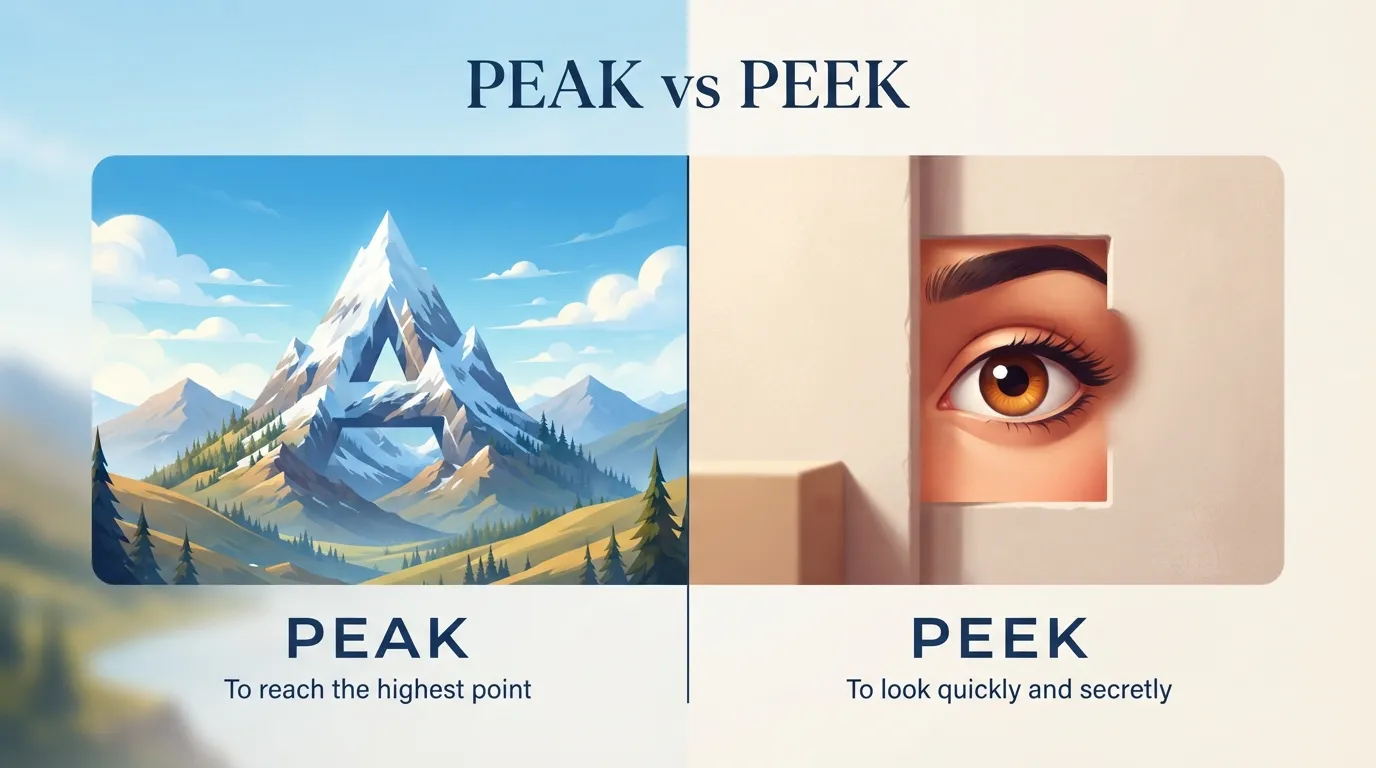
Peak means the highest point of something, while peek means a quick, secret look at something.
I once wrote “sneak a peak” in a text message. My friend replied with three laughing emojis and nothing else.
That small mistake stuck with me. Two words. One sound. Completely different meanings.
You have probably typed one of these words and paused, wondering if it looked right. You are not alone.
Peak and peek sound identical but mean nothing alike. Mixing them up is one of the most common spelling slips in English.
This guide fixes that for good. You will learn the exact meaning of each word, when to use them, and how to remember the difference forever.
By the end, you will never second guess this pair again.
Peak or Peek: Quick Answer
A peak is the top or highest point of something, like a mountain peak or a peak in sales.
A peek is a quick or secret glance at something, like taking a peek inside a box.
Example: “We hiked to the peak of the mountain, then took a peek at the view below.”
The Origin and Background of Peak or Peek
Both words trace back centuries, but they grew from completely different roots.
Peak likely evolved from the word “pike,” referring to a pointed top or summit. Over time it settled into describing mountain tops, graphs, and moments of highest activity.
Peek comes from Middle English, possibly linked to old words for peeping or glancing through a small opening. It has always carried the idea of a brief, careful look.
The confusion happens because both words share the same pronunciation. English is full of these homophones, and this pair trips up even skilled writers.
Peak or Peek Explained: Key Differences
The meanings are simple once you separate them clearly.
Peak refers to a high point, whether physical, like a mountain, or abstract, like a peak in traffic.
Peek refers to a quick look, often done quietly or without permission.
There is also a third cousin, pique, meaning to provoke interest or irritation. It sounds the same too, which adds to the mix up.
| Term | Meaning | When to Use | Region/Context |
| Peak | Highest point | Mountains, graphs, performance levels | Used worldwide, common in US and UK |
| Peek | Quick or secret look | Glancing, checking briefly | Used worldwide, common in US and UK |
| Pique | To provoke interest or anger | Curiosity, irritation | Used worldwide, less common in casual speech |
Which Version Should You Use?
Not sure which word fits your sentence? This simple guide helps.
- For describing a high point or maximum level, use peak. Think mountain peak, peak season, or peak performance.
- For describing a quick glance, use peek. Think sneak a peek, take a peek, or peek around the corner.
- For describing curiosity or irritation, use pique. Think pique your interest.
If you can replace the word with “top” or “highest,” use peak. If you can replace it with “glance” or “look,” use peek.
Common Mistakes with Peak or Peek
Mistake 1: Writing “sneak a peak” instead of “sneak a peek.”
Correction: The correct phrase is “sneak a peek,” since it means a quick look.
Mistake 2: Using “peak” when describing curiosity.
Correction: The correct word is “pique,” as in “pique my interest.”
Mistake 3: Writing “reach its peek” instead of “reach its peak.”
Correction: Use “peak” for highest points, like sales or performance.
Mistake 4: Confusing “peek” with “peak” in weather or traffic reports.
Correction: Use “peak” for high points, such as “peak traffic hours.”
Mistake 5: Assuming spellcheck will catch the error.
Correction: Spellcheck often misses homophones since both words are spelled correctly, just used wrong.
Peak or Peek in Real World Examples
A professional email:
“Sales reached their peak in December, and we expect similar numbers this year.”
In a news headline:
“Tourists Flock to Mountain Peak Despite Freezing Temperatures”
In a social media post:
“Sneaking a peek at my new apartment before the big move!”
Also, In a formal document:
“The report indicates a peak in customer demand during the holiday quarter.”
Each example shows how the right word changes the clarity of the message.
Peak or Peek: Data, Trends, and Usage
Searches for “peak or peek” spike whenever people write emails, essays, or social posts and pause on spelling.
Students and content writers search this pair often, especially during exam season or content deadlines. Business professionals also search it when writing reports involving performance data.
This search falls into the informational category. People want a clear answer fast, not a long grammar lesson.
That matters now because more people write daily content through emails, social media, and workplace messages, where small spelling errors get noticed quickly.
Comparison Table
| Term/Variant | Meaning | Region/Context | Best Used When |
| Peak | Highest point or maximum level | Common worldwide | Describing tops, maximums, or high performance |
| Peek | Quick or secret glance | Common worldwide | Describing brief looks or glances |
| Pique | To provoke interest or irritation | Common worldwide | Describing curiosity or annoyance |
Frequently Asked Questions
Q: What does peak mean?
A: Peak means the highest point of something, like a mountain top or the highest level of sales, performance, or activity.
Q: How do you use peek correctly in a sentence?
A: Use peek to describe a quick or secret glance, such as “She took a peek through the window.”
Q: Peak vs peek, what’s the real difference?
A: Peak describes a high point. Peek describes a quick look. They sound the same but mean completely different things.
Q: Is peak or peek acceptable in formal writing?
A: Yes, both words are standard English and appear correctly in formal writing when used with their proper meaning.
Q: Which version is correct, sneak a peak or sneak a peek?
A: The correct phrase is “sneak a peek,” since it describes a quick, secret look, not a high point.
Q: Where does the word peak come from?
A: Peak likely evolved from the word “pike,” which referred to a pointed top or summit, later shifting to describe high points in general.
Q: Can peak be used to describe traffic or business activity?
A: Yes, peak commonly describes traffic, such as “peak hours,” and business activity, such as “peak sales season.”
Final Thoughts
Peak and peek sound the same but mean two very different things. One points up. One looks in.
Remember the key points. Peak means the highest point. Peek means a quick or secret glance. Pique means to provoke interest.
Next time you write either word, ask yourself if you mean “top” or “glance.” That one question solves the confusion instantly.
Bookmark this guide so you never second guess peak or peek again.
Read More: Rat or Mouse: The Real Differences Explained

My name is Ayesha Sadiqah, the writer behind this website. I write in-depth articles on English spelling, word comparisons, grammar, and vocabulary to help learners make better language choices. Every guide is carefully researched and designed to provide accurate, practical, and easy-to-understand information.