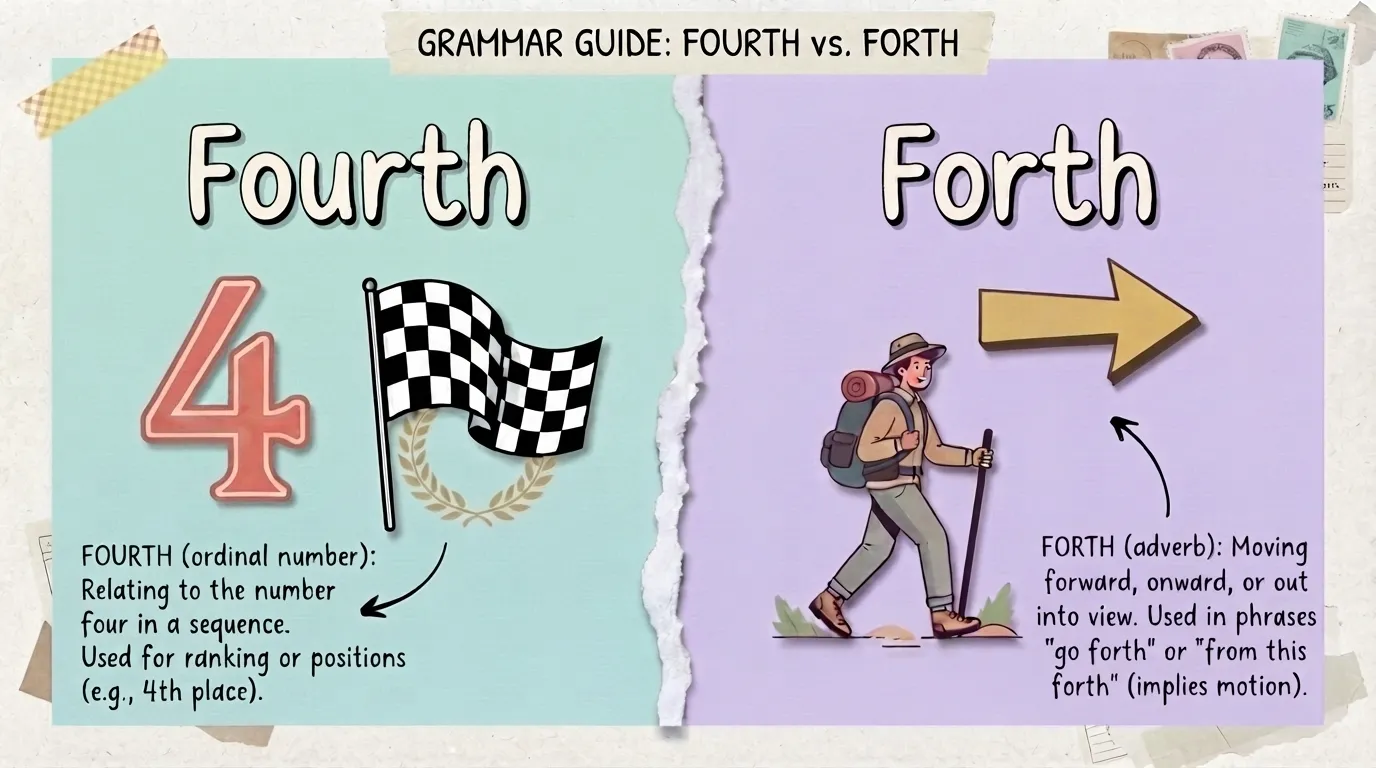
Fourth refers to the number four in order, like “fourth place,” while forth means “forward” or “onward,” as in “back and forth.”
I once wrote “from this day forth” as “from this day fourth” in a wedding card. My friend still brings it up at every dinner party.
Fourth and forth sound exactly alike when spoken out loud. That single letter swap changes the entire meaning of a sentence, yet almost nobody catches it while typing fast.
One word counts. The other word moves. Mixing them up is one of the most common spelling slips in English, right up there with there and their.
This guide walks through the real difference in plain terms. You will learn what each word means, where the confusion comes from, and the exact trick to pick the right one every time.
Whether you are writing a date, a ranking, or a formal announcement, this guide gives you the exact rule to follow.
Fourth or Forth Quick Answer
Fourth is an ordinal number, meaning it shows position or order, as in first, second, third, fourth.
Forth means “forward” or “onward,” almost always describing movement or continuation.
Example: “She finished fourth in the race.” (order) Example: “The soldiers marched forth into battle.” (movement)
The Origin of Fourth and Forth
Fourth comes directly from the number four, with a “u” added to match the spelling pattern of “four.” It has always been tied to counting and sequence.
Forth comes from Old English forð, meaning “forward” or “onward.” It has nothing to do with numbers at all, despite the similar sound.
The confusion exists purely because of pronunciation. Both words sound nearly identical in casual speech, so writers often reach for the more familiar spelling, fourth, without stopping to check the actual meaning.
Old texts and legal documents kept forth alive for centuries in phrases meant to sound formal and lasting, like wedding vows and government proclamations. Fourth, meanwhile, stayed locked into everyday counting, showing up in school grades, race results, and calendar dates without much variation over time.
Fourth or Forth Explained Key Differences
Here is a clear breakdown of the two words, with real examples for each.
| Term | Meaning | When to Use | Region/Context |
| Fourth | Ordinal number showing position | Ranking, dates, sequence, counting | Common in US and UK English |
| Forth | Forward or onward movement | Describing motion, continuation, or old fashioned phrasing | Common in US and UK English |
More examples:
- “This is the fourth time I’ve called you today.” (order)
- “Please step forth and receive your award.” (movement)
- “July fourth is a national holiday in the US.” (date)
- “The idea was put forth during the meeting.” (presented, moved forward)
A simple trick: if you are counting or ranking something, use fourth. If you are describing movement, forward motion, or presenting something, use forth.
Which Version Should You Use
Your choice depends entirely on the meaning you intend, not on region or formality.
- For dates, rankings, and counting, always use fourth. Example: “the fourth of July” or “she came in fourth place.”
- For describing movement or presenting ideas, use forth. Example: “the plan was set forth clearly” or “he walked back and forth.”
- For idiomatic phrases, stick with the traditional spelling tied to that phrase, such as “and so forth” or “from this day forth.”
- When unsure, ask if a number fits naturally in the sentence. If yes, you likely need fourth.
Common Mistakes with Fourth or Forth
Mistake 1: “The team finished forth in the tournament.” Correction: “The team finished fourth in the tournament.” Why it happens: writers hear the word spoken and default to the more common spelling without checking meaning.
Mistake 2: “Please step fourth and accept your certificate.” Correction: “Please step forth and accept your certificate.” Why it happens: the phrase involves movement, which calls for forth, but the more familiar spelling gets used instead.
Mistake 3: “And so fourth, the list goes on.” Correction: “And so forth, the list goes on.” Why it happens: this idiom is rarely written out fully, so people guess the spelling based on sound alone.
Mistake 4: “We celebrate the Fourth of July with fireworks.” Correction: This one is actually correct, since July Fourth refers to the date, the fourth day of July. Why it happens: some writers second guess this one and switch to forth by mistake, not realizing dates always take the ordinal spelling.
Mistake 5: Using forth to describe a ranking or position. Correction: Always use fourth for rankings, positions, and counting, never forth. Why it happens: the words sound close enough that writers assume either spelling works interchangeably.
Mistake 6: Writing “fourth coming” instead of “forthcoming.” Correction: The correct word is “forthcoming,” a single word meaning upcoming or about to happen, never split with fourth. Why it happens: writers hear the syllables separately and guess at a spelling that sounds plausible but is actually incorrect.
Fourth or Forth in Real World Examples
Professional email: “This is the fourth reminder about the outstanding invoice.”
News headline: “City Sets Forth New Plan for Downtown Development”
Social media post: “Fourth of July weekend was unforgettable 🎆”
Formal document: “The terms set forth in this agreement are binding upon both parties.”
Notice how fourth always points to a number or position, while forth always points to movement, presentation, or continuation.
Fourth or Forth Data Trends and Usage
People search for this comparison constantly because both words sound identical, and spell check will not catch the wrong one used in the wrong place.
Search interest spikes heavily around early July, tied to searches for “Fourth of July” spelling, along with steady year round interest from students and writers proofreading their work.
The intent behind this search is almost always informational. Readers want a clear, fast rule, not a long grammar lesson.
This matters now because voice typing and speech to text tools cannot hear the difference between fourth and forth at all. Writers using dictation software need to manually check and correct this word every single time it appears.
Legal and business writing still leans on forth constantly, in phrases like “the terms set forth herein,” which keeps the word alive in professional contexts even as casual writing rarely uses it outside a few fixed idioms.
Students proofreading essays and reports also search this comparison often, especially when writing about historical events, anniversaries, or ranked results where fourth appears frequently.
Quick Decision Cheat Sheet
Use this fast checklist whenever you pause on which spelling to use:
- Are you counting or ranking something? Use fourth.
- Are you describing movement, forward motion, or presenting an idea? Use forth.
- Writing a date, like July 4th? Use fourth.
- Writing an idiom like “and so forth” or “back and forth”? Use forth.
- Still stuck? Try replacing the word with “forward.” If it fits, use forth.
Keep this list handy for proofreading dates, reports, and any writing with idiomatic phrases.
Fourth and Forth in Everyday Language
Beyond dates and rankings, these words show up in a few common idioms worth knowing.
“Back and forth” describes repeated movement between two points, whether physical or in conversation, and it always uses forth, never fourth.
“From this day forth” is a formal, often ceremonial phrase used in vows and declarations, signaling ongoing continuation into the future.
“And so forth” is used to trail off a list, implying more items could follow, and it never involves a number despite how it sounds.
“Forthcoming” describes something about to happen or someone being open and honest, showing how the root word forth extends into other useful vocabulary.
These idioms show why forth leans toward movement and continuation, while fourth stays firmly tied to counting and order.
Fourth or Forth Full Comparison Table
| Term/Variant | Meaning | Region/Context | Best Used When |
| Fourth | Ordinal number, position four | US and UK English, dates and rankings | Counting, ranking, or writing a date |
| Forth | Forward or onward movement | US and UK English, idioms and formal phrasing | Describing motion, continuation, or presenting an idea |
Frequently Asked Questions
Q: What does fourth mean?
A: Fourth is the ordinal number that comes after third, used for counting, ranking, and dates, such as the fourth of July.
Q: How do you use forth correctly?
A: Use forth to describe forward movement or continuation, as in “step forth” or “and so forth.”
Q: Fourth or forth, what’s the real difference?
A: Fourth deals with numbers and order. Forth deals with movement and continuation. They are not interchangeable, despite sounding the same.
Q: Is forth acceptable in formal writing?
A: Yes. Forth is completely correct in formal writing, especially in legal or ceremonial phrases like “the terms set forth.”
Q: Which version is correct, fourth or forth, for July 4th?
A: Fourth is correct here, since the date refers to the fourth day of the month.
Q: Where does this confusion come from?
A: Fourth and forth sound identical when spoken, so writers often default to the more familiar spelling without checking the actual meaning.
Q: Can forth ever refer to a number?
A: No. Forth never refers to numbers or order. Any counting or ranking context always calls for fourth instead.
Q: Does fourth ever mean movement or continuation?
A: No. Fourth strictly refers to position or order. Any sense of movement or forward motion always calls for forth instead.
Q: Is there a quick way to remember which spelling to use?
A: Yes. Fourth contains the word “four,” which is a strong visual clue tying it to numbers, while forth simply means forward.
Final Thoughts
Fourth and forth split cleanly once you know the rule. Fourth handles numbers, order, and dates. Forth handles movement, continuation, and formal phrasing.
The fastest test is simple. Try swapping the word for “forward.” If that fits, you need forth. If a number fits better, you need fourth.
Getting this right keeps your writing clear and accurate, especially in dates, rankings, and formal documents where precision really matters.
Now you know exactly how to use fourth or forth, go try it in your next piece of writing. Bookmark this guide so you never second guess it again.
Explore more: Yea or Yeah: The Simple Rule You Need to Know

I’m Zain. I got interested in commonly confused words while helping non-native English speakers prep for writing exams, where a single misused word could cost real marks. That experience shaped how I write now: I try to explain not just which spelling is correct, but why the confusion exists in the first place, since understanding the reason is what actually makes it stick.