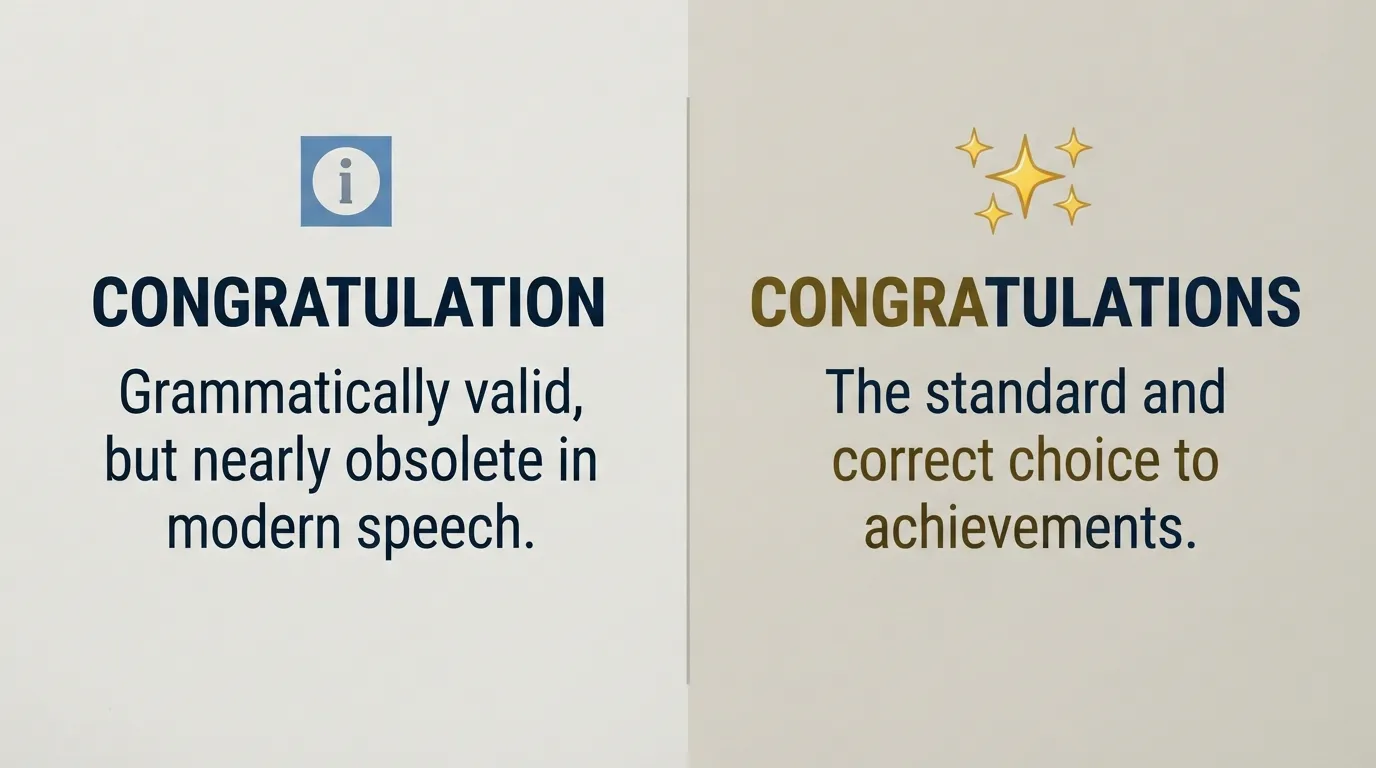
Congratulations is the correct word to use when praising someone for an achievement. Congratulation, without the s, is grammatically valid but almost never used in modern English.
I once wrote “Congratulation on your new job” in a card for a coworker, and she gently pointed out the missing s. I felt embarrassed, because I had written that word a hundred times before without ever questioning it.
That small mistake happens more often than people admit. Congratulation and congratulations look like they should follow normal singular and plural rules, but this particular word behaves differently from almost every other noun in English.
This guide settles the debate for good. You will learn exactly why congratulations always takes the s, when congratulation without the s is technically allowed, and how to avoid sounding awkward in cards, emails, and speeches. By the end, you will never hesitate over this word again.
Getting this right matters more than people think. Congratulations shows up in wedding cards, graduation posts, work emails, and text messages constantly. A small slip here stands out, especially in writing meant to celebrate someone.
Congratulation or Congratulations: Quick Answer
Congratulations is the word you almost always want. It expresses praise or good wishes for someone’s achievement. Example: “Congratulations on your promotion!”
Congratulation, without the s, technically exists as a singular noun, but it sounds outdated and stiff in modern writing. Example: “Please accept my congratulation” sounds unnatural to most native speakers today.
The simple rule: always add the s when addressing someone directly about their success. Save the singular form only for very formal or literary writing, if you use it at all.
The Origin of Congratulations
Congratulations comes from the Latin word congratulari, formed from com, meaning together, and gratulari, meaning to wish joy. Together, the word literally means to rejoice together with someone.
The word entered English in the sixteenth century, originally used more often in its singular form, congratulation, especially in formal letters and speeches. Over the following centuries, English speakers began using the plural form almost exclusively, since offering congratulations felt like offering multiple wishes of joy rather than a single one.
By the nineteenth century, the plural congratulations had firmly become the standard greeting, appearing in cards, speeches, and everyday conversation. The singular form did not disappear completely, but it retreated into formal or academic contexts, where it still occasionally appears today.
This shift mirrors similar patterns in English, where words expressing warm wishes, like thanks and regards, also settled into plural forms over time, even though singular versions technically exist.
Congratulation and Congratulations Explained: Key Differences
| Term | Part of Speech | Meaning | Example |
| Congratulations | Plural noun, interjection | Expression of praise for an achievement | Congratulations on your wedding! |
| Congratulation | Singular noun | The act of congratulating someone | His congratulation felt sincere and warm. |
Notice that congratulations functions almost like an interjection in everyday use, similar to words like thanks or cheers. It stands alone as a complete expression, without needing a full sentence around it.
Congratulation, by contrast, behaves like a normal countable noun. It needs an article or possessive before it, such as “a congratulation” or “his congratulation,” and it almost never stands alone the way congratulations does.
- Congratulations! You did it. (standalone expression)
- His congratulation arrived a week late. (normal singular noun)
Which Version Should You Use?
For cards and messages, always use congratulations. This is the version everyone expects, and using the singular form here will sound strange to most readers.
For formal speeches, congratulations remains the standard choice as well, even in the most formal settings, such as graduation ceremonies or award presentations.
For academic or literary writing, congratulation can appear occasionally, particularly when discussing the concept itself rather than offering praise directly, such as “A congratulation delivered too late loses its warmth.”
For everyday conversation, congratulations is essentially universal. Native English speakers rarely, if ever, use the singular form in casual speech.
If you are ever unsure, default to congratulations. It works in nearly every situation, while congratulation carries real risk of sounding outdated or oddly formal.
Common Mistakes with Congratulations
Mistake 1: Writing “Congratulation on your new house” instead of “Congratulations on your new house.” Why it happens: writers assume singular subjects require singular nouns, forgetting that congratulations functions differently.
Mistake 2: Writing “Congradulations” with a d instead of a t. Why it happens: the word sounds similar when spoken quickly, leading to a common phonetic misspelling.
Mistake 3: Treating congratulations as a singular verb subject, such as “Congratulations is in order.” Why it happens: some style guides actually accept this construction, since congratulations functions as a single idea, but many readers still expect “Congratulations are in order.”
Mistake 4: Adding an apostrophe, writing “Congratulation’s” incorrectly. Why it happens: writers mistakenly treat the s as a possessive marker rather than part of the plural noun itself.
Mistake 5: Using “congrats” and “congratulation” interchangeably, assuming congrats is simply short for the singular form. Why it happens: congrats is actually a shortened form of congratulations, the plural, not the singular congratulation.
Congratulations in Real World Examples
In a professional email: “Congratulations on closing the deal. The whole team is thrilled for you.”
In a news headline: “City Council Sends Congratulations to Local Olympic Champion”
In a social media post: “Congratulations to my sister on her graduation! So proud of you.”
In a formal document: “The board extends its congratulations to the newly appointed director.”
Each example uses the plural form naturally, since congratulations remains the standard across nearly every register of English writing, from casual posts to formal board resolutions.
Congratulations vs Similar Celebratory Words
Congratulations often gets grouped with other celebratory expressions, but each one carries a slightly different tone and use case worth understanding.
Well done feels more casual and works well for smaller achievements, such as finishing a project or passing a small test, while congratulations tends to fit bigger, more significant milestones.
Kudos carries a slightly informal, almost trendy tone, often used in workplace chat messages or casual social posts, whereas congratulations remains appropriate across every level of formality, from texts to formal ceremonies.
Cheers works well in casual, spoken contexts, particularly in British English, but rarely appears in written congratulatory messages the way congratulations does.
Knowing these distinctions helps you choose the right celebratory word for the right moment, even when congratulations feels like the obvious default choice in most situations.
Congratulations Around the World
English is not alone in wrestling with singular versus plural forms for celebratory words. Looking at how other languages handle similar expressions helps explain why English speakers sometimes hesitate over this word too.
In many Romance languages, similar expressions also default to a plural form, echoing the same idea that congratulating someone involves offering multiple wishes of joy at once, not just a single sentiment.
This pattern is not unique to congratulations either. Words like thanks, regards, and best wishes all follow a similar plural tradition in English, expressing warmth through multiple implied gestures rather than one isolated word.
Understanding this broader pattern makes the plural form of congratulations feel less like an arbitrary rule and more like part of a consistent tradition across warm, celebratory language in English.
Congratulations: Data, Trends and Usage
Search interest in “congratulation or congratulations” spikes around graduation season, wedding season, and major holidays, when people write cards and messages celebrating others. It falls under informational search intent, with searchers wanting a quick confirmation before sending a message.
Non native English speakers search this term frequently, since many languages use a singular form for similar expressions, which creates natural confusion when translating the sentiment into English.
This topic also matters for greeting card writers, event planners, and social media managers, who need to get common phrases exactly right at scale, since a single typo can appear across hundreds of cards or posts.
Getting this word right carries real emotional weight too. Congratulations often marks meaningful life moments, so a spelling mistake can feel more noticeable than it would in ordinary writing.
Standalone Comparison Table
| Term | Meaning | Region or Context | Best Used When |
| Congratulations | Expression of praise, plural noun | All English speaking regions | Cards, speeches, everyday praise |
| Congratulation | The act of congratulating, singular noun | Formal or literary writing | Rare, mostly academic contexts |
Frequently Asked Questions
Q: What does congratulations mean? A: Congratulations expresses praise or good wishes toward someone for an achievement or happy event, such as a wedding, graduation, or promotion.
Q: How do you use congratulations correctly? A: Use congratulations as a standalone expression or followed by “on,” such as “Congratulations on your success.” It almost always appears in its plural form.
Q: Congratulation vs congratulations, what is the difference? A: Congratulations is the plural form used to express praise directly to someone. Congratulation is the rare singular form, referring to the general act of congratulating.
Q: Is congratulation acceptable in formal writing? A: It is grammatically correct but uncommon. Most formal writing, including business letters and ceremonies, still uses congratulations, even in highly formal contexts.
Q: Which version is correct, congratulation or congratulations, when writing a card? A: Congratulations is correct for cards. The singular congratulation would sound unnatural and outdated in this context.
Q: Where does the word congratulations come from? A: It comes from the Latin word congratulari, meaning to wish joy together, entering English in the sixteenth century before eventually becoming standardized in its plural form.
Q: Can congratulation be used in academic writing? A: Yes, though rarely, congratulation can appear in academic or literary writing when discussing the concept of congratulating someone rather than offering direct praise.
Q: Is congrats short for congratulation or congratulations? A: Congrats is a shortened form of congratulations, the plural word, not the singular congratulation.
A Quick Cheat Sheet for Congratulations
Keep this simple reference nearby whenever you are writing a card, email, or speech and want to double check your word choice instantly, without rereading the full guide again.
- Use congratulations for cards, speeches, emails, and nearly all direct praise.
- Use congratulation only in rare formal or academic contexts discussing the concept itself.
- Never write congradulations, since the correct spelling always uses a t, not a d.
- Never add an apostrophe before the final s, since it is not a possessive form.
- Remember that congrats is short for the plural congratulations, not the singular congratulation.
This short reference covers nearly every situation you will encounter, whether you are writing a quick text message or a formal congratulatory letter for a colleague’s promotion.
Congratulation or Congratulations: Final Thoughts
Language habits like this one often form early and stick around for years without anyone questioning them. Most native English speakers use congratulations correctly by instinct, simply because they hear and read it constantly from childhood onward.
Non native speakers and careful writers benefit most from understanding the actual grammar behind the word, since instinct alone will not always guide the right choice in a second language.
Whether you are writing your first congratulatory card or your hundredth, this small grammar rule remains worth remembering, especially since the word appears in some of the most meaningful, celebratory writing people ever produce.
Conclusion
Congratulations is the word you want almost every time you want to celebrate someone’s achievement. Congratulation, the singular form, still exists, but it belongs mostly in formal or academic writing, not in everyday cards or messages.
Remember the simple rule: when speaking directly to someone about their success, always reach for the s. That plural form carries centuries of tradition behind it, and it remains the clear standard across English today.
This distinction might seem small, but it shapes how warm and natural your writing feels during genuinely happy moments in someone’s life.
Now you know exactly when to use congratulation or congratulations correctly. Bookmark this guide so you never second guess it again, and share it with someone who might need the reminder before their next big card.
Read More: Loath or Loathe: The Real Difference Explained

My name is Ayesha Sadiqah, the writer behind this website. I write in-depth articles on English spelling, word comparisons, grammar, and vocabulary to help learners make better language choices. Every guide is designed to provide accurate, practical, and easy-to-understand information.