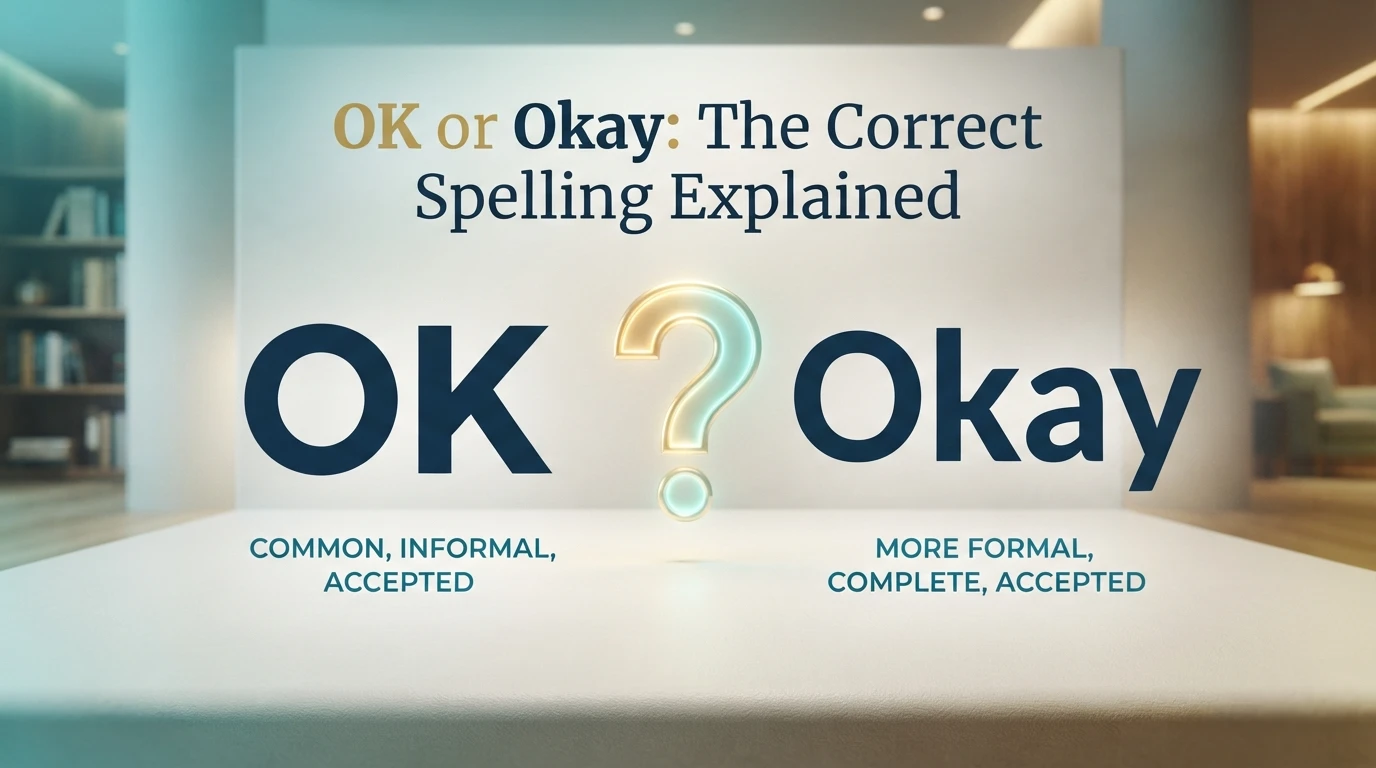
Both “OK” and “okay” are correct spellings in modern English. They mean exactly the same thing, and the choice between them mostly comes down to style, formality, and personal preference rather than right or wrong.
The Story Behind This Mixup
I once sat in a meeting where two coworkers argued for five full minutes about which spelling belonged in a client email. One insisted “okay” looked more professional. The other swore “OK” was the only real version, since it started as an abbreviation. Neither of them was wrong, and neither of them was fully right either.
That small disagreement captures exactly why this question gets searched so often. Most spelling debates have one correct answer and one mistake. This one does not. “OK” and “okay” are both accepted by major dictionaries, both used by professional writers, and both understood instantly by any English speaker.
The real question is not which spelling is correct. It is which spelling fits your specific situation, whether that is a text message, a formal report, or a company style guide. This guide breaks down exactly how to choose, where each version came from, and which mistakes to avoid.
OK or Okay Quick Answer
“OK” and “okay” are interchangeable words meaning acceptable, fine, or in agreement. “OK” is the shorter, original form, while “okay” is a fuller spelling that developed later to match how the word sounds when spoken.
Neither version is grammatically incorrect. Style guides simply differ on which one they recommend for consistency.
The Origin of OK
The most widely accepted explanation traces “OK” back to 1839 Boston newspapers. Writers at the time enjoyed playful misspellings and abbreviations as a kind of inside joke, and “OK” stood for “oll korrect,” a deliberately misspelled version of “all correct.”
What started as a passing joke stuck around far longer than anyone expected. Political campaigns in the 1840s helped spread the term further, and by the twentieth century, “OK” had become one of the most recognized words on the planet, understood in nearly every language and culture.
“Okay” emerged later as a natural way to spell out the sound of the two letters. Since “O” and “K” are pronounced “oh” and “kay,” writing “okay” simply captures that pronunciation directly, without requiring readers to know the abbreviation’s backstory.
Linguists have traced other, less popular theories too, including possible ties to a Choctaw word and various initials from historical figures and organizations. None of these alternative stories have the same level of documented evidence as the “oll korrect” newspaper origin, which is why most dictionaries treat it as the leading explanation.
What makes this history unusual is how far the word traveled from its joking origins. A phrase meant as a wink to readers in 1839 eventually became one of the most universally recognized words across languages that otherwise share almost no vocabulary with English.
OK vs Okay Explained: Key Differences and Variations
Both spellings mean the same thing, but they carry slightly different impressions depending on where you use them. Here is how the main variants compare.
| Term | Meaning | When to Use | Region/Context |
| OK | Acceptable, fine, correct | Casual writing, texting, informal business use | Standard everywhere, especially US style guides |
| Okay | Acceptable, fine, correct | General writing, conversational tone, dialogue | Standard everywhere, common in books and articles |
| O.K. | Acceptable, fine, correct | Older or more formal documents | Rare today, seen in older publications |
| Okey | Casual variant of okay | Informal speech or dialogue only | Not standard, avoid in formal writing |
Notice that meaning never changes across these forms. The difference is entirely about tone, formality, and how established the spelling is in modern style guides.
A useful way to picture this is to think of “OK” and “okay” as two outfits for the same word. One is quick and casual, built for speed. The other is a little more filled out, better suited for narrative writing or a slightly warmer tone. Neither outfit is wrong, but wearing the right one for the occasion still matters.
Which Version Should You Use?
For texting and casual chat, “OK” tends to feel quick and natural, matching the fast pace of informal conversation.
For professional emails and reports, many style guides, including AP style, prefer “OK” for consistency, though “okay” is never technically wrong.
For fiction and dialogue, “okay” often reads more naturally, since it mirrors how the word sounds when spoken aloud by a character.
For global or neutral use, either spelling works everywhere. There is no regional rule that makes one version more correct than the other, unlike true spelling errors such as confusing “truely” for “truly.”
For teams and businesses, the smartest move is picking one spelling for internal style guides and sticking with it across every document, website, and customer email. Consistency signals attention to detail, even when both choices are technically correct.
Common Mistakes With OK or Okay
Mistake: Okey Correction: Okay Why it happens: Writers sometimes spell the word phonetically without realizing “okay” is already the standard phonetic spelling.
Mistake: O.k. (mixed capitalization with a period) Correction: OK or okay Why it happens: Writers blend the old “O.K.” style with modern lowercase habits, creating an inconsistent hybrid that most style guides no longer recommend.
Mistake: Ok (only the first letter capitalized) Correction: OK or okay Why it happens: Many people treat “OK” like a regular word rather than an abbreviation, so they capitalize it the way they would capitalize the start of a sentence.
Mistake: Switching between OK and okay within the same document Correction: Pick one spelling and use it consistently throughout a single piece of writing Why it happens: Since both spellings are correct, writers often use them interchangeably without noticing the inconsistency until a final proofread.
Mistake: Using “kk” or “k” in formal writing Correction: OK or okay Why it happens: Texting shorthand slips into emails and reports when writers move quickly between casual and professional messages.
Mistake: Writing “okey dokey” in a formal or professional message Correction: OK or okay Why it happens: Playful phrases feel natural in casual speech, but they rarely translate well to written business communication, where a plain confirmation reads more clearly.
OK or Okay in Real World Examples
In a professional email: “Thanks for the update. That schedule works fine for us, and the revised budget is OK on our end.”
In a news headline: “City Council Gives Okay to New Downtown Park Project”
In a social media post: “Not gonna lie, today has been a rough one, but I’m okay 💛”
In a formal document or report: “The compliance team confirmed the updated policy is OK to implement starting next quarter.”
Each example shows the word doing the same job, signaling approval or acceptability, while the surrounding tone shifts naturally from casual to formal.
Look closely at the news headline example again. A writer could easily swap “okay” for “OK” without changing the meaning, but “okay” carries a slightly softer, more conversational feel that headline writers sometimes prefer for human interest stories rather than hard news.
The same flexibility applies to customer service writing. A support agent replying to a frustrated customer might choose “That’s completely OK, let me fix this for you” for a brisk, efficient tone, or “That’s totally okay, I’m happy to help sort this out” for a warmer, more personal feel. Both versions solve the same problem. They just set a different mood.
OK or Okay: Data, Trends, and Usage
People search “OK or okay” constantly because both spellings appear everywhere, from text messages to company style guides, and writers want confidence they are choosing correctly. This search falls into the informational category, since readers want a clear answer rather than a product or service.
Interest tends to spike around writing tasks with real stakes, such as drafting a professional email, following a publication’s house style, or settling a friendly debate like the one that inspired this guide. Students and content writers search this pairing especially often when a style guide, like AP or Chicago, sets specific rules they need to follow.
This matters now because so much communication happens in writing, across email, chat apps, and social media, often written quickly without time for a style check. Knowing that both spellings are correct removes unnecessary hesitation and lets writers focus on tone instead of worrying about a hidden mistake.
There is also a generational pattern worth noting. Younger writers raised on texting often default to “OK” out of pure habit, since it takes less effort to type. Writers who grew up reading more traditional print media sometimes lean toward “okay” simply because that is the version they saw most often in books and newspapers. Neither habit is better, but understanding where your own instinct comes from can help you make a more deliberate choice instead of an automatic one.
OK vs Okay Comparison Table
| Term/Variant | Meaning | Region/Context | Best Used When |
| OK | Acceptable or fine | All English speaking regions | Casual writing, texting, AP style documents |
| Okay | Acceptable or fine | All English speaking regions | General writing, dialogue, conversational tone |
| O.K. | Acceptable or fine | Older publications, formal archives | Rare, mostly historical documents |
| Okey | Casual phonetic variant | Informal speech only | Avoid in written or formal contexts |
Frequently Asked Questions
Q: What does OK or okay mean? A: Both words mean acceptable, fine, or in agreement. They are used to confirm something is satisfactory or to respond affirmatively to a question or request.
Q: How do you use OK or okay correctly in a sentence? A: Either spelling works as an adjective, adverb, or interjection, as in “The plan sounds OK” or “Okay, let’s get started.” Choose one spelling and stay consistent within a single piece of writing.
Q: OK vs okay, what is the real difference? A: There is no difference in meaning. “OK” is the shorter, original abbreviation, while “okay” is a fuller spelling that later developed to match the word’s pronunciation.
Q: Is okay acceptable in formal writing? A: Yes. “Okay” appears in professional writing, published books, and formal documents. Some style guides simply prefer “OK” for brevity and consistency.
Q: Which version is correct, OK or okay? A: Both are correct. Major dictionaries and style guides accept either spelling, so the choice depends on your audience, tone, and any specific style guide you follow.
Q: Where does the word OK come from? A: “OK” likely originated in 1839 Boston newspapers as a joking abbreviation for “oll korrect,” a deliberate misspelling of “all correct” that was popular at the time.
Q: Can OK or okay be used in academic writing? A: Both can appear in academic writing, though many academic style guides favor more formal alternatives like “acceptable” or “satisfactory” for a more polished tone.
Final Thoughts
Both “OK” and “okay” are correct, and neither one is a spelling mistake. “OK” traces back to a nineteenth century newspaper joke about “oll korrect,” while “okay” developed later as a natural way to spell the word’s sound.
Remember these key points: choose “OK” for quick, casual, or AP style writing, choose “okay” for a more conversational or narrative tone, and always stay consistent within the same document. Avoid outdated forms like “O.K.” and nonstandard spellings like “okey” in professional writing. When in doubt, pick whichever version matches the tone you already used earlier in the same piece.
Now you know exactly how to choose between them. Bookmark this guide so you never second guess “OK or okay” again, and share it with anyone who has ever argued about which version is the “real” one, whether that is a coworker, a classmate, or a friend proofreading an important message.
Read more: Truly or Truely: The Correct Spelling Explained

Hey, I’m Ayeza. I started this site because I kept hitting the same wall over and over: typing a word, freezing, and not trusting my own instinct on the spelling. Now I research these mix-ups properly so you don’t have to, and I write every guide the way I wish these explanations had been written for me.