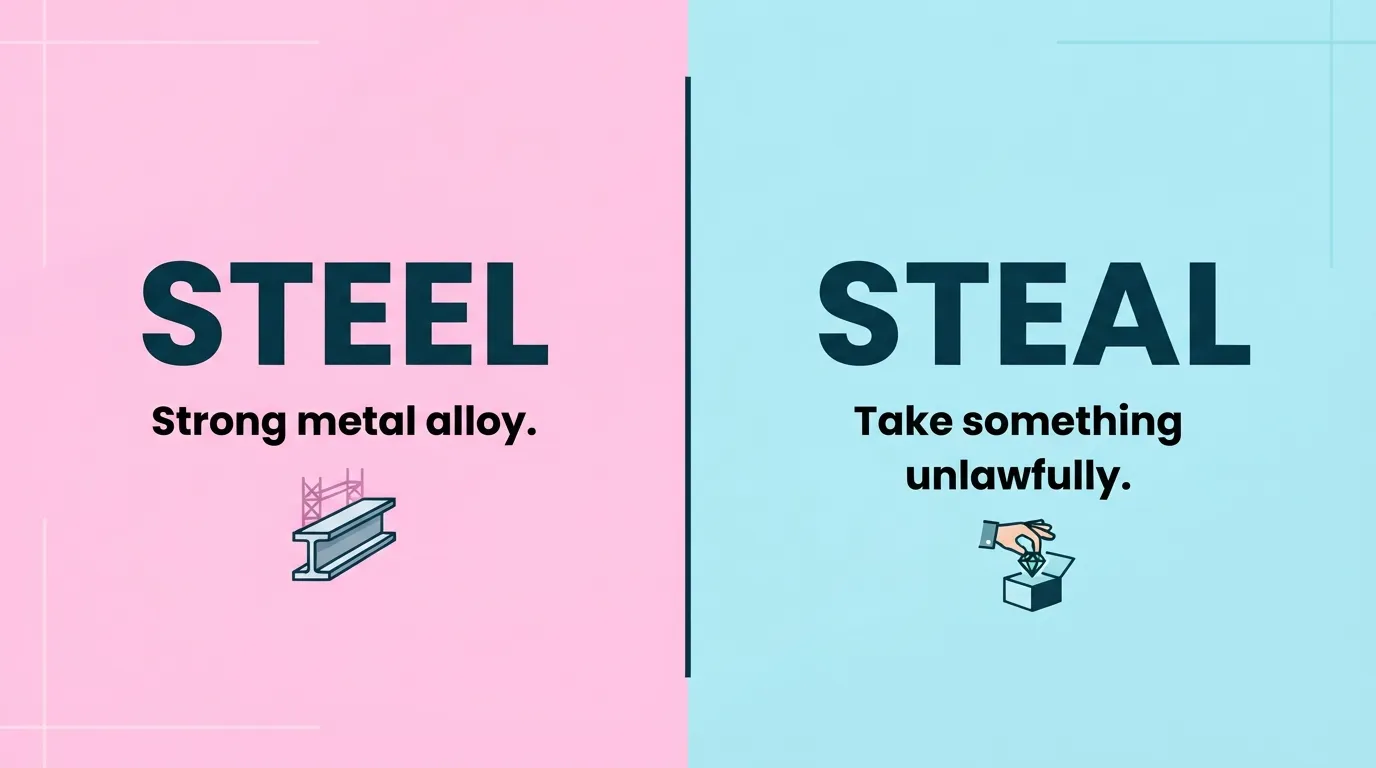
Steel and steal are two completely different words that just happen to sound alike. Steel is a strong metal made mostly from iron. Steal means to take something that does not belong to you without permission.
I once sent a work email that said “we need to steal ourselves for the upcoming budget cuts” when I meant “steel ourselves.” My manager replied with a laughing emoji and a gentle correction, and I have never made that mistake again.
If that sounds familiar, you are in good company. Steel and steal are classic homophones, words that sound identical when spoken but carry entirely different meanings and spellings. This tiny overlap in pronunciation causes constant mix ups in emails, essays, and everyday writing.
The confusion makes sense. Your ear cannot tell these words apart, only your eyes can, and only once you know the rule. Miss it, and your writing suddenly says something you never intended.
This guide walks through exactly what separates steel from steal, where each word comes from, and how to catch the mistake before it embarrasses you in a report, a text, or a job application. By the end, this pair of words will never trip you up again.
Let us break it down.
Steel or Steal: Quick Answer
Steel is a noun and sometimes a verb describing a hard, durable metal alloy made primarily from iron and carbon. It is used in construction, manufacturing, and countless industrial applications.
Steal is a verb meaning to take something without permission or right, often secretly. It can also describe getting an incredible bargain, as in “that couch was such a steal.”
For example, a construction worker uses steel beams to build a bridge, while a thief might steal materials from a job site overnight. Same sound, completely different meaning.
The Origin of Steel and Steal
Steel comes from the Old English word stele, related to an ancient Germanic root meaning firm or strong. The word has described this hardened metal alloy for well over a thousand years, evolving alongside advances in metalworking technology across Europe.
Steal traces back to the Old English word stelan, which already carried the meaning of taking something unlawfully. This root connects to a broader Germanic family of words describing secretive or unauthorized action, showing just how old the concept of theft is within the English language.
Despite both words descending from Old English and sharing a similar sound, they come from entirely separate root words with no shared meaning or connection. Their similarity in pronunciation is coincidental, a result of how English vowel sounds shifted and merged over centuries, a linguistic pattern called a homophone collision.
This kind of collision happens throughout English. Words that once sounded quite different slowly drifted closer together in pronunciation, even while keeping their separate spellings and meanings intact, which is exactly why spelling still matters so much today.
Historians of the English language point out that the Industrial Revolution gave the word steel an enormous boost in everyday usage. As factories, railways, and bridges multiplied across Britain and later the United States, steel became one of the most talked about materials of the era, appearing constantly in newspapers, advertisements, and business correspondence.
Meanwhile steal kept its consistent presence in legal documents, court records, and everyday speech, since theft has remained a constant part of human society regardless of era or technology. Court transcripts from centuries ago already used forms of the word almost identically to how we use it now.
What makes this pair especially tricky for modern writers is that both words remained extremely common through every stage of English history. Neither one faded into obscurity or became old fashioned, so both stayed active in daily vocabulary, keeping the risk of confusion alive generation after generation.
Steel Explained: Key Differences and Variations
Understanding related words and phrases helps cement the distinction between steel and steal even further.
| Term | Meaning | When to Use | Region or Context |
| Steel | Hard metal alloy | Construction, manufacturing, cooking terms like steel pan | Universal across English |
| Steal | Take without permission | Crime, theft, casual bargain talk | Universal across English |
| Steely | Describing a hard, determined attitude | Describing personality or resolve | Universal, figurative use |
| Stealthy | Quiet, secretive movement | Describing sneaky or covert action | Universal, often military or gaming context |
| Steal the show | Idiom meaning to attract the most attention | Performance, entertainment context | Universal English idiom |
Notice how steel also branches into figurative language, like having a steely resolve, while steal branches into idioms like stealing the spotlight, both moving far from their literal roots while staying true to their original meaning.
Which Version Should You Use?
Since steel and steal mean entirely different things, the real challenge is not choosing between them but catching which one your sentence actually needs.
If your sentence involves metal, construction, strength, or hardness, you need steel. Think steel beams, stainless steel, or steeling your nerves before a difficult conversation.
If your sentence involves taking something, theft, or an incredible deal, you need steal. Think stealing a base in baseball, stealing someone’s idea, or finding a steal at a clearance sale.
A helpful trick many writers use is remembering that steal contains the word “eal,” which can be mentally linked to “illegal,” since stealing is an illegal act. Meanwhile, steel simply describes something solid and structural.
Common Mistakes With Steel and Steal
These two words trip up even experienced writers. Here are the most frequent slip ups.
Mistake 1: Using steal instead of steel for the metal Wrong: “The bridge is made of reinforced steal.” Correct: “The bridge is made of reinforced steel.” Why it happens: Autocorrect and quick typing often let the wrong homophone slide through unnoticed.
Mistake 2: Using steel instead of steal for taking something Wrong: “Someone tried to steel my bike last night.” Correct: “Someone tried to steal my bike last night.” Why it happens: Writers focus on the sound of the word rather than its actual spelling and meaning.
Mistake 3: Misusing the idiom “steal the show” Wrong: “Her performance really steeled the show.” Correct: “Her performance really stole the show.” Why it happens: The idiom involves theft, meaning to take attention, not strength, so steel never belongs here.
Mistake 4: Confusing “steeling yourself” with “stealing yourself” Wrong: “I had to steal myself for the difficult news.” Correct: “I had to steel myself for the difficult news.” Why it happens: This idiom means to mentally strengthen yourself, directly tied to the hardness of steel, not the act of theft.
Mistake 5: Mixing up “a steal” with “a steel deal” Wrong: “That laptop was such a steel deal.” Correct: “That laptop was such a steal.” Why it happens: Writers overcorrect, assuming steel sounds more formal or accurate, when the informal expression actually requires steal.
Steel and Steal in Real World Examples
Context makes these words far easier to tell apart once you see them side by side.
Professional email, using steel correctly: “The new warehouse structure will rely on steel framing throughout the entire building.”
News headline, using steal correctly: “Local Man Charged After Attempting to Steal Delivery Packages From Front Porches”
Social media post, using steal casually: “Got this jacket for fifteen dollars, absolute steal, could not believe the price tag.”
Formal document, using steel correctly: “All structural components must meet industry standards for tensile strength using certified steel materials.”
Each example shows how context instantly reveals which word belongs, metal and strength point to steel, while theft and bargains point to steal.
Steel and Steal: Data, Trends and Usage
Search interest for these two words often spikes around grammar help sites, homophone lists, and writing guides, showing this is a strongly informational search intent driven by people trying to avoid embarrassing mistakes.
Steel also carries heavy commercial search intent tied to the construction and manufacturing industries, where people search terms like steel prices, steel suppliers, or steel beam specifications for business purposes.
Steal sees a different kind of commercial interest, especially around shopping and deal hunting content, where phrases like “absolute steal” or “steal of a deal” appear constantly in product reviews and bargain hunting articles.
Understanding this distinction matters for content creators, copywriters, and students alike, since a single misused homophone can undercut credibility instantly, even when every other part of the writing is strong.
Editors and proofreaders often flag homophone errors like steel and steal as some of the most common mistakes in first drafts, right alongside their and there or your and you are. Spell check tools rarely catch these errors because both words are spelled correctly on their own, just used in the wrong place.
For business writing especially, a stray mix up between steel and steal can create unintentional humor or confusion in an otherwise serious document, which is exactly why a careful final read through matters so much before sending anything important out into the world.
Comparison Table: Steel vs Steal
| Term or Variant | Meaning | Region or Context | Best Used When |
| Steel | Hard metal alloy | Universal English | Describing metal, strength, or industrial material |
| Steal | Take without permission | Universal English | Describing theft or an excellent bargain |
| Steely | Firm, determined | Figurative English | Describing personality or resolve |
| Stealthy | Quiet, secretive | Universal English | Describing sneaky or covert movement |
Frequently Asked Questions
Q: What does steel or steal mean? A: Steel refers to a strong metal alloy made from iron and carbon, while steal means to take something without permission, or informally, to get a great bargain.
Q: How do you use steel or steal correctly? A: Use steel when referring to metal or strength, and use steal when referring to theft or a great deal, always checking your sentence context before finalizing your writing.
Q: Steel vs steal, what is the real difference? A: They are completely unrelated words that only share a pronunciation. Steel is a material, while steal is an action, and mixing them up changes your sentence meaning entirely.
Q: Is steal acceptable in formal writing? A: Yes, steal is appropriate in formal writing whenever discussing theft or crime, but avoid using it casually to mean a bargain in highly formal documents.
Q: Which word is correct, steel or steal, for talking about metal? A: Steel is always correct for referring to the metal material used in construction, manufacturing, and industrial applications.
Q: Where does the word steal come from? A: Steal comes from the Old English word stelan, which already meant to take something unlawfully over a thousand years ago.
Q: Can steel and steal ever mean the same thing? A: No, they never share meaning despite sounding identical. Their similarity is purely due to pronunciation, not shared origin or definition.
Final Thoughts
Steel and steal prove that English loves to trip people up with words that sound the same but mean completely different things. One describes strength and metal, the other describes taking something that is not yours.
Remember these key takeaways. Steel is the metal, strong and structural. Steal is the action, taking something, or scoring a great deal. Context always reveals which word your sentence needs, so pause and check before hitting send.
Next time you write about construction, theft, or a great bargain, you will know exactly which word to reach for without a second thought.
Bookmark this guide so you never mix up steel and steal again, and share it with anyone who has ever sent an email like the one that started this whole article.
Explore More: Sceptical or Skeptical: Clearing Up the Confusion for Good

I’m Zain. Through Wordiums.com, I write clear, accurate word comparison guides that show the difference between similar words, spellings, and phrases, so readers can choose the right word in seconds.