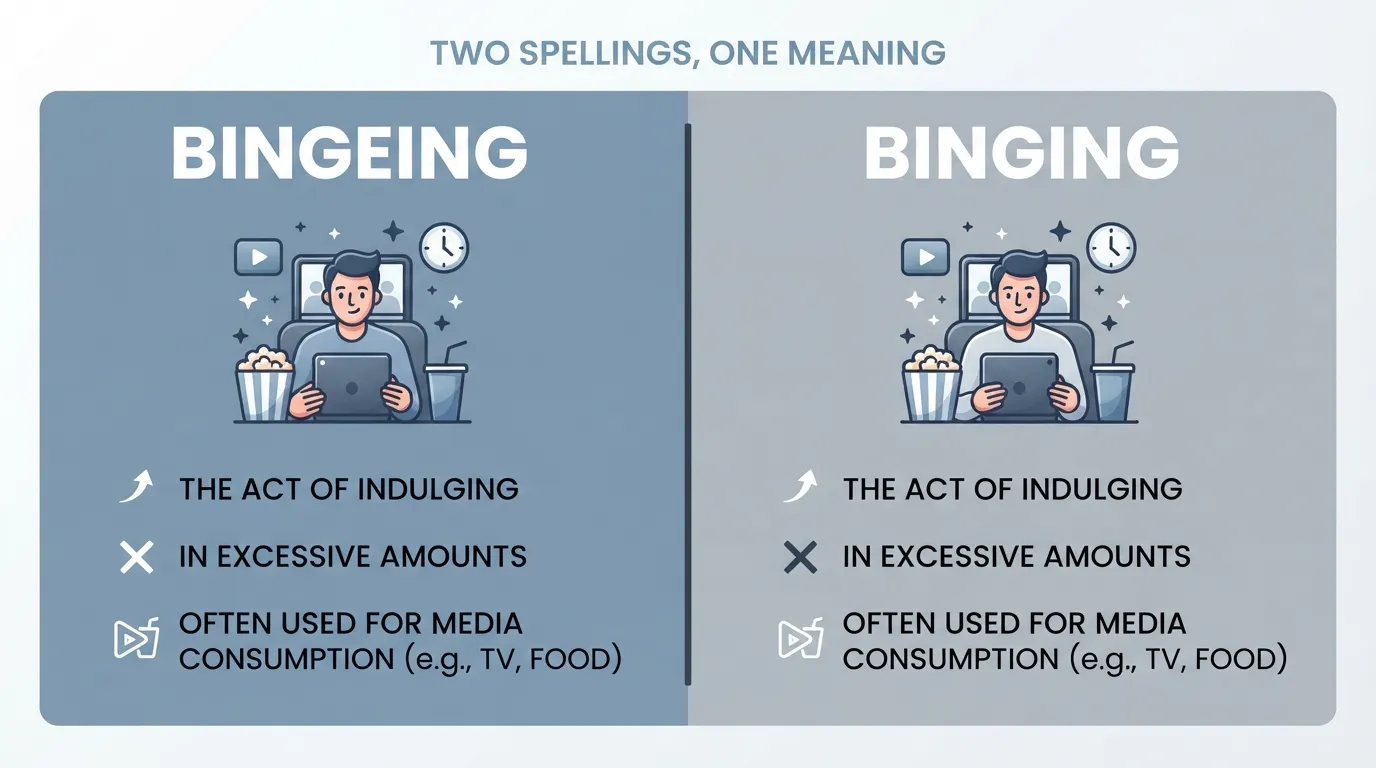
Bingeing or binging both mean doing something in excess, like watching many episodes at once. Bingeing is the traditional British spelling. Binging is the shortened American spelling. Both are correct.
Last year I watched an entire season of a crime drama in one weekend. When I sat down to write about it, I froze. Was it bingeing or binging? I typed one version, deleted it, then typed the other. This tiny word stopped me for five full minutes.
If this sounds familiar, you are not alone. Thousands of people search this exact question every month. Streaming culture made this word part of daily conversation, but nobody agrees on how to spell it. Some spell checkers accept both forms. Others flag one as wrong. That inconsistency creates real confusion, especially for students, writers, and non native English speakers who want to sound correct.
This guide settles the question for good. You will learn where the word came from, how British and American English handle it differently, and which version fits your writing. You will also see how the word behaves in emails, headlines, and casual posts, so you never freeze mid sentence again. By the end, you will pick the right spelling every time, without pausing to guess.
Bingeing or Binging: Quick Answer
Both spellings describe the same action. It means consuming something in large amounts during a short time, usually food, drinks, or entertainment.
Bingeing keeps the silent “e” from the base word “binge.” Binging drops that “e” before adding “ing.”
Simple examples:
- “I am bingeing the entire series tonight.”
- “He admits to binging on snacks during exam week.”
- “We spent Sunday binge watching old sitcoms.”
Neither form is a typo. Dictionaries list both, though usage shifts depending on where you live and how formal your writing is.
The Origin of Bingeing or Binging
The word “binge” started in an old English dialect from northern England. It originally meant to soak something in liquid, like soaking a wooden barrel to stop it from leaking. Over time, people began using it for drinking too much alcohol in one sitting.
By the twentieth century, “binge” grew beyond drinking. It began describing any activity done in excess: eating, shopping, and eventually watching television. Newspapers used it casually at first, often inside quotation marks, as though it were slang rather than standard vocabulary. Over decades it earned a permanent place in everyday English, appearing in dictionaries without any special label.
When streaming services exploded in popularity during the 2010s, “binge watching” became a household phrase almost overnight. Entire marketing campaigns built themselves around the idea of releasing full seasons at once, encouraging viewers to watch everything in a single sitting. The word finally matched the behavior it always described, just applied to a brand new form of entertainment.
The spelling split happened because English grammar has a general rule: drop the silent “e” before adding “ing,” as in “make” turning into “making” or “write” turning into “writing.” But some words keep the “e” to protect a soft consonant sound, like “singe” becoming “singeing” instead of “singing,” which would completely change the meaning. Writers disagreed on which rule applied to “binge,” and both spellings survived side by side. That disagreement, carried across decades of publishing, is exactly why you still see both forms today.
British English vs American English Spelling
Spelling differences between British and American English follow patterns you already know, like “colour” versus “color” or “travelling” versus “traveling.” The same logic applies here.
British English tends to preserve the “e” to keep the soft “g” sound clear. Without the “e,” a reader might expect a hard “g” sound, similar to the word “ringing.” So British writers use bingeing.
American English favors simpler, shorter spelling. Dropping the extra letter feels cleaner and faster to type, which is why American writers often use binging. This pattern shows up across many word pairs, not just this one, and reflects a broader trend in American publishing toward streamlined, efficient spelling.
It helps to remember that neither approach is more “correct” in a strict grammatical sense. Both trace back to genuine, accepted rules within their own regional standards. The confusion only appears when readers expect one fixed answer, the way math has one right solution. Language rarely works that way, and spelling especially bends to regional habit far more than most people assume.
| Version | Spelling | Region | Example Sentence |
| Traditional | Bingeing | United Kingdom, Commonwealth countries | “She has been bingeing the new season all weekend.” |
| Modern | Binging | United States | “They started binging the show last night.” |
| Neutral | Binge watching | Global, streaming context | “Binge watching became popular during the pandemic.” |
Which Spelling Should You Use?
Your audience decides your answer.
US audience: Choose binging. It matches how most American publications, blogs, and social platforms already write it.
UK or Commonwealth audience: Choose bingeing. It follows standard British dictionaries and feels more formal to readers in these regions.
Global or SEO audience: Either spelling ranks fine in search engines, since both versions are widely searched. Pick one and stay consistent across your entire piece. Mixing both spellings in the same article looks careless and can confuse readers.
If you write for an international brand, bingeing often works best because it aligns with more formal dictionary standards, even though binging feels more common in casual online writing.
Common Mistakes with Bingeing or Binging
Even confident writers slip up with this word. Here are the most frequent errors.
Mistake: Writing “bingeing” with a double “e,” like “bingeeing.” Correct: Bingeing, with only one extra “e” before “ing.”
Mistake: Spelling it “bingging” or “binjing.” Correct: Binging, with a single “g.”
Mistake: Confusing “binging” with the search engine name “Bing.” Correct: These are unrelated words. “Binging” describes excessive behavior, not searching online.
Mistake: Switching between bingeing and binging within the same document. Correct: Pick one spelling and use it every time in that piece of writing.
Mistake: Assuming one spelling is grammatically wrong. Correct: Both spellings are accepted. The right choice depends on region and formality, not correctness.
Mistake: Using the wrong spelling inside a business document meant for a specific regional audience. Correct: Match the spelling to the audience. A UK client contract should use bingeing, while a US marketing post can safely use binging.
Bingeing or Binging in Everyday Examples
Email: “Apologies for the delayed response. I was bingeing a documentary series and completely lost track of time.”
News Headline: “Streaming Reports Show Viewers Are Binging More Shows Than Ever Before”
Social Media Post: “Currently binging true crime shows and eating way too much popcorn.”
Formal Report: “Recent research indicates a measurable increase in bingeing behavior linked to on demand streaming access among younger demographics.”
Each example shows the same word adapting naturally to different tones, from casual to professional.
Bingeing or Binging: Data, Trends & Usage
Interest in this word grows every year alongside streaming platforms and short video apps. People search for the correct spelling most often right after finishing a show or during major release weekends, when everyone rushes to discuss new episodes online.
British and Commonwealth users search “bingeing” more frequently, matching their standard spelling habits. American users lean toward “binging,” reflecting simplified US spelling patterns. Search intent for this keyword is almost entirely informational. People want a fast, clear answer, not a long academic explanation.
This matters now because content creators, marketers, and students all write about entertainment habits constantly. Getting the spelling right builds credibility, especially in professional writing where small errors stand out. A single inconsistent spelling inside an otherwise polished article can make readers question the writer’s attention to detail, even if the content itself is accurate and useful.
Search engines also reward consistency within a single page. When an article uses one spelling throughout instead of alternating randomly, it reads as more trustworthy and better edited, which tends to keep readers on the page longer. That signal, combined with clear structure and genuinely helpful answers, is part of what separates a strong article from a rushed one.
Comparison Table
| Term | Meaning | Region or Context | Best Used When |
| Bingeing | Doing something excessively | UK, formal writing | Academic papers, British publications |
| Binging | Doing something excessively | US, casual writing | Social media, blogs, American audiences |
| Binge watching | Watching many episodes in a row | Global, entertainment | Streaming reviews, TV articles |
| Binge eating | Eating large amounts quickly | Health and medical writing | Clinical or wellness content |
Frequently Asked Questions
Q: Is bingeing or binging correct? A: Both are correct. Bingeing is standard in British English, while binging is standard in American English. Neither spelling is a mistake.
Q: How do you use binging correctly in a sentence?
A: Use it as a verb form of “binge,” such as “I am binging that new show this weekend.” It functions like any other “ing” verb.
Q: Bingeing vs binging, what is the real difference?
A: The meaning is identical. The only difference is regional spelling preference, similar to color versus colour.
Q: Is binging acceptable in formal writing?
A: Yes, though bingeing is often considered slightly more formal because it follows traditional dictionary spelling rules.
Q: Which version is correct, bingeing or binging, for American readers?
A: Binging fits American readers best, since it matches common US spelling and everyday online usage.
Q: Where does the word binge originally come from?
A: It comes from an old English dialect word that originally meant soaking something in liquid, later evolving to describe drinking, then excessive behavior in general.
Q: Can binging be used outside of watching television?
A: Yes. Binging applies to eating, shopping, drinking, gaming, and any activity done in large amounts over a short time.
Conclusion
Bingeing or binging, both spellings are correct, and choosing between them comes down to your audience and setting. British and Commonwealth readers expect bingeing. American readers expect binging. Global content works with either, as long as you stay consistent throughout your writing.
You now know where this word came from, why the spelling splits by region, and how to avoid the most common mistakes writers make with it. Whether you are drafting an email, writing a headline, or posting on social media, you can choose your spelling with total confidence.
Remember the simple rule: match your spelling to your reader. British and Commonwealth audiences expect the traditional form. American audiences expect the shorter form. Global content works with either, provided you stay consistent from the first paragraph to the last.
Bookmark this guide so you never second guess bingeing or binging again, and share it with anyone who has typed it, deleted it, and typed it again just like you once did.
Read More: Traveling Or Travelling: The Simple Rule You Need

Hey, I’m Ayeza. I started this site because I kept hitting the same wall over and over: typing a word, freezing, and not trusting my own instinct on the spelling. Now I research these mix-ups properly so you don’t have to, and I write every guide the way I wish these explanations had been written for me.