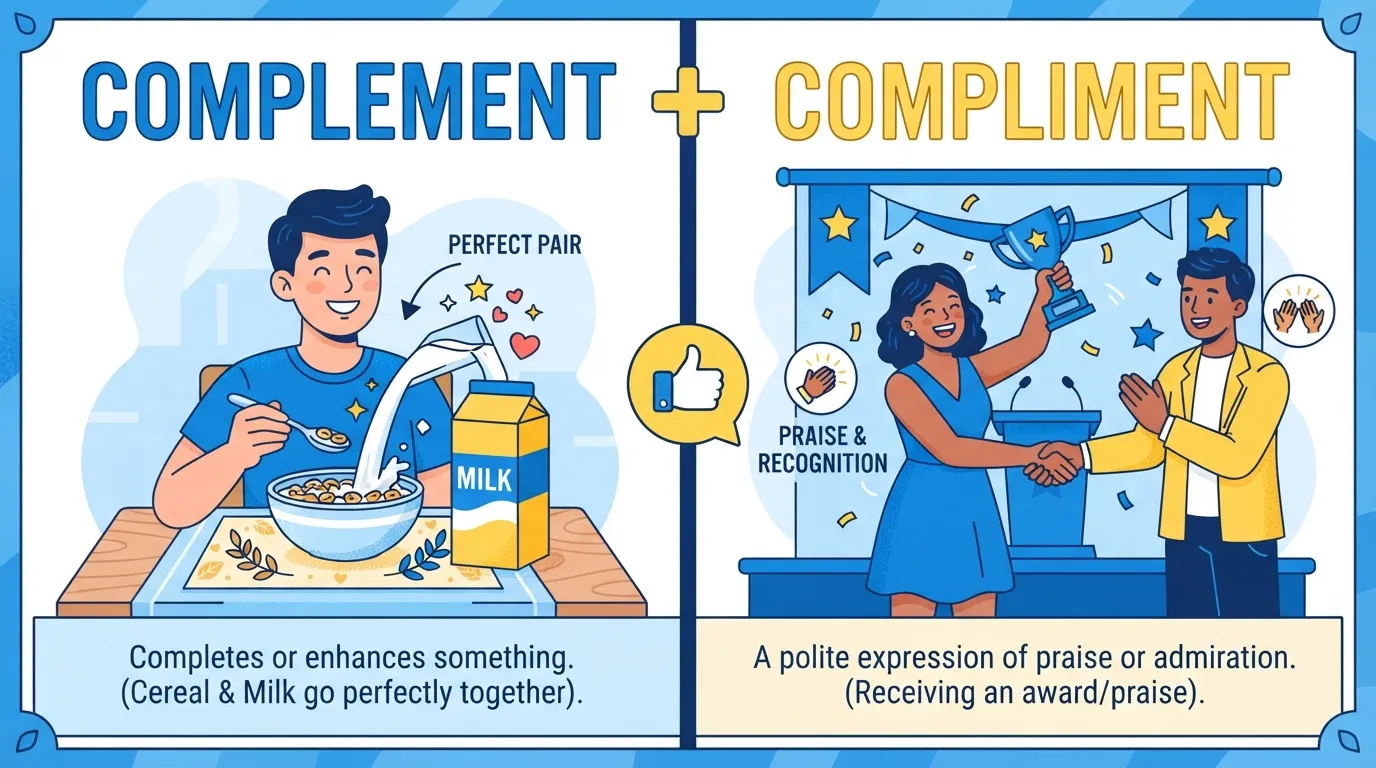
Compliment means to praise someone. Complement means something that completes or goes well with another thing. They sound identical but mean completely different things.
A few years ago, I wrote “your dress really complements your smile” in a text to a friend. She replied, “aw thank you, that’s such a nice compliment.” I froze. I had actually meant it the way she took it, but I’d used the wrong word entirely, and I didn’t even notice until she pointed it out.
That’s the tricky part about complement and compliment. They sound exactly the same when spoken. They’re spelled almost identically. And yet one word is about praise, while the other is about balance or completeness.
If you’ve ever hesitated before typing one of these words, wondering which one fits, you’re in good company. This mix up shows up constantly in emails, reviews, wedding toasts, and everyday texts.
By the end of this guide, you’ll know exactly which word to use, every single time, without pausing to think twice.
Complement or Compliment: Quick Answer
Compliment is praise. You give someone a compliment when you tell them something nice, like “you did a great job on that presentation.”
Complement means something completes or enhances another thing. A wine can complement a meal. A scarf can complement an outfit.
Example: “She gave me a compliment on my scarf, saying it complements my jacket perfectly.” Notice how both words appear in one natural sentence.
The Origin of Complement and Compliment
Both words trace back to the same Latin root, complementum, meaning something that completes or fills up. Centuries ago, English speakers used them almost interchangeably.
Over time, the spellings split into two paths. Complement kept its original meaning tied to completeness. Compliment shifted toward expressing admiration, likely influenced by French court culture, where polite flattery and formal praise became closely linked to the word.
This shared history explains why the spelling still looks so close today. It also explains why so many writers, even careful ones, still swap the two by accident.
Complement vs Compliment: Key Differences
| Term | Meaning | When to Use | Example |
| Compliment | An expression of praise or admiration | Talking about kind words or flattery | “He gave her a compliment on her speech.” |
| Complement | Something that completes or pairs well | Talking about balance, addition, or completeness | “The tie complements the suit nicely.” |
| Complementary | Adjective form of complement | Describing things that go well together | “These colors are complementary.” |
| Complimentary | Adjective form of compliment, also means free | Describing praise, or something given at no cost | “The hotel offered a complimentary breakfast.” |
That last row trips people up the most. Complimentary doesn’t just mean flattering. It also means free, as in “complimentary Wi-Fi” at a hotel.
Which Version Should You Use?
For students and beginners, remember this trick: compliment has an “i” like in the word “praise” reminder. Complement has an “e” like the word “complete.”
For business writers, use complimentary carefully. It can mean free, or it can mean flattering, so make sure your sentence makes the meaning obvious.
For casual conversation, most people default to compliment because it’s used more often in daily speech. But if you’re describing how two things fit or pair together, complement is the correct choice.
For formal or academic writing, always double check your spelling here. These two words are among the most commonly confused in professional documents, and spellcheck often won’t catch the error since both are valid words.
Common Mistakes with Complement and Compliment
Mistake 1: “Thank you for the complement on my work.” Correction: “Thank you for the compliment on my work.” Why it happens: writers default to the “e” spelling without checking which meaning they intend.
Mistake 2: “This sauce really compliments the chicken.” Correction: “This sauce really complements the chicken.” Why it happens: since compliment feels more familiar in everyday speech, people reach for it even when describing pairing, not praise.
Mistake 3: “The hotel offers a complementary breakfast.” Correction: “The hotel offers a complimentary breakfast.” Why it happens: writers assume complementary covers both meanings, but the “free” sense only applies to complimentary.
Mistake 4: “Her shoes complement her on her outfit.” Correction: “Her shoes complement her outfit.” or “She complimented her on her outfit.” Why it happens: mixing the sentence structure of both words together creates confusion about who is doing what.
Mistake 5: “They’re complimentary colors on the wheel.” Correction: “They’re complementary colors on the wheel.” Why it happens: color theory uses complement in the sense of completing a pair, but the similar spelling of compliment sneaks in.
Complement and Compliment in Real World Examples
Professional email: “I wanted to send a quick compliment on your presentation yesterday. Your data visuals really complemented the story you were telling.”
News headline: “Local Bakery Offers Complimentary Coffee With Every Order” “Critics Compliment New Restaurant’s Bold Flavors”
Social media post: “Nothing complements a sunset like good music. Also, shoutout to my friend for the sweetest compliment today.”
Formal document: “The committee wishes to extend its compliments to the design team. Their proposal complements the company’s long term goals.”
Complement vs Compliment: Data, Trends & Usage
This confusion ranks among the most searched grammar pairs online, alongside similar sound alike words like affect and effect. Search interest often spikes during wedding season, when toasts and speeches are full of compliments, and during product marketing, where complementary items are commonly discussed.
Writers, marketers, students, and customer service teams search this term most often, since both professions rely heavily on precise word choice.
This is primarily an informational search, though it overlaps slightly with commercial intent, especially around phrases like “complimentary offer” in marketing copy.
One reason this matters more now: brands constantly advertise “complimentary” services and products, and getting that spelling wrong in marketing material can look unprofessional or confusing to customers.
Standalone Comparison Table
| Term/Variant | Meaning | Region/Context | Best Used When |
| Compliment | Praise or admiration | Universal English | Giving or receiving kind words |
| Complement | Something that completes or pairs well | Universal English | Describing balance, addition, or fit |
| Complimentary | Flattering, or free of charge | Universal English | Marketing, hospitality, or praise contexts |
| Complementary | Completing, pairing, or balancing | Universal English | Design, color theory, or product pairing |
Frequently Asked Questions
Q: What does compliment mean?
A: Compliment means to give praise or express admiration. It can be a noun, as in “she gave a compliment,” or a verb, as in “he complimented her work.”
Q: How do you use complement correctly?
A: Use complement when describing something that completes or enhances another thing, like “the shoes complement the dress” or “this app complements our existing workflow.”
Q: Complement vs compliment, what’s the real difference?
A: Compliment is about praise. Complement is about completeness or balance. They share a Latin root but diverged in meaning centuries ago.
Q: Is complimentary acceptable in formal writing?
A: Yes, when used correctly. Complimentary works in formal writing for both praise, as in “complimentary remarks,” and free offerings, as in “complimentary parking.”
Q: Which version is correct, complementary or complimentary colors?
A: Complementary colors is correct. This refers to colors that sit opposite each other on the color wheel and enhance one another visually.
Q: Where does the word complement come from?
A: Complement comes from the Latin word complementum, meaning something that fills up or completes. Compliment shares the same root but shifted toward meaning praise over time.
Q: Can complement be used in a sentence about food?
A: Yes. Complement works well in food writing, such as “a crisp white wine complements the seafood,” meaning the wine pairs nicely with the dish.
Final Thoughts on Complement or Compliment
Here’s the simple rule to remember: compliment with an “i” means praise. Complement with an “e” means something that completes or pairs well. Their adjective forms, complimentary and complementary, follow the same pattern.
Next time you’re unsure, picture the meaning first. Are you praising someone? Use compliment. Are you describing how two things fit together? Use complement.
Now you know exactly how to use complement or compliment correctly, go try it in your next email or review. Bookmark this guide so you never second guess yourself again, and share it with someone who’s mixed these up before.
Read More: Chose or Choose: The Simple Trick to Never Mix Them Up Again

Hey, I’m Ayeza. I started this site because I kept hitting the same wall over and over: typing a word, freezing, and not trusting my own instinct on the spelling. Now I research these mix-ups properly so you don’t have to, and I write every guide the way I wish these explanations had been written for me.