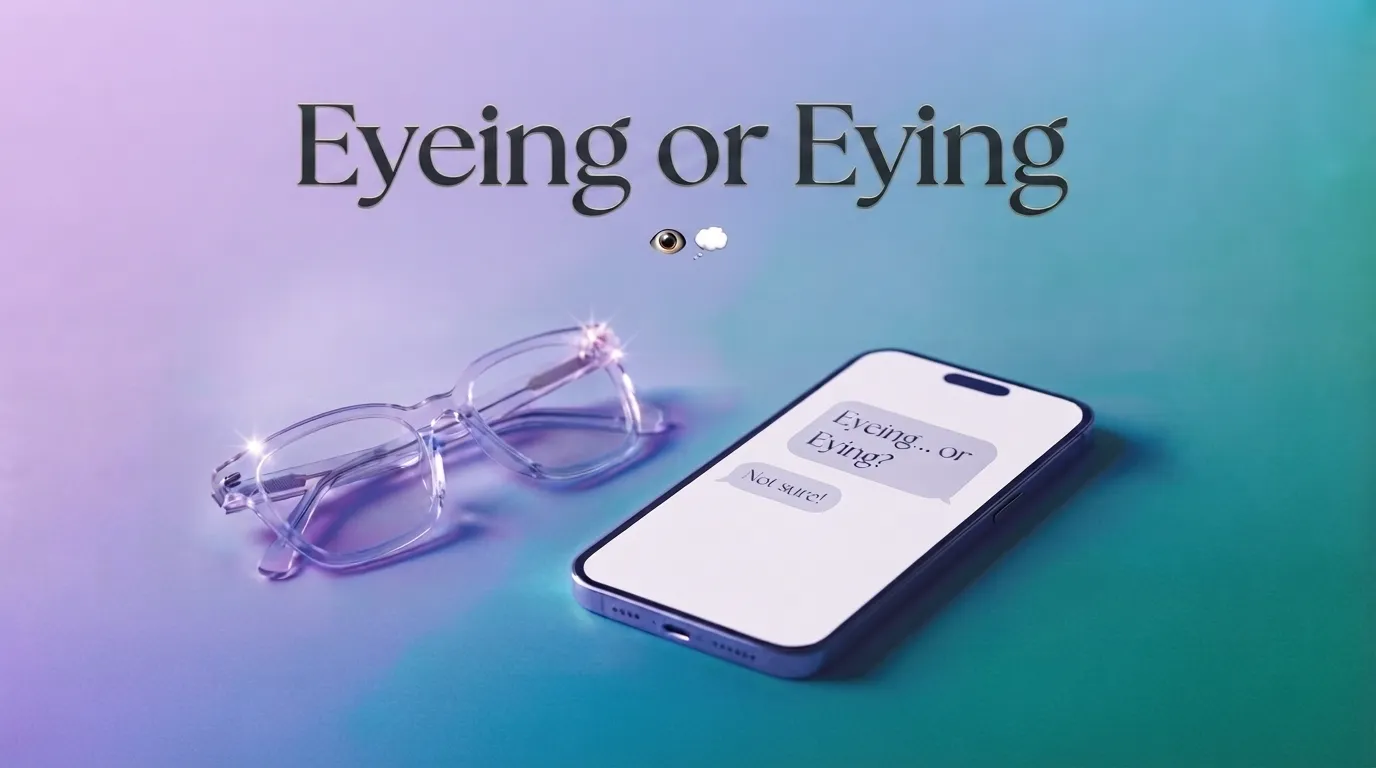
Both eyeing and eying are correct spellings. Eyeing is the more common form in modern English. Eying is an older, less frequent variant that still appears in some dictionaries.
I once spent ten minutes staring at a sentence, unsure whether to type “eyeing” or “eying.” Both looked correct. Both looked slightly wrong. Spellcheck stayed silent on both.
That moment sent me down a small rabbit hole. It turns out this confusion is incredibly common, even among strong writers.
You have probably paused at this exact word too. Maybe you were writing an email about a job opportunity you were eyeing. Maybe a report about a company eying new investors.
This guide will settle the question completely. You will learn which spelling wins in modern writing, why the second version still exists, and how to use each one with total confidence.
Let’s dig in.
Eyeing or Eying: Quick Answer
Eyeing is the standard, widely accepted spelling today. You will see it in newspapers, books, and everyday writing.
Eying is a valid but rare alternative. Some dictionaries list it as a secondary form, but few writers use it anymore.
Example: “She kept eyeing the last slice of cake” versus the older style “She kept eying the last slice of cake.”
The Origin of Eyeing and Eying
The verb “eye” means to watch someone or something closely. Adding “ing” to a word ending in a silent e usually means dropping the e first, like make becomes making.
Eye breaks that normal pattern. English speakers kept the e in most cases to avoid confusion with other short words. This gave us eyeing, which looks a bit unusual but reads clearly.
Eying followed the standard dropping rule instead, matching words like like becomes liking. Some older texts and British publications used this version more often in the past.
Over time, eyeing pulled ahead as the dominant spelling. Most style guides and modern dictionaries now list it as the preferred choice, while eying lingers as a secondary entry.
The confusion still exists because both spellings technically follow real English rules. Neither one is a made up error, which makes the choice feel less obvious than a typical misspelling.
Eyeing vs Eying Explained: Key Differences
| Term | Meaning | When to Use | Region or Context |
| Eyeing | Watching closely or considering something | General writing, business, everyday use | United States, United Kingdom, worldwide standard |
| Eying | Watching closely or considering something | Rare, older or stylistic writing | Occasionally seen in British or literary texts |
Both words mean exactly the same thing. The difference is entirely about spelling convention, not meaning or grammar.
Most editors, teachers, and style guides now treat eying as outdated. Eyeing has become the safe, professional choice across nearly every context.
Which Version Should You Use?
Your safest choice, almost always, is eyeing.
For business writing, use eyeing. Example: “The company is eyeing expansion into new markets.”
For casual writing, use eyeing. It matches what most readers expect and feels natural on the page.
For academic or journalistic writing, use eyeing as well. Major style guides, including AP style, favor this spelling.
For creative or literary writing, eying can occasionally appear for stylistic reasons, especially in older or British influenced text. Even then, eyeing remains the safer default.
For global or neutral writing, always lean toward eyeing. It reduces the risk of looking like a typo to readers unfamiliar with the older form.
Common Mistakes with Eyeing or Eying
Mistake 1: Assuming eying is a misspelling.
Correction: Eying is a real, dictionary listed word. It is simply less common, not incorrect.
Mistake 2: Switching between both spellings within the same article.
Correction: Pick one spelling and stay consistent throughout your entire piece.
Mistake 3: Dropping the e out of habit from other verbs, then feeling unsure.
Correction: Remember that eye is an exception. Keep the e for the standard spelling, eyeing.
Mistake 4: Using eying in formal business or academic writing.
Correction: Stick with eyeing in professional contexts, since most readers expect the standard modern form.
Mistake 5: Believing one spelling is American and the other is British.
Correction: Both spellings appear in American and British dictionaries. Eyeing simply dominates in both regions today.
Eyeing or Eying in Real World Examples
In a professional email:
“Our team has been eyeing a potential partnership with the new supplier since last quarter.”
In a news headline:
“Investors Eyeing Growth Opportunities as Market Rebounds This Year”
In a social media post:
“Currently eyeing that new pair of running shoes. Should I get them?”
In a formal document or report:
“The board is eyeing several candidates for the open leadership position.”
Notice how eyeing fits naturally into every tone, from casual posts to formal reports.
Eyeing or Eying: Data, Trends & Usage
Search and usage data show eyeing far outpacing eying across books, news articles, and websites published in the last several decades. The gap has only widened over time.
Eying still shows up occasionally in older archives, classic literature, and some British publications from earlier eras. Modern British writing has largely shifted toward eyeing as well.
This search falls under an informational intent. Writers and students search this term mainly to confirm correct spelling before submitting work or publishing content.
This matters now because search engines and readers both favor familiar, standard spellings. Using the less common form can make writing look outdated or slightly off, even though it is technically valid.
Standalone Comparison Table
| Term or Variant | Meaning | Region or Context | Best Used When |
| Eyeing | Watching or considering closely | Standard worldwide English | Everyday, business, and formal writing |
| Eying | Watching or considering closely | Rare, older or literary use | Stylistic or historical writing only |
Frequently Asked Questions
Q: What does eyeing mean?
A: Eyeing means watching something closely or considering it seriously, like eyeing a promotion at work or eyeing a new car.
Q: How do you use eying correctly?
A: Eying works the same way as eyeing grammatically. It simply drops the extra e, making it a rarer stylistic spelling of the same word.
Q: Eyeing vs eying, what is the real difference?
A: There is no difference in meaning. Eyeing is the modern, standard spelling. Eying is an older, less common alternative.
Q: Is eying acceptable in formal writing?
A: It is technically correct, but most style guides and editors now prefer eyeing for formal or professional writing.
Q: Which version is correct, eyeing or eying?
A: Both are correct. Eyeing is strongly preferred today, while eying remains a valid but uncommon alternative.
Q: Where does the spelling difference come from?
A: It comes from an exception in English spelling rules for words ending in a silent e before adding ing.
Q: Can eying be used in creative writing?
A: Yes. Some writers use eying for stylistic or historical tone, though eyeing still works fine in creative contexts too.
Final Thoughts
Eyeing and eying share the same meaning, but they are not equally common. Eyeing has become the clear standard across business, news, and everyday writing.
Choose eyeing for almost every situation you write in. Save eying only for rare stylistic or literary moments, if you use it at all.
Getting this small detail right keeps your writing looking sharp, current, and professional, whether you’re drafting an email or publishing an article.
Now you know exactly how to use eyeing or eying. Bookmark this guide so you never second guess it again.
See More: Specially or Especially: Use the Right One Every Time

Hey, I’m Ayeza. I started this site because I kept hitting the same wall over and over: typing a word, freezing, and not trusting my own instinct on the spelling. Now I research these mix-ups properly so you don’t have to, and I write every guide the way I wish these explanations had been written for me.