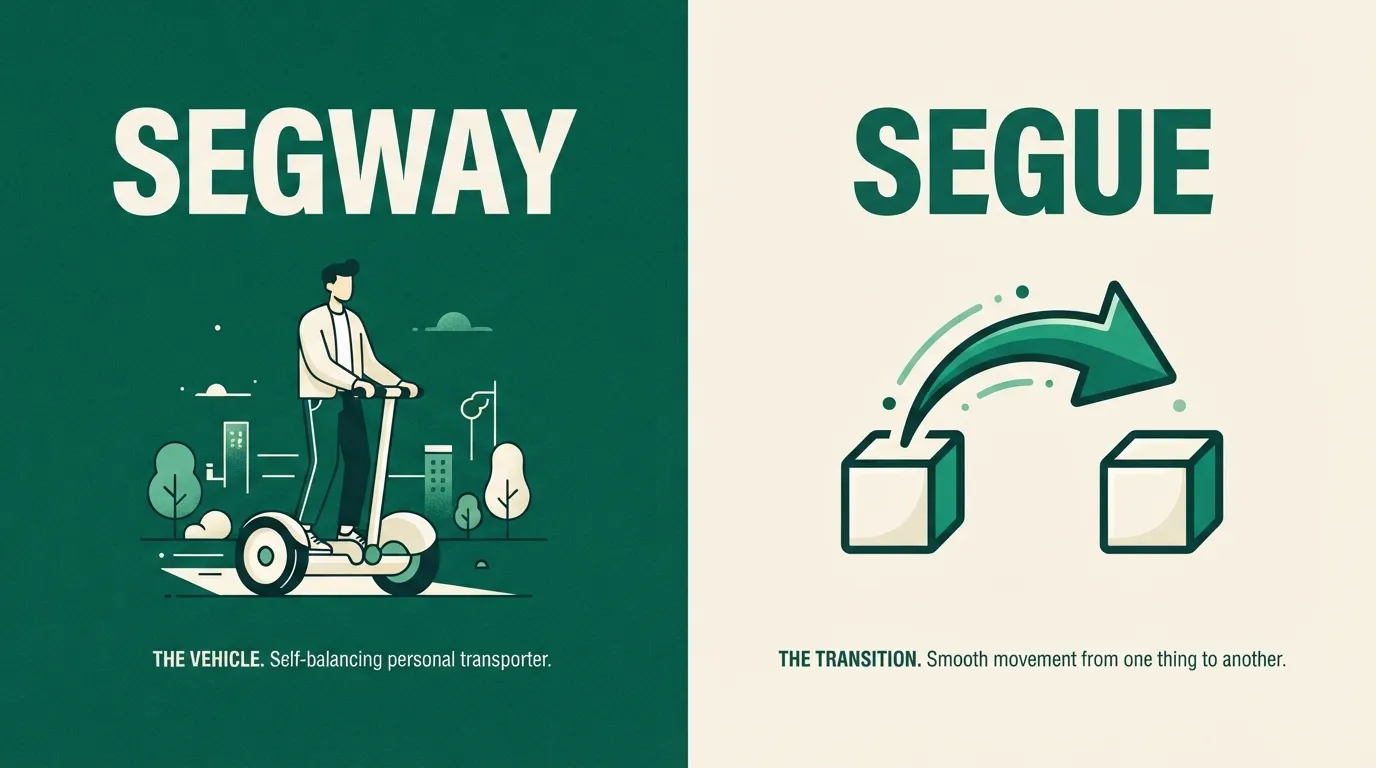
A segue is a smooth transition from one topic to another, while a Segway is a trademarked two wheeled personal transporter. The words sound almost identical, but they mean completely different things.
I still remember the email that made me want to write this guide. A colleague sent a note to our whole team that read, “Let’s segway into the next agenda item.” Three people replied with laughing emojis. Nobody corrected her directly, but everyone noticed.
That single letter swap, a instead of u, turns a common word about smooth transitions into a reference to a rideable scooter. It happens constantly in emails, presentations, and casual writing. The two words sound identical when spoken aloud, so the confusion spreads fast once someone hears it rather than reads it.
This guide clears up the confusion for good. You will learn where each word comes from, how to use them correctly, and how to avoid the mistake that quietly undermines otherwise polished writing. By the end, you will never second guess yourself again when moving between topics in a sentence, a speech, or a slide deck.
Let’s get into it.
Segway or Segue: Quick Answer
Segue (pronounced “seg way”) means a smooth transition between two things, especially topics in conversation, writing, or music. Example: “After discussing sales, she made a smooth segue into next quarter’s budget.”
Segway is a proper noun. It refers to the brand name of an upright, self balancing, two wheeled personal transporter invented in 2001. Example: “Tourists rented Segways to explore the city.”
One is a common noun borrowed from Italian. The other is a company name. They just happen to sound the same.
The Origin of Segway and Segue
Segue comes straight from Italian, where it literally means “it follows.” Musicians used the term centuries ago as a direction in sheet music, telling a performer to move into the next section without pausing. Writers and speakers later adopted it to describe any smooth shift from one idea to another.
Segway, on the other hand, is a modern invention. Inventor Dean Kamen created the self balancing scooter and launched it in 2001. His marketing team needed a name that sounded futuristic and smooth, so they borrowed the sound of “segue” and respelled it with a w. The choice was clever from a branding standpoint. It also planted the seed for decades of spelling confusion.
So the mix up is not really your fault. The company built its name specifically to echo an already existing word. That is exactly why so many people type “segway” when they mean the transition word.
Segway vs Segue: Key Differences
| Term | Meaning | Part of Speech | When to Use |
| Segue | Smooth transition between topics, scenes, or sections | Noun or verb | Writing, speeches, music, presentations |
| Segway | Brand name for a self balancing personal transporter | Proper noun | Talking about the actual scooter or company |
Notice that segue works as both a noun (“a smooth segue”) and a verb (“to segue into something”). Segway almost never functions as a verb in correct usage, since it is a product name, not an action.
Which One Should You Use?
The right word depends entirely on what you are actually describing.
For writers, speakers, and presenters: use segue. If you are transitioning between two points in an essay, a speech, a podcast, or a slide, this is the word you want.
For anyone talking about the scooter, the tour company, or the vehicle itself: use Segway. Always capitalize it, since it is a brand name, similar to how you would capitalize Kleenex or Xerox.
For a simple memory trick: think of the scooter as something with wheels, and the transition as something with words. If you are moving physically on two wheels, it is Segway. If you are moving a conversation forward, it is segue.
Common Mistakes with Segway and Segue
Here are the errors people make most often, along with the fix.
Mistake: “Let’s segway into the next topic.” Correction: “Let’s segue into the next topic.” Why it happens: The words sound identical when spoken, so people write the more familiar spelling without thinking twice.
Mistake: “That was a nice segue tour around the city.” Correction: “That was a nice Segway tour around the city.” Why it happens: Since segue is the more commonly typed word, people default to it even when discussing the actual scooter.
Mistake: “seague” or “segeu” Correction: “segue” Why it happens: The Italian spelling does not follow typical English patterns, so the letters get jumbled.
Mistake: Lowercasing “segway” when referring to the scooter brand. Correction: Capitalize it as “Segway,” since it is a registered trademark. Why it happens: Many brand names eventually get treated like ordinary words once they become common in speech, similar to what happened with escalator or aspirin.
Mistake: Using segue as a plural noun incorrectly, like “segueways.” Correction: The plural of segue is “segues.” Segway pluralizes as “Segways.” Why it happens: Blending the two words creates a completely made up term that does not exist in either sense.
Segway and Segue in Real World Writing
In a professional email: “Before we segue into the marketing update, does anyone have questions about the finance section?”
In a news headline: “City Launches Segway Rental Program for Downtown Tourists”
In a social media post: “Rented a Segway today and somehow survived. 10/10 would wobble again.”
In a formal report: “This section provides a natural segue between the risk assessment and the recommendations that follow.”
Notice how segue always connects ideas, while Segway always refers to the physical device or brand.
Segway or Segue: Data and Search Trends
Search interest in this exact confusion stays steady year round, which tells you something important: this is not a passing trend. It is an ongoing, common spelling mix up rooted in pronunciation.
Writers, students, marketers, and podcast hosts search this comparison most often, since spoken language rarely reveals the spelling difference. Search intent here is almost entirely informational. People want a quick, clear answer, not a product comparison or purchase decision.
This matters now more than ever because so much writing today gets drafted quickly, on phones, in chat apps, and inside fast moving emails. Autocorrect tools often fail to catch this error since both words are technically real and spelled correctly on their own.
Standalone Comparison Table
| Term/Variant | Meaning | Region/Context | Best Used When |
| Segue | Smooth transition | Universal, works in any English speaking region | Writing or speaking about moving between topics |
| Segway | Brand name scooter | Universal, but tied to a specific product | Talking about the actual transporter or its brand |
| Segueway | Not a real word | None | Never use this spelling |
| Segeu / Seague | Common misspellings | None | Never use these spellings |
Frequently Asked Questions
Q: What does segue actually mean?
A: Segue means a smooth, natural transition from one topic, scene, or section to another. It comes from Italian and originally referred to moving between musical sections without pausing.
Q: How do you use segue correctly in a sentence?
A: Use it as a noun (“a smooth segue”) or a verb (“to segue into”). For example, “She used the sales numbers as a segue into the marketing plan.”
Q: Segway vs segue, what is the real difference?
A: Segue is a common word about transitions. Segway is a brand name for a self balancing scooter. They sound the same but serve entirely different purposes.
Q: Is segue acceptable in formal writing?
A: Yes. Segue is completely standard in formal writing, academic papers, business reports, and professional speeches.
Q: Which spelling is correct, segway or segue, when talking about changing topics?
A: Segue is always correct for changing topics. Segway should only appear when referring to the actual scooter brand.
Q: Where does the word segue come from?
A: It comes from Italian, where it means “it follows.” Musicians used it centuries ago as a performance direction before writers adopted it for general use.
Q: Can Segway be used as a verb, like “to segway into something”?
A: No. Since Segway is a trademarked product name, it should not be used as a verb. The correct verb form is always “segue.”
Final Thoughts
Here is what to remember. Segue means a smooth transition, and it works as a noun or a verb. Segway is a brand name for a scooter, and it should always be capitalized. The confusion exists because the two words sound identical, not because either one is wrong on its own.
Next time you write a script, an email, or a presentation, pause for one second before typing this word. Ask yourself: am I moving between ideas, or am I talking about a scooter? That one question will save you from an easy, avoidable mistake.
Bookmark this guide so you never second guess segway or segue again. Share it with a coworker who might need it too.
Read More: Woah or Whoa: The Correct Spelling Revealed

Hi, I’m Zara. Words that look almost identical but mean completely different things have always fascinated me, that’s what pulled me toward writing about spelling and usage. I focus on digging into where these mix-ups actually come from, whether it’s a British-American split or just a rule English never bothered to make consistent. My goal with every guide is simple: give you the answer fast, then explain it well enough that you never have to look it up again.