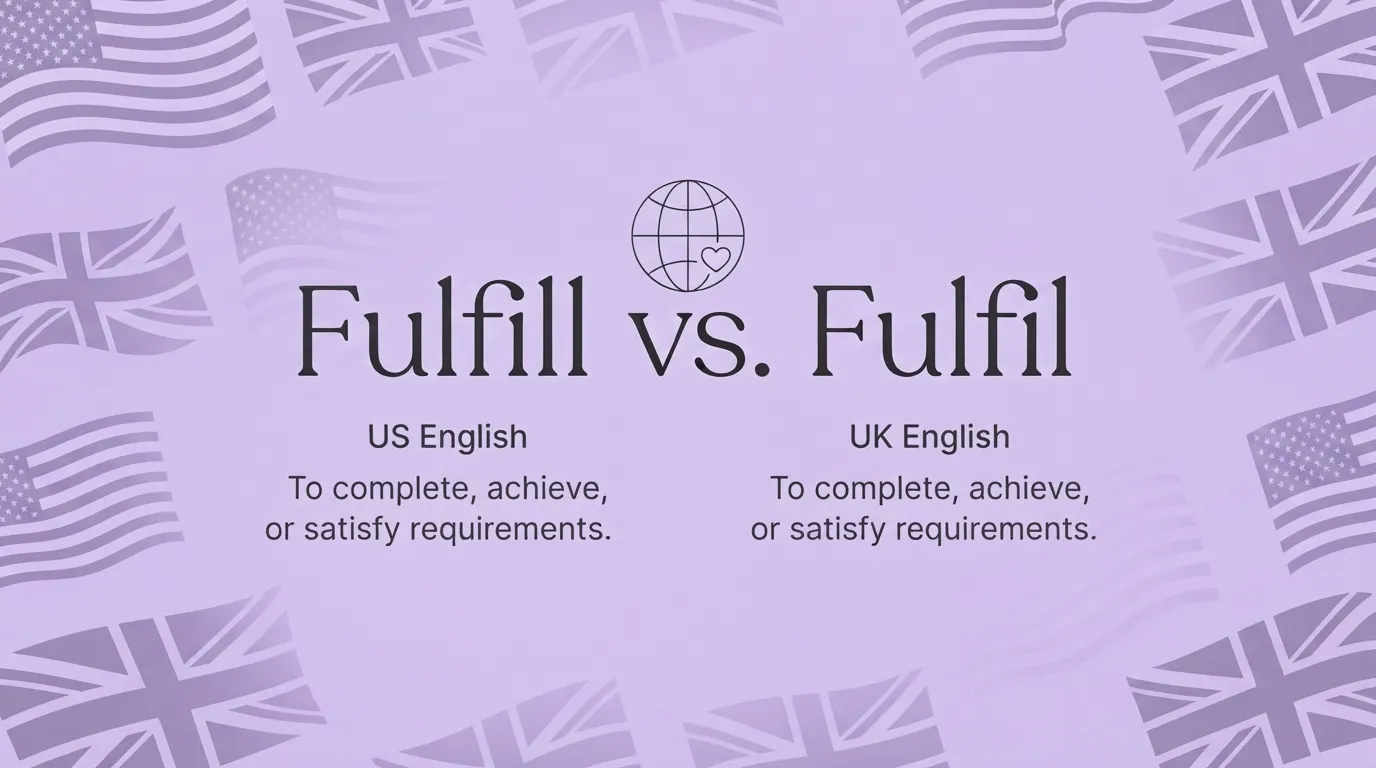
Fulfill is the standard American spelling. Fulfil is the standard British and Commonwealth spelling. Both mean to complete a task, promise, or requirement.
I once submitted an assignment to a British professor using “fulfill.” She marked it wrong and wrote “fulfil” in the margin. I was confused, since spellcheck never flagged it before.
That small red mark taught me something important. This is not a spelling mistake at all. It is a regional difference hiding in plain sight.
You have probably faced this exact moment too. Maybe you were writing for an international client. Maybe your spellcheck kept switching the word back and forth.
This guide will clear up the confusion for good. You will learn exactly which spelling belongs where, why both exist, and how to pick the right one every single time.
Let’s sort this out together.
Fulfil or Fulfill: Quick Answer
Fulfill is the American English spelling. You will see it across the United States in books, websites, and business writing.
Fulfil is the British English spelling. It appears throughout the United Kingdom, Australia, and most Commonwealth countries.
Example: “She worked hard to fulfill her dream” versus the British style “She worked hard to fulfil her dream.”
The Origin of Fulfil and Fulfill
The word traces back to Old English, combining “full” and “fillan,” meaning to fill completely. Early spellings varied widely before printing presses standardized English spelling.
American English later doubled certain consonants to match related word patterns, like install and installed. This habit shaped fulfill into its double L form.
British English kept the single L spelling instead, following older, more traditional patterns found in words like fulfil and instil.
Neither version came from a mistake. Both spellings evolved naturally as American and British English drifted apart over centuries of separate use.
Fulfil vs Fulfill Explained: Key Differences
| Term | Meaning | When to Use | Region or Context |
| Fulfill | To complete or satisfy a task, promise, or requirement | American English writing | United States, Canada often follows this too |
| Fulfil | To complete or satisfy a task, promise, or requirement | British English writing | United Kingdom, Australia, most Commonwealth countries |
Both words carry identical meaning and grammar rules. The only real difference is one letter and the audience you are writing for.
Related forms follow the same pattern. Americans write fulfilling and fulfillment, while British writers use fulfilling and fulfilment, dropping the extra L again.
Which Version Should You Use?
Your choice depends entirely on your audience’s location.
For American readers, use fulfill. This includes US based blogs, businesses, and academic writing.
For British, Australian, or Commonwealth readers, use fulfil. This includes UK publications, Australian media, and most international organizations following British style.
For global or mixed audiences, pick one spelling and stay consistent throughout your entire piece. Switching midway looks like a typo, even though both forms are correct.
For SEO content, check your target audience’s location first. Google often shows slightly different results based on regional spelling preferences.
Common Mistakes with Fulfil or Fulfill
Mistake 1: Mixing both spellings in the same document.
Correction: Choose one spelling based on your audience and use it consistently from start to finish.
Mistake 2: Assuming fulfil is simply a typo.
Correction: Fulfil is a completely correct, standard British spelling, not an error.
Mistake 3: Using fulfill in formal British writing.
Correction: Switch to fulfil for UK based readers, publications, or businesses to match expected style.
Mistake 4: Forgetting the same pattern applies to related words.
Correction: Remember fulfillment pairs with fulfill, while fulfilment pairs with fulfil.
Mistake 5: Letting autocorrect silently switch your intended spelling.
Correction: Double check your settings match your target region before publishing any content.
Fulfil or Fulfill in Real World Examples
In a professional email:
“We are committed to fulfilling every order within two business days.” (American style)
In a news headline:
“Council Vows to Fulfil Promises Made During Local Elections” (British style)
In a social media post:
“Finally fulfilling my dream of visiting Japan this year!” (American style)
In a formal document or report:
“The contractor failed to fulfil the terms outlined in the agreement.” (British style)
Notice how the spelling shifts naturally based on the intended audience in each example.
Fulfil or Fulfill: Data, Trends & Usage
Search data shows fulfill dominating in the United States, while fulfil holds strong, steady usage across the UK, Australia, and India.
This search falls under an informational intent overall. Writers, students, and business professionals search this term mainly to confirm correct regional spelling before publishing.
Global companies and international brands increasingly need both versions, especially when creating content for multiple English speaking markets.
This matters now more than ever. Businesses writing for global audiences must choose spelling carefully to sound credible and locally accurate in every region they target.
Standalone Comparison Table
| Term or Variant | Meaning | Region or Context | Best Used When |
| Fulfill | To complete or satisfy something fully | American English | Writing for US audiences |
| Fulfil | To complete or satisfy something fully | British English | Writing for UK, Australian, or Commonwealth audiences |
Frequently Asked Questions
Q: What does fulfil mean?
A: Fulfil means to complete a task, promise, or requirement fully. It carries the same meaning as fulfill, just spelled the British way.
Q: How do you use fulfill correctly in a sentence?
A: Use fulfill in American English writing, as in “He worked hard to fulfill his responsibilities at the new job.”
Q: Fulfil vs fulfill, what is the real difference?
A: There is no difference in meaning. Fulfill is the American spelling, while fulfil is the British spelling of the exact same word.
Q: Is fulfil acceptable in formal writing?
A: Yes. Fulfil is entirely standard and expected in formal British, Australian, and Commonwealth English writing.
Q: Which version is correct, fulfil or fulfill, for a business proposal?
A: It depends on your audience. Use fulfill for American clients and fulfil for British or Commonwealth clients.
Q: Where does the word fulfil come from?
A: It comes from Old English, combining “full” and “fillan,” meaning to fill completely. Both regional spellings evolved from this same root.
Q: Can fulfil be used in American writing?
A: It is uncommon and may look like a typo to American readers. Stick with fulfill for US based content instead.
Final Thoughts
Fulfil and fulfill mean exactly the same thing. The only real difference comes down to region, not correctness or grammar.
Choose fulfill for American audiences and fulfil for British, Australian, or Commonwealth readers. Stay consistent once you pick a version.
Getting this small detail right shows readers you understand your audience, which builds trust and polish in your writing.
Now you know exactly how to use fulfil or fulfill. Bookmark this guide so you never second guess it again.
Read More: Eyeing or Eying: The Complete Guide to Getting It Right

I’m Zain. I got interested in commonly confused words while helping non-native English speakers prep for writing exams, where a single misused word could cost real marks. That experience shaped how I write now: I try to explain not just which spelling is correct, but why the confusion exists in the first place, since understanding the reason is what actually makes it stick.