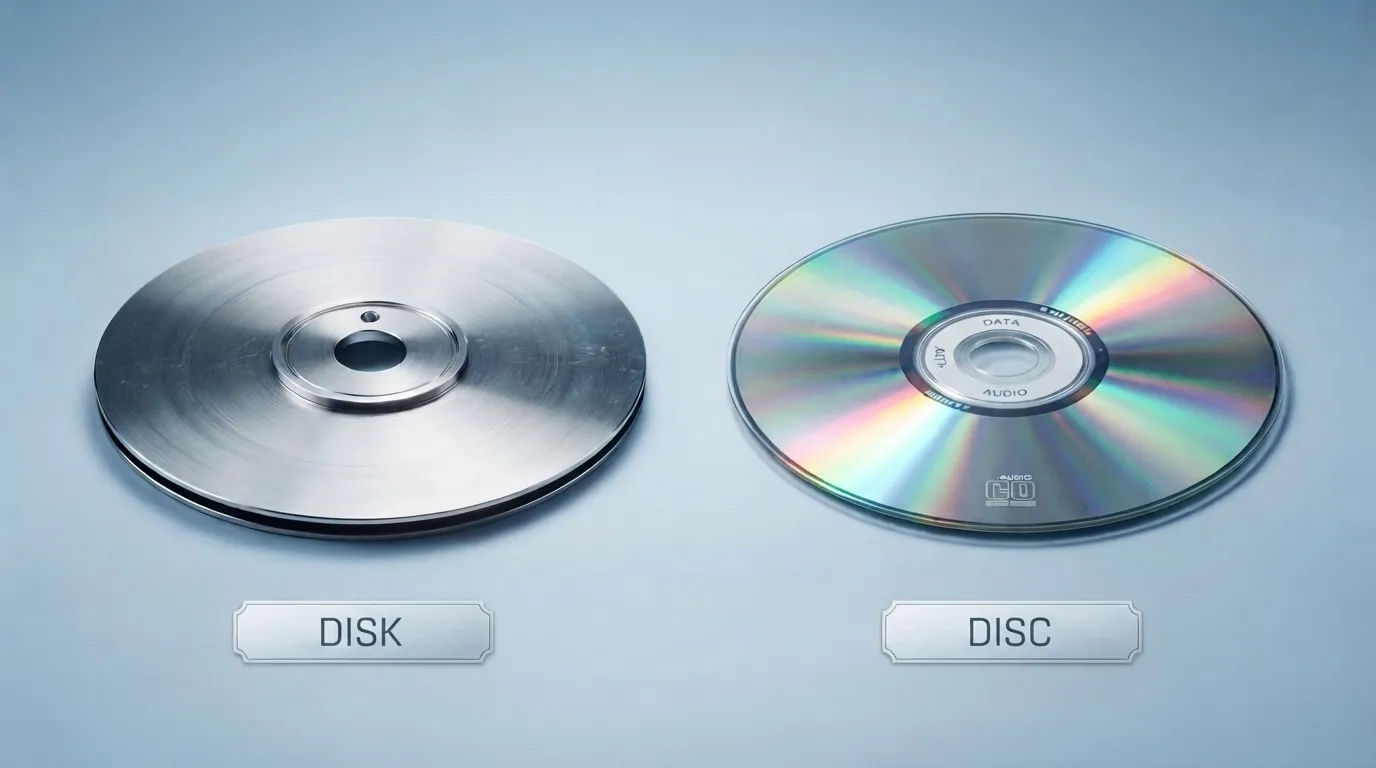
Disk usually refers to computer storage and flat, magnetic devices, while disc usually refers to optical media like CDs and DVDs, along with round, flat objects in general use.
I bought a “hard disc” once and got laughed at by a tech friend. Turns out, that single letter matters more than most people think.
Disk and disc sound identical. They mean almost the same thing. Yet spelling one wrong in a tech document or a product listing can make you look careless.
This mix up trips up writers, students, and even professionals in tech fields. Spell check will not save you here, since both spellings are technically correct words.
Even seasoned editors pause on this one sometimes. The rules feel unwritten, almost like an insider secret passed around tech offices and publishing desks.
This guide breaks the confusion down for good. You will learn exactly when to use disk, when to use disc, and why the split even exists in the first place.
By the end, you will spell it right every single time, no guessing required.
Disk or Disc: Quick Answer
Disk is the preferred spelling in American English for computer storage, like hard disks and floppy disks.
Disc is the preferred spelling for optical media, like compact discs and DVDs, and for round, flat objects in general.
Example: “I saved the file to my hard disk.” Example: “She scratched the disc while burning the movie.”
The Origin of Disk and Disc
Both words trace back to the Latin discus, meaning a flat, round plate, the same root behind the sport of discus throwing.
English borrowed the word twice, once through French as “disc” and once through a more direct route that became “disk.” For a long time, both spellings floated around interchangeably in British and American writing.
The split sharpened with technology. When computer storage became common, American tech companies leaned toward disk, giving us floppy disks and hard disks. When optical media like CDs arrived, the industry settled on disc, giving us compact discs and DVDs.
That is the real reason the confusion exists. The line was drawn by industry habit, not by strict grammar rules.
Older typewriters and early print dictionaries listed both spellings side by side for decades. Neither one was treated as wrong. It was the rise of personal computers in the 1970s and 1980s that forced writers to pick a lane, and disk won that battle for storage terms specifically.
Meanwhile, the music and film industries built their own vocabulary around optical discs at almost the same time. That timing locked disc into place for anything you could physically play in a machine, like a jukebox or a DVD player.
Disk vs Disc: Key Differences
Here is how the two spellings split by use case, with clear examples for each.
| Term | Meaning | When to Use | Region/Context |
| Disk | Magnetic storage device or American general spelling | Hard disks, floppy disks, disk drives | Common in American English and computing |
| Disc | Optical media or round flat object | CDs, DVDs, Blu-rays, brake discs, discus | Common worldwide, especially in British English |
More examples:
- “The hard disk failed, so I lost my files.” (storage)
- “He burned the movie onto a blank disc.” (optical media)
- “British writers often use disc for general round objects too.”
- “American writers stick with disk for anything storage related.”
A simple trick: if it stores digital data magnetically, like a computer hard drive, reach for disk. If it is round, flat, and often optical, like a CD or DVD, reach for disc.
Which Version Should You Use?
Your choice depends on what the object actually is, plus a bit of regional habit.
- For computer hard drives and storage devices, use disk. This is the standard in American tech writing and most software documentation.
- For CDs, DVDs, Blu-rays, and other optical media, use disc. This spelling is standard worldwide, in both American and British English.
- For general round, flat objects outside tech, like a brake disc or a discus, British English tends to prefer disc, while American English sometimes uses either, depending on the industry.
- When writing for a tech audience, disk almost always wins outside of optical media.
Quick Decision Cheat Sheet
Use this fast mental checklist whenever you are unsure which spelling fits:
- Does it plug into a computer and store files? Use disk.
- Does it play music or video, like a CD or DVD? Use disc.
- Is it a flat, round object outside of tech, like a brake part or a sports discus? Use disc.
- Are you writing for a British audience about general round objects? Lean toward disc.
- Are you writing American tech documentation? Lean toward disk.
Keep this list nearby when editing product pages, manuals, or tech support articles. It settles the question in seconds.
Disk and Disc in Everyday Language
Beyond tech and media, these words show up in phrases you might not expect.
“Slipped disk” describes a common back injury, where a soft cushion between spinal bones shifts out of place. American medical writing usually keeps the k spelling here.
“Wipe the disk clean” is often used as a metaphor for starting over completely, borrowed from the idea of erasing a hard drive.
“Spinning like a disc” sometimes describes something moving in fast, smooth circles, drawing on the shape of a record or CD.
These small idioms show how deeply both words have settled into daily language, far beyond their original technical meanings.
Common Mistakes with Disk or Disc
Mistake 1: “I need to buy a new hard disc for my laptop.” Correction: “I need to buy a new hard disk for my laptop.” Why it happens: writers assume disc is the default spelling since it looks more familiar from CDs.
Mistake 2: “Please insert the disk to install the software.” Correction: “Please insert the disc to install the software.” Why it happens: people mix up storage terminology with optical media terminology.
Mistake 3: Using disk and disc interchangeably in the same document. Correction: Pick the correct term for each specific object and stay consistent. Why it happens: writers do not realize the split is tied to the object type, not personal preference.
Mistake 4: “The doctor found a slipped disk in his back.” Correction: Both spellings are actually accepted here, though American medical writing leans toward disk. Why it happens: medical terminology followed the general American spelling pattern.
Mistake 5: Spelling disk drive as “disc drive” in software manuals. Correction: Stick with “disk drive” for storage hardware documentation. Why it happens: brand names like “disc drive” for optical readers cause cross contamination in usage.
Disk or Disc in Real-World Examples
Professional email: “The backup files were moved to an external hard disk yesterday.”
News headline: “New Optical Disc Format Promises Faster Data Transfer”
Social media post: “Just found my old CD collection, so many scratched discs! 💿”
Formal document: “All storage disk drives must be encrypted before deployment.”
Notice how disk always points to storage hardware, while disc always points to optical or round physical objects.
Disk or Disc: Data, Trends, and Usage
People search for this comparison constantly because both spellings appear across tech products, medical terms, and everyday objects.
Search interest spikes around new hardware releases and whenever someone is shopping for storage devices or optical media online.
The intent behind this search is mostly informational, though some searches carry commercial intent, especially “hard disk vs disc” queries from shoppers comparing storage options.
This matters now because cloud storage has reduced how often people physically buy disks or discs, yet the spelling confusion has not gone away. If anything, fewer people encounter these words often enough to build natural confidence with the spelling.
Tech support teams still see this mix up daily, especially in written tickets and manuals. A support article that mislabels a hard disk as a hard disc can look unpolished, even if the meaning is clear. Getting the spelling right is a small signal of quality that readers notice, even if they cannot explain why.
Retailers selling storage drives and optical media also benefit from using the correct term. Product listings that say “disc drive” instead of “disk drive” can confuse shoppers searching for computer parts, since the wrong spelling sometimes pulls up unrelated results for CD and DVD players instead.
Disk or Disc: Full Comparison Table
| Term/Variant | Meaning | Region/Context | Best Used When |
| Disk | Magnetic storage device | American English, computing and tech industries | Talking about hard drives, floppy disks, or disk drives |
| Disc | Optical media or round flat object | Global English, especially British English | Talking about CDs, DVDs, Blu-rays, or general round objects |
Frequently Asked Questions
Q: What does disk mean?
A: Disk refers to magnetic storage devices used in computers, such as hard disks and floppy disks. It is the standard American spelling for these terms.
Q: How do you use disc correctly?
A: Use disc for optical media like CDs, DVDs, and Blu-rays, as well as general round, flat objects outside of computing.
Q: Disk vs disc, what’s the difference?
A: Disk refers mainly to storage hardware, while disc refers mainly to optical media and general round objects. The split comes from industry habit, not strict grammar.
Q: Is disc acceptable in formal writing?
A: Yes. Disc is completely correct in formal writing when referring to optical media or round objects like a discus.
Q: Which version is correct, disk or disc, for a computer hard drive?
A: Disk is correct here. American computing standards use disk for all magnetic storage devices.
Q: Where does this confusion come from?
A: Both spellings trace back to the same Latin word, discus, and industry habits split them apart differently for storage versus optical media.
Q: Can disc be used in medical writing?
A: Yes, though American medical writing often prefers disk, as in a slipped disk. Both spellings appear in medical literature.
Q: Do British and American English always agree on disk versus disc?
A: Not always. British English often uses disc more broadly, even for some computing contexts, while American English keeps disk strictly for storage hardware.
Q: Is it ever okay to just pick one spelling and stick with it?
A: No. Since disk and disc describe different types of objects, picking one spelling for everything will eventually create confusing or incorrect sentences.
Final Thoughts
Disk and disc split along one clear line. Disk belongs to computer storage. Disc belongs to optical media and general round objects.
The fastest test is simple. Ask if the object stores digital data magnetically. If yes, use disk. If it is a CD, DVD, or round flat object, use disc.
Getting this right shows attention to detail, especially in tech writing, product listings, and professional documents where precision matters.
Now you know exactly how to use disk or disc, go try it in your next piece of writing. Bookmark this guide so you never second guess the spelling again.
See More: Specially or Especially: Use the Right One Every Time

Hey, I’m Ayeza. I started this site because I kept hitting the same wall over and over: typing a word, freezing, and not trusting my own instinct on the spelling. Now I research these mix-ups properly so you don’t have to, and I write every guide the way I wish these explanations had been written for me.