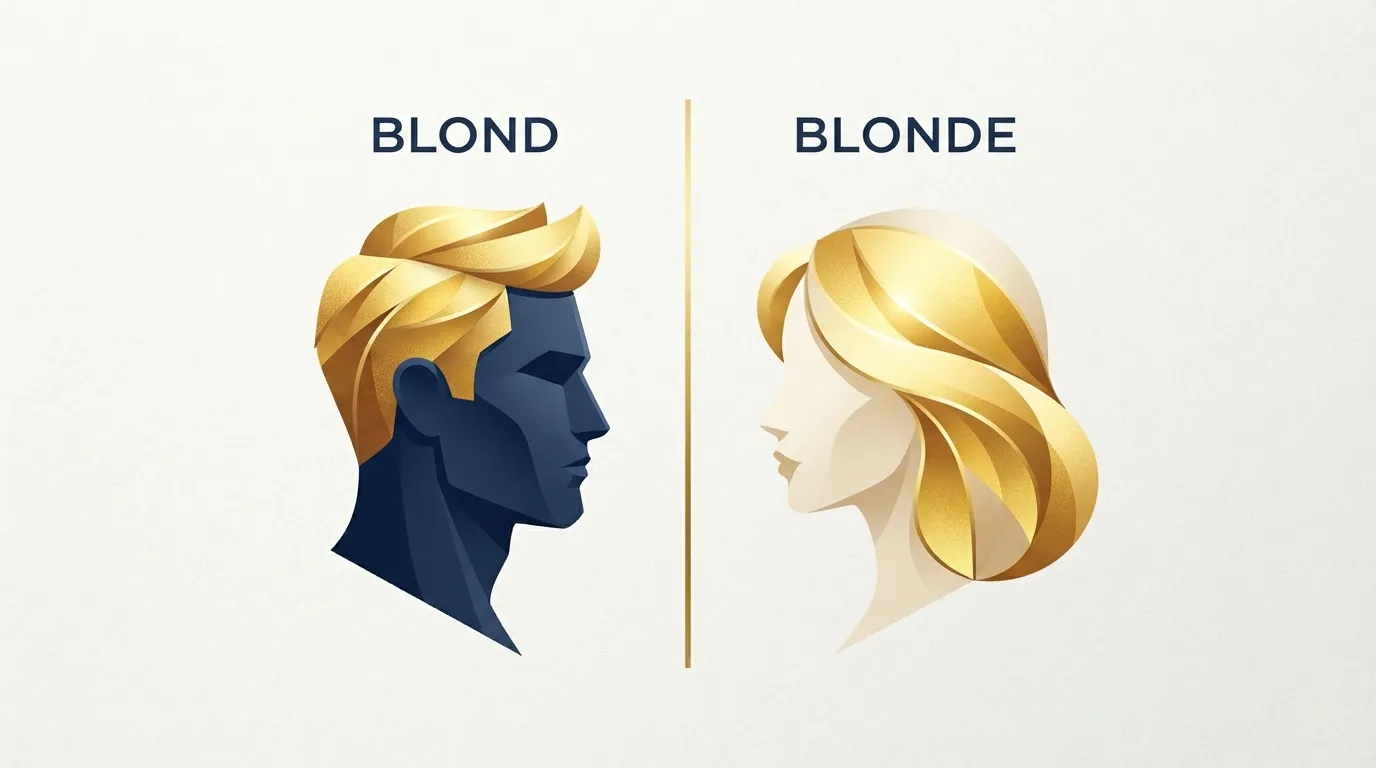
Blond is the general and masculine spelling, while blonde is the feminine spelling, though in American English blond is now widely accepted for everyone and everything.
Why This Tiny Spelling Trips Up So Many Writers
I still remember the email that made me stop and stare at my own sentence. I had written “she has blonde hair,” then two lines later typed “his blond hair” without even thinking about it. My editor circled both and asked, “Which one do you actually mean?”
That question stuck with me. Most people learn English without ever being taught this rule directly. You pick it up from books, magazines, and casual conversation, and somewhere along the way the two spellings start to blur together.
Here’s why it happens. English borrowed this word from French, and French splits adjectives by gender. That grammar rule quietly rode along into English, even though English doesn’t normally care about gender agreement.
By the end of this guide, you’ll know exactly when to use blond, when to use blonde, and why even professional writers still mix them up sometimes. No more guessing, no more double checking every time you write about hair color.
Blond or Blonde: Quick Answer
Both words describe pale or light colored hair. The difference comes down to grammar tradition, not meaning.
Blond traditionally describes a man or boy, or is used as a neutral, general term. Blonde traditionally describes a woman or girl.
Example: “He has blond hair” and “She has blonde hair” both follow the classic rule. But you’ll also see “blond hair” used for everyone in modern American writing, since the neutral form has become the safer, more common choice.
The Origin of Blond and Blonde
This spelling split comes straight from French. In French grammar, adjectives change form to match the gender of the noun they describe. A man is described as blond, and a woman is described as blonde, simply because French treats every noun as masculine or feminine.
When English absorbed the word centuries ago, it kept that gendered pattern for a while. Formal writing, fashion magazines, and beauty brands often preserved the French style, since it felt more elegant or precise.
Over time, English speakers started asking a fair question: why should a hair color depend on gender at all? Other color words, like brown or red, never split this way. That inconsistency is exactly why confusion still exists today. There’s no logical grammar reason for English to keep the French rule, yet plenty of style guides still mention it.
Blond or Blonde Explained: Key Differences and Variations
Here’s where things get genuinely useful. Different regions and different writers treat this word differently, and knowing the pattern will save you from constant second guessing.
| Term | Meaning | When to Use | Region or Context |
| Blond | Masculine or neutral | Describing men, or general/neutral use | Common in American English, especially outside fashion writing |
| Blonde | Feminine | Describing women or girls | Common in British English and traditional or formal writing |
| Blond (noun) | A man with light hair | Referring to a man as “a blond” | Traditional usage |
| Blonde (noun) | A woman with light hair | Referring to a woman as “a blonde” | Traditional usage, also common in casual pop culture |
A simple example: “The blond man walked into the room” follows the masculine rule. “The blonde woman ordered coffee” follows the feminine rule. But you’ll increasingly see “The blond woman ordered coffee” too, especially in American journalism and everyday blog writing, since many style guides now recommend blond as the default spelling regardless of gender.
Which Version Should You Use?
This depends heavily on your audience and the type of writing you’re doing.
For everyday American writing, use blond as your default. Most US style guides, including the AP Stylebook, now recommend blond for general and neutral use, and for describing men.
For formal or traditional writing, especially fashion, beauty, or British publications, use blonde when describing a woman, and blond when describing a man. This keeps the gendered French tradition intact.
For global or neutral audiences, where you’re not sure which readers you’re addressing, blond is the safer, simpler choice. It reads cleanly and avoids any appearance of outdated gender rules.
If you’re writing marketing copy, product descriptions, or general blog content, stick with blond unless your brand style guide says otherwise. Consistency matters more than picking the “correct” one, since both spellings are technically valid.
Common Mistakes with Blond or Blonde
Mistake 1: Using “blonde” for a man.
Correction: “He has blond hair,” not “He has blonde hair.” Many writers default to blonde out of habit, but the masculine form is blond.
Mistake 2: Mixing both spellings in the same document.
Correction: Pick one style and apply it consistently, unless you’re intentionally using the gendered rule throughout.
Mistake 3: Assuming blonde is always more formal.
Correction: Formality depends on your style guide, not the spelling itself. Blond can be just as formal, especially in American publications.
Mistake 4: Treating “a blonde” as an insult or stereotype without noticing tone.
Correction: Using “blonde” as a standalone noun to describe a woman can sound outdated or reductive in some contexts. When in doubt, describe hair color as an adjective instead: “a woman with blonde hair” rather than “a blonde.”
Mistake 5: Forgetting regional differences when writing for international audiences.
Correction: British English leans toward the traditional gendered split more often than American English. Check your target audience before choosing.
These errors happen because the rule isn’t taught explicitly in most schools, and spellcheck tools rarely flag either version as wrong, since both are legitimate words.
Blond or Blonde in Real World Examples
Professional email: “Please find attached the campaign visuals featuring our blond model for the summer catalog.”
News headline: “Local Bakery Owner, a Longtime Blonde Icon of Main Street, Retires After 40 Years.”
Social media post: “New hair, who dis? Officially blonde for summer! ☀️”
Formal document or report: “Witness description: male, approximately 30 years old, blond hair, medium build.”
Notice how each example fits naturally into its context. The email and report lean toward blond for neutral, factual tone. The headline and social post lean toward blonde, matching a warmer, more personal style often used in lifestyle content.
Blond or Blonde: Data, Trends, and Usage
Search interest in this exact question spikes regularly, since it’s one of those small grammar points people never quite memorize. Most searches fall under informational intent. People aren’t shopping or comparing products, they simply want a clear, quick answer.
Writers, students, and content creators search this term most often, especially those working in beauty, fashion, journalism, and marketing, where hair color comes up constantly.
American audiences increasingly search for confirmation that blond works for everyone, reflecting a broader shift toward simplifying gendered grammar rules in everyday English. British and European audiences still search for the traditional distinction more frequently, since regional style guides there tend to preserve it.
This matters right now because inclusive language trends are reshaping how brands and publications think about gendered word choices. Many editorial teams are quietly updating their style guides to favor the neutral spelling.
Comparison Table: Blond vs Blonde at a Glance
| Term or Variant | Meaning | Region or Context | Best Used When |
| Blond | Neutral or masculine | American English, general writing | Describing a man, or writing for a broad audience |
| Blonde | Feminine | British English, fashion, traditional writing | Describing a woman in formal or classic style |
| Blond (as noun) | A man with light hair | Traditional usage | Referring directly to a man |
| Blonde (as noun) | A woman with light hair | Casual and traditional usage | Referring directly to a woman, with attention to tone |
Frequently Asked Questions
Q: What does blond or blonde actually mean?
A: Both words describe pale, light colored hair. The spelling difference comes from French grammar, where adjectives change based on gender, not from any difference in the actual hair color.
Q: How do you use blond and blonde correctly?
A: Use blond for men or as a neutral, general term, and blonde for women, especially in traditional or formal writing. In modern American English, blond is often used for everyone.
Q: Blond vs blonde, what’s the real difference?
A: The only difference is grammatical gender, inherited from French. There’s no difference in meaning, tone, or the actual color being described.
Q: Is blonde acceptable in formal writing?
A: Yes, blonde is fully acceptable in formal writing, particularly in British English or fashion and beauty publications that follow the traditional gendered rule.
Q: Which version is correct, blond or blonde?
A: Both are correct. Blond is now the more common default in American English for general and masculine use, while blonde remains standard for describing women in many style guides.
Q: Where does the word blond or blonde come from?
A: It comes from French, where blond describes something masculine and blonde describes something feminine. English absorbed both spellings along with the underlying grammar rule.
Q: Can blond or blonde be used to describe objects, not just hair?
A: Yes. You’ll see “blond wood” or “blond beer” used to describe light coloring in furniture, flooring, or drinks. In these neutral contexts, blond is almost always the spelling used, since there’s no gender to consider.
Final Thoughts on Blond or Blonde
Here’s what really matters. Blond and blonde mean exactly the same thing, light colored hair, and the spelling choice comes down to grammar tradition, not accuracy.
Use blond as your safe, neutral default, especially for men or general audiences. Use blonde when you’re following traditional gendered style, particularly for women in fashion, beauty, or British English writing. Stay consistent within any single piece of writing, and check your brand or publication style guide when one exists.
Now you know exactly how to use blond or blonde, so go apply it confidently in your next piece of writing. Bookmark this guide so you never second guess the spelling again, and share it with anyone who’s ever paused mid sentence wondering which version to type.
See More: Grey or Gray? The Real Difference Explained

I’m Zain. I got interested in commonly confused words while helping non-native English speakers prep for writing exams, where a single misused word could cost real marks. That experience shaped how I write now: I try to explain not just which spelling is correct, but why the confusion exists in the first place, since understanding the reason is what actually makes it stick.