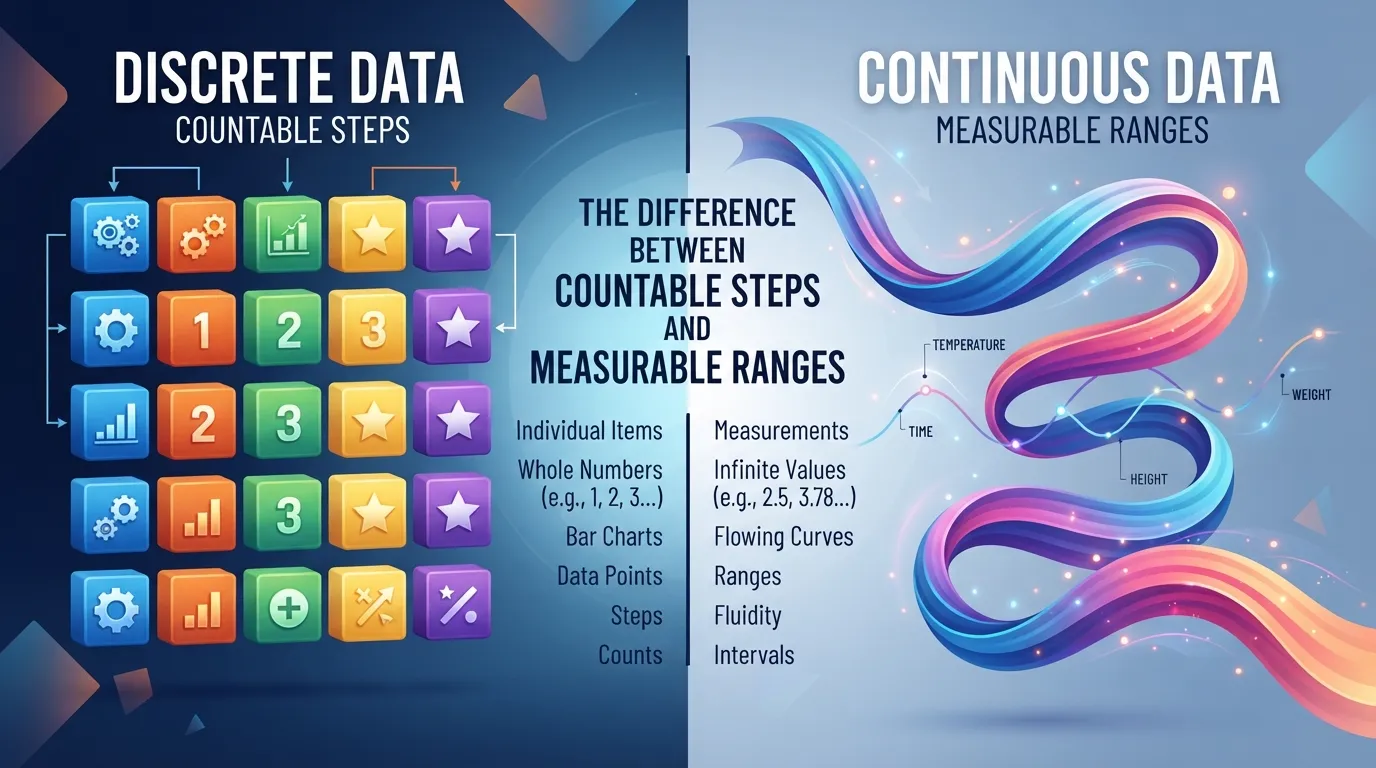
Discrete describes data or values that can only be counted in fixed, separate steps, while continuous describes data or values that can take any number within a range, including fractions and decimals.
I remember staring at a statistics worksheet in college, completely stuck. The question asked whether “number of children in a family” was discrete or continuous. I guessed continuous. I was wrong.
My professor smiled and said, “Can you have two and a half children?” That single question fixed the idea in my head forever.
People search for discrete or continuous because these words show up everywhere. Math class. Data science. Economics assignments. Even everyday conversations about counting versus measuring.
The confusion makes sense. Both words describe types of data. Both sound technical. But once you learn the one simple test behind them, you will never mix them up again.
This guide breaks down exactly what each word means, where the idea comes from, and how to tell them apart in seconds. You will also get a quick cheat sheet near the end, perfect for exams or assignments.
Discrete or Continuous, Quick Answer
Discrete values are countable. You get whole, separate numbers. Think of the number of students in a class, or the number of cars in a parking lot.
Continuous values are measurable. You get numbers that can include decimals and fractions. Think of height, weight, or time.
Here is the simplest test. Ask yourself, can this value be cut in half and still make sense? If yes, it is continuous. If no, it is discrete.
The Origin of Discrete and Continuous
Both words come from Latin. Discrete comes from a root meaning separate or distinct. Continuous comes from a root meaning to hold together or flow without a break.
These meanings match perfectly with how mathematicians use the words today. A discrete value stands alone, like a single step on a staircase. A continuous value flows, like water moving down a ramp.
The formal use of these terms grew alongside probability and statistics in the seventeen hundreds. Mathematicians needed clear language to separate countable events, like dice rolls, from measurable ones, like distance or temperature.
That need never went away. Today, the same split shapes everything from spreadsheets to scientific research.
Think about how a graph looks for each type. Discrete data often appears as a bar chart, with clear gaps between each bar. Continuous data usually appears as a smooth line or curve, since the values flow without breaks. Your eyes can often spot the difference before you even read the label.
Understanding this split matters even more now. Data science, economics, and machine learning all depend on knowing whether a variable is discrete or continuous before choosing the right method to analyze it.
Discrete or Continuous Explained, Key Differences
| Term | Meaning | When to Use | Region or Context |
|---|---|---|---|
| Discrete | Countable, separate values with no in between | Counting people, objects, or events | Statistics, economics, everyday counting |
| Continuous | Measurable values within a range | Measuring height, time, temperature, distance | Statistics, science, engineering |
Example with discrete: “The number of goals scored in a football match is discrete. You cannot score two and a half goals.”
Example with continuous: “A runner’s finishing time is continuous. It could be 12.47 seconds or 12.472 seconds.”
Notice the pattern. Discrete values jump from one whole number to the next. Continuous values can slide smoothly between any two points.
Think about a staircase versus a ramp. Climbing a staircase means landing on one step, then the next, with nothing in between. Walking up a ramp means passing through every possible point along the slope. That single image captures the whole idea.
This distinction also affects how you display data. Discrete values usually fit neatly into a table or a simple bar chart. Continuous values often need a line graph or histogram, since they can take on so many possible points.
Which Word Should You Use?
For students working on statistics homework: Ask if the value comes from counting or measuring. Counting means discrete. Measuring means continuous.
For economics or business data analysis: Use discrete for things like number of transactions, number of employees, or number of units sold. Use continuous for things like income, prices, or GDP growth rate.
For science and engineering writing: Almost all physical measurements, like weight, speed, or temperature, are continuous. Counts of items, like number of particles, stay discrete.
For general or neutral writing: If you can imagine a fraction of the value making sense, it is continuous. If a fraction sounds impossible, it is discrete.
For choosing a statistical test or model: Discrete data often pairs with methods like Poisson regression or chi square tests. Continuous data often pairs with methods like linear regression or t tests. Getting this classification right at the start saves hours of confusion later.
Common Mistakes with Discrete and Continuous
Mistake 1: Calling money continuous just because it involves decimals. Correction: Money is often treated as discrete in practice, since it moves in fixed smallest units like cents.
Mistake 2: Assuming all numerical data is continuous. Correction: Numbers alone do not decide the category. The question is whether the value can be divided further and still make sense.
Mistake 3: Confusing discrete with “small” and continuous with “large.” Correction: Size has nothing to do with it. A count of one million people is still discrete.
Mistake 4: Treating age in years as continuous. Correction: Age itself is continuous, since a person can be exactly 25.4 years old. But age rounded to whole years becomes discrete.
Mistake 5: Forgetting that time can be either, depending on how it is measured. Correction: Number of days is discrete. Exact duration in hours and minutes is continuous.
Mistake 6: Mixing up discrete with categorical data. Correction: Categorical data describes labels, like colors or names. Discrete data describes countable numbers. They often get grouped together, but they are not the same thing.
Discrete or Continuous in Real World Examples
Professional email: “Our dataset includes both discrete variables, like number of orders, and continuous variables, like delivery time in hours.”
News headline: “Economists Debate Whether Inflation Should Be Modeled as a Continuous Variable”
Social media post: “Just learned the difference between discrete and continuous data, and now stats homework finally makes sense.”
Formal report: “The survey collected discrete responses for household size and continuous responses for monthly income.”
Each example shows how naturally these words fit into real writing once you understand the core idea.
Discrete or Continuous, Data and Trends
Searches for discrete or continuous spike heavily during exam seasons, especially among students studying statistics, economics, or computer science. Search intent is almost entirely informational, since people want a clear explanation rather than a product or service.
Interest also grows steadily among data science learners. Choosing the right chart, test, or model often depends first on knowing whether a variable is discrete or continuous.
This matters right now because data literacy keeps growing in importance. More students and professionals need to classify variables correctly before running any kind of analysis.
Discrete or Continuous, Quick Cheat Sheet
Use this cheat sheet whenever you get stuck.
- Can you count it in whole numbers only? It is discrete.
- Can it include decimals or fractions and still make sense? It is continuous.
- Number of people, pets, or products? Discrete.
- Height, weight, time, or temperature? Continuous.
- Rolling a die? Discrete.
- Measuring rainfall in inches? Continuous.
Discrete or Continuous, Comparison Table
| Term or Variant | Meaning | Region or Context | Best Used When |
|---|---|---|---|
| Discrete | Countable values with clear gaps between them | Statistics, economics, everyday counting | Describing whole number counts of items or events |
| Continuous | Measurable values within an unbroken range | Science, statistics, engineering | Describing measurements that can include decimals |
| Discrete Variable | A specific countable variable in a dataset | Data analysis and research | Naming a column of countable data |
| Continuous Variable | A specific measurable variable in a dataset | Data analysis and research | Naming a column of measurable data |
Frequently Asked Questions
Q: What does discrete mean? A: Discrete means separate and countable. Discrete values are whole numbers with clear gaps between them, like the number of pets someone owns.
Q: What does continuous mean? A: Continuous means measurable across a smooth range. Continuous values can include decimals and fractions, like a person’s exact weight.
Q: Discrete vs continuous, what is the real difference? A: Discrete values come from counting and jump between whole numbers. Continuous values come from measuring and can fall anywhere within a range.
Q: Is discrete acceptable in formal writing? A: Yes. Discrete is a standard term used across statistics, economics, and science writing.
Q: Which version is correct, discrete or continuous, for describing exam scores? A: It depends. Scores counted as whole points are discrete. Scores measured on a precise scale with decimals are continuous.
Q: Where does the word discrete come from? A: It comes from Latin, from a root meaning separate or distinct, which matches its modern mathematical meaning.
Q: Can continuous be used in everyday, non technical writing? A: Yes. People use continuous naturally when describing smooth, uninterrupted change, like continuous rainfall or continuous growth.
Q: Can a variable be treated as either discrete or continuous depending on context? A: Yes. Age, income, and time are common examples. The exact value is continuous, but rounded or grouped versions of the same data become discrete.
Q: Why does this distinction matter in economics assignments? A: Many models, including regression analysis, require you to know whether your variable is discrete or continuous before choosing the correct statistical approach.
Conclusion
The words discrete and continuous both describe types of values, but they follow very different rules. Discrete values are countable and separate. Continuous values are measurable and can flow smoothly across a range.
Remember the simple test. If a fraction of the value still makes sense, it is continuous. If it does not, it is discrete.
Both types of data matter deeply in statistics, economics, and science. Knowing which one you are working with helps you choose the right chart, the right test, and the right conclusion.
This small classification decision often shapes an entire project. Get it right early, and every graph, test, and conclusion that follows becomes easier to trust.
Now you know exactly how to tell discrete or continuous apart. Bookmark this guide so you never second guess it again during your next assignment.
Explore More: Forester or Gatherer: The Real Difference Explained

I’m Zain. I got interested in commonly confused words while helping non-native English speakers prep for writing exams, where a single misused word could cost real marks. That experience shaped how I write now: I try to explain not just which spelling is correct, but why the confusion exists in the first place, since understanding the reason is what actually makes it stick.