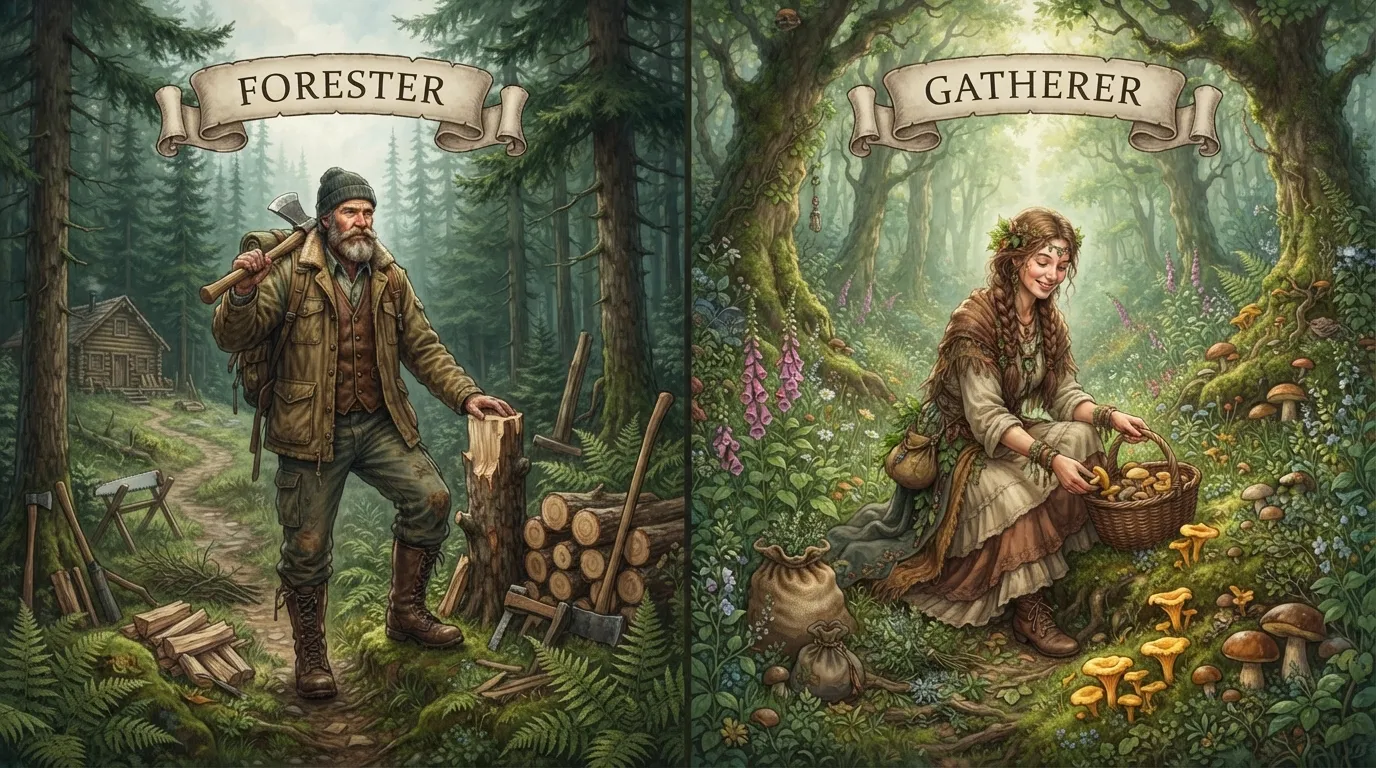
A forester is a trained professional who manages and protects forests, while a gatherer is someone who collects wild food, plants, or resources by hand, often without formal training.
I once spent a summer volunteering on a woodland trail crew. My supervisor introduced himself as “the forester” for the reserve. Later that same week, I met an older woman picking wild berries along the same trail. She laughed when I asked if she was a forester too.
“No,” she said. “I’m just a gatherer. I take what the forest offers. He decides what the forest becomes.”
That one sentence stuck with me. It is the cleanest way to explain the difference between these two words.
People search for forester or gatherer because the terms sound related. Both involve the woods. Both involve nature. But they describe two very different roles, skill sets, and histories.
This guide breaks down exactly what each word means, where they came from, and how to use them correctly. By the end, you will never mix them up again.
You will also get a simple cheat sheet near the end. Save it, and you can check the right word in seconds.
Forester or Gatherer, Quick Answer
A forester manages forests professionally. This often means planting trees, tracking wildlife, preventing wildfires, and planning timber harvests.
A gatherer collects things from nature by hand. Think berries, mushrooms, nuts, and herbs.
Here is a simple way to remember it. A forester studies the forest. A gatherer uses the forest.
The Origin of Forester and Gatherer
The word forester comes from Old French, tied to the Latin word for forest. It first described royal officials who guarded hunting grounds for kings and nobles. Over centuries, the job shifted from guarding land for the wealthy to managing land for everyone.
Gatherer has a much older root. It traces back to early human survival. Long before farming existed, people gathered wild plants, roots, and berries to eat. This gave rise to the term hunter gatherer, used by anthropologists to describe early human societies.
So one word grew from law and land management. The other grew from raw human survival. That history explains why they feel connected, yet mean such different things today.
Back then, a forester answered to a king. A gatherer answered only to the seasons. That single contrast still shapes how we use both words now.
Foresters eventually became linked to science. Modern forestry programs teach ecology, soil health, and wildlife management. Gatherers, by contrast, stayed close to their original meaning. The word still points to a person working with their hands, not a desk or a degree.
This gap in formality is exactly why the two words never became true synonyms, even though both sit under the same wide topic of “people who work with forests.”
Forester or Gatherer, Key Differences
| Term | Meaning | When to Use | Region or Context |
|---|---|---|---|
| Forester | A trained expert who manages forest land | Professional, scientific, or government settings | Common worldwide, especially in forestry and conservation |
| Gatherer | A person who collects wild food or materials | Historical, anthropological, or informal settings | Common in discussions of early humans or foraging today |
Example with forester: “The forester marked which trees needed to be cut to prevent overcrowding.”
Example with gatherer: “Every autumn, the gatherer filled her basket with wild mushrooms and chestnuts.”
Notice how the forester’s action is planned and technical. The gatherer’s action is direct and personal.
Think about the tools each person carries too. A forester often uses maps, growth charts, and measuring tools. A gatherer usually carries a basket, a knife, or simple hand tools. The gear alone tells you which word fits the scene.
Another clue is scale. Foresters think in acres and decades. They plan for forests that will outlive them. Gatherers think in seasons and baskets. Their work happens in a single afternoon, then repeats again next year.
Which Word Should You Use?
For students writing about anthropology or early human history: Use gatherer, because this word fits the hunter gatherer lifestyle of early societies.
For writers covering environmental jobs or conservation: Use forester, because it names a real modern profession with training and certification.
For modern foraging content, like wild food blogs: Gatherer still works well, since foraging today echoes the same collecting behavior.
For neutral or general nature writing: Choose based on the action described. If someone is managing land, say forester. If someone is collecting food or plants, say gatherer.
For fiction or storytelling: Pick the word that matches your character’s purpose in the forest. A ranger character who protects the land fits forester. A survivor character who lives off the land fits gatherer.
Common Mistakes with Forester and Gatherer
Mistake 1: Using forester to describe someone foraging for food. Correction: Use gatherer instead. A forester manages land, not baskets of berries.
Mistake 2: Assuming gatherer is a modern job title. Correction: Gatherer is mostly a descriptive or historical term, not a formal career.
Mistake 3: Writing “forester and gatherer society” instead of “hunter gatherer society.” Correction: The correct anthropological phrase is hunter gatherer, not forester gatherer.
Mistake 4: Treating both words as synonyms. Correction: They are related to nature, but describe completely different roles.
Mistake 5: Capitalizing forester as a formal title without context. Correction: Only capitalize it when it is part of an official job title, like Regional Forester.
Mistake 6: Using gatherer to describe someone hunting animals. Correction: Gatherer refers to plant based collecting. Hunting is a separate action, even in the phrase hunter gatherer.
Mistake 7: Assuming a forester works alone. Correction: Foresters usually work within teams, agencies, or companies. Gatherers, historically and today, often work alone or in small family groups.
Forester or Gatherer in Real World Examples
Professional email: “Please connect with our certified forester before the site inspection next week.”
News headline: “Local Forester Warns of Rising Wildfire Risk This Summer”
Social media post: “Spent the morning as a happy little gatherer, my basket full of wild blackberries.”
Formal report: “The gatherer communities in this region relied on seasonal plants for over half their diet.”
Each example shows the natural home for each word. Foresters appear in professional and official language. Gatherers appear in historical, casual, and descriptive language.
Forester or Gatherer, Data and Trends
Searches for hunter gatherer spike often in education and anthropology spaces, especially around school projects and documentaries. Searches for forester as a career tend to rise steadily, tied to interest in environmental jobs and conservation careers.
Search intent for both terms is mostly informational. People want definitions, not products. Interest also grows in spring and autumn, when foraging and forestry work both become more visible outdoors.
This matters now because more people are curious about sustainable living, wild food, and forest conservation. Both words sit right at the center of that growing interest.
Climate change has also pushed forester into more headlines. Wildfire prevention, tree planting programs, and land management all rely on trained foresters. At the same time, foraging apps and wild food communities have brought gatherer back into everyday conversation.
Forester or Gatherer, Quick Cheat Sheet
Use this short cheat sheet whenever you get stuck.
- Talking about a job or career? Use forester.
- Talking about collecting berries, nuts, or herbs? Use gatherer.
- Writing about early human history? Use gatherer, or hunter gatherer.
- Writing about wildfire prevention or tree planting? Use forester.
- Describing someone with training and certification? Use forester.
- Describing someone working with their hands in nature? Use gatherer.
Forester or Gatherer, Comparison Table
| Term or Variant | Meaning | Region or Context | Best Used When |
|---|---|---|---|
| Forester | Manages and protects forest land professionally | Global, formal and scientific writing | Talking about jobs, land management, or conservation |
| Gatherer | Collects wild food or resources by hand | Global, historical and casual writing | Talking about foraging, survival, or early human life |
| Hunter Gatherer | A society that hunts and gathers for food | Anthropology, history, education | Describing early human lifestyles before farming |
Frequently Asked Questions
Q: What does forester mean?
A: A forester is a trained professional who manages forest land. Their work includes planting trees, tracking wildlife, and preventing wildfires.
Q: What does gatherer mean?
A: A gatherer is someone who collects wild plants, berries, or other resources by hand, often for food.
Q: Forester vs gatherer, what is the real difference?
A: A forester manages land as a job. A gatherer collects resources directly from nature, often without formal training.
Q: Is forester acceptable in formal writing?
A: Yes. Forester is a proper job title used in government, environmental, and scientific writing.
Q: Which version is correct, forester or gatherer, when describing early humans?
A: Use gatherer, or the full phrase hunter gatherer, since this describes how early humans lived and ate.
Q: Where does the word forester come from?
A: It comes from Old French, originally describing officials who guarded royal forests centuries ago.
Q: Can gatherer be used in a modern context?
A: Yes. It fits naturally in writing about foraging, wild food, and sustainable living today.
Q: Do foresters and gatherers ever work together?
A: Rarely in a formal sense, but their goals can overlap. A forester who protects a healthy forest also protects the plants that gatherers rely on.
Q: Is one word more positive than the other?
A: No. Both carry respect. A forester is respected for expertise. A gatherer is respected for knowledge passed down through generations of hands on experience.
Conclusion
The words forester and gatherer both belong to the forest, but they tell very different stories. A forester plans, protects, and manages. A gatherer collects, survives, and connects directly with what nature offers.
Remember this simple rule. If someone studies or runs the land, call them a forester. If someone collects food or resources by hand, call them a gatherer.
Both roles matter. Without foresters, forests lose the careful planning that keeps them healthy for the future. Without gatherers, we lose a direct human connection to the wild food growing right under our feet.
Keep this guide handy. Whether you are writing a school paper, a blog post, or just settling a debate with a friend, you now have a clear answer.
Now you know exactly how to use forester or gatherer the right way. Bookmark this guide so you never second guess these two words again.
Explore More: Modeling or Modelling: The Real Difference Explained

Hey, I’m Ayeza. I started this site because I kept hitting the same wall over and over: typing a word, freezing, and not trusting my own instinct on the spelling. Now I research these mix-ups properly so you don’t have to, and I write every guide the way I wish these explanations had been written for me.