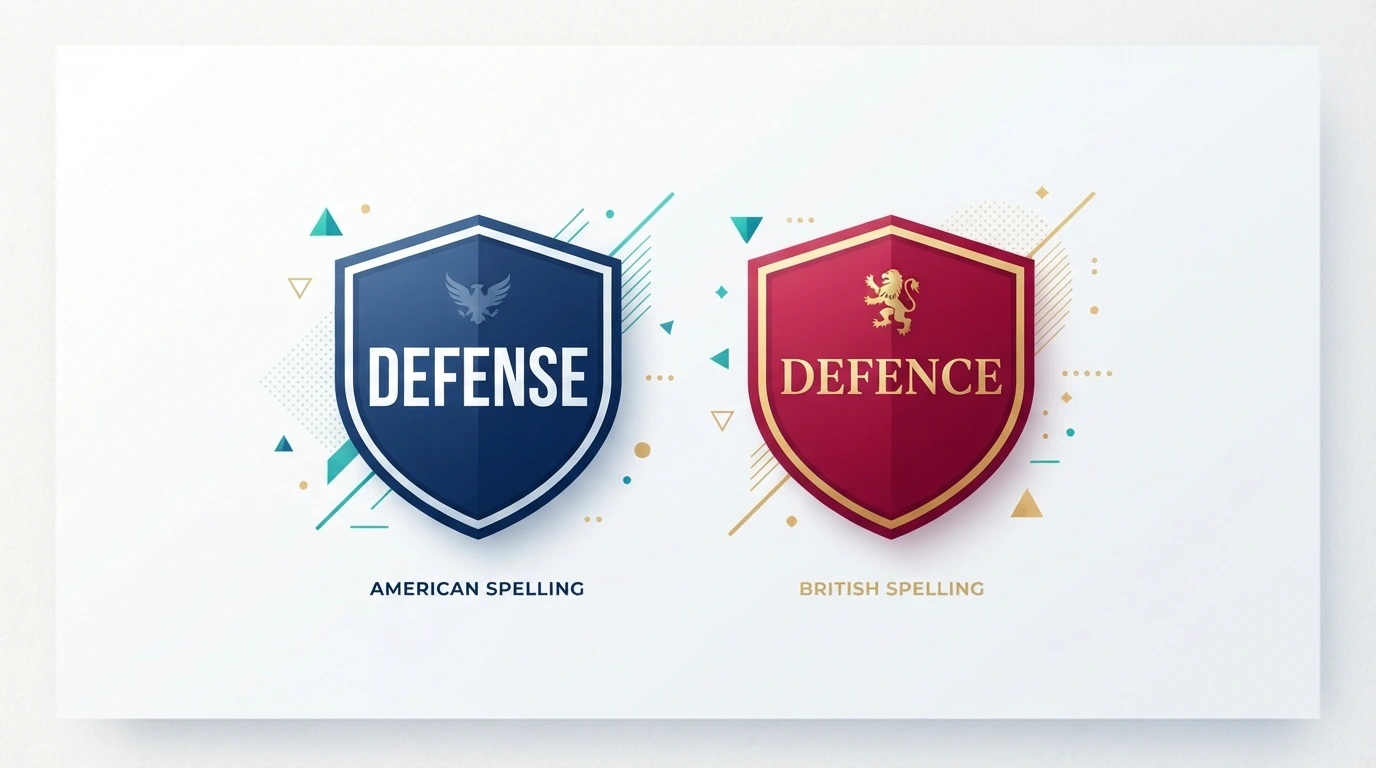
Both defense and defence are correct. Defense is the American English spelling, while defence is the British English spelling. The meaning stays exactly the same.
I once submitted an essay in university with “defence” spelled the British way, only to have my American professor mark it as a spelling error. I argued my case, showed her a British dictionary, and she still took off half a point out of habit.
That small moment taught me something every writer eventually learns. Spelling isn’t always about right or wrong. Sometimes it’s about which country you’re writing for.
If you’ve ever paused while typing this word, wondering whether to use an “s” or a “c,” you’re dealing with one of the most common American versus British spelling questions in the English language.
This guide will clear up the confusion completely. You’ll learn exactly when to use each spelling, why the difference exists, and how to avoid looking inconsistent in your own writing. By the end, you’ll never second guess this word again.
Defense or Defence: Quick Answer
Defense is used throughout the United States and in American style publications, businesses, and government documents.
Defence is used in the United Kingdom, Australia, Canada, and most Commonwealth countries.
Example: An American news site would write “The team’s defense improved this season,” while a British paper would write “The team’s defence improved this season.” Same word. Same meaning. Different regional spelling.
The Origin of Defense and Defence
Both spellings trace back to the same French root word, “defense,” which itself came from Latin. English absorbed this word centuries ago, long before American and British English split into their own distinct styles.
The real divide happened much later, largely thanks to one man: Noah Webster. In the early 1800s, Webster wanted American English to have its own identity, separate from British influence. He simplified many spellings, dropping letters he considered unnecessary.
Words ending in “ce” in British English, like defence, licence, and offence, were changed to end in “se” in American English, becoming defense, license, and offense.
This wasn’t random. Webster believed simpler spelling made the language more accessible and more distinctly American. His dictionary, published in 1828, became the foundation for spelling rules still used in the US today.
Meanwhile, British English kept the original French influenced spelling, which is why the “ce” ending survived across the UK and most former British colonies.
Defense Explained: Key Differences and Variations
| Term | Meaning | When to Use | Region or Context |
| Defense | Protection or a legal argument | American English writing | United States |
| Defence | Protection or a legal argument | British English writing | UK, Australia, Canada, most Commonwealth nations |
| Defensive | Adjective form, protective in nature | Both regions, spelled the same | Global |
| Defender | A person or thing that defends | Both regions, spelled the same | Global |
Notice something important here. Only the noun form changes between regions. Related words like “defensive” and “defender” stay identical everywhere, since the spelling shift only applies to that specific “ce” versus “se” pattern.
Which Version Should You Use?
For American audiences, always use defense. This applies to blog posts, business documents, news articles, and everyday writing aimed at US readers.
For British, Australian, or Canadian audiences, use defence. Canadian English actually mixes American and British conventions depending on the word, but defence typically follows the British pattern in formal writing.
For global or neutral content, choose based on your primary audience and stay consistent throughout the entire piece. Mixing both spellings in the same document looks like a mistake, even though both versions are technically correct.
For legal and government writing, match the spelling convention of the country your document applies to. A US legal defense strategy uses “defense.” A UK court document discussing a defence argument uses “defence.”
Common Mistakes with Defense or Defence
Mistake 1: Switching between defense and defence within the same document.
Correction: Pick one spelling based on your audience and use it consistently from start to finish.
Mistake 2: Assuming Canadian English always follows British spelling.
Correction: Canadian English is a blend. Some words follow British patterns, others follow American ones, so defence specifically tends to lean British, but it’s worth checking style guides for consistency.
Mistake 3: Changing related words incorrectly, like writing “defencive” instead of “defensive.”
Correction: Only the noun form changes. Adjectives and other related words stay the same in both American and British English.
Mistake 4: Assuming one spelling is more correct or more formal than the other.
Correction: Neither spelling is superior. They are equally valid, just regionally different, similar to color versus colour or organize versus organise.
Mistake 5: Using spellcheck set to the wrong regional dictionary, which flags the correct spelling as an error.
Correction: Check your word processor’s language settings and match them to your intended audience before writing.
Defense in Real World Examples
In a professional email (American):
“Our legal team has prepared a strong defense strategy ahead of next week’s hearing.”
In a professional email (British):
“Our legal team has prepared a strong defence strategy ahead of next week’s hearing.”
In a news headline (American):
“Pentagon Announces Increased Defense Spending for Next Fiscal Year”
In a news headline (British):
“Ministry of Defence Announces Increased Spending for Next Fiscal Year”
In a social media post:
“That was the best defense I’ve seen all season, absolutely shut down their entire offense.”
In a formal document or report:
“The company’s cybersecurity defense protocols were updated following the recent audit, ensuring compliance with federal regulations.”
Each example shows how naturally the word shifts depending purely on regional audience, never on meaning or context.
Defense: Data, Trends and Usage
Search interest for “defense” spikes heavily in American contexts, particularly around sports commentary, military news, and legal proceedings. Searches for “defence” follow a nearly identical pattern but concentrated in UK, Australian, and Canadian regions.
Search intent for “defense or defence” itself falls almost entirely into the informational category. People typing this into Google usually want to confirm which spelling matches their target audience, especially content writers, students, and businesses operating internationally.
Global businesses and content creators searching for this term skew heavily toward marketing teams and copywriters who publish content across multiple English speaking regions and need consistency guidelines.
This matters more now than ever, since global content distribution means a single article can reach both American and British readers simultaneously. Choosing the wrong regional spelling, or worse, mixing both, can quietly damage credibility with international audiences who notice these small details.
Standalone Comparison Table
| Term or Variant | Meaning | Region or Context | Best Used When |
| Defense | Protection or legal argument | United States | Writing for American audiences |
| Defence | Protection or legal argument | UK, Australia, most Commonwealth nations | Writing for British or Commonwealth audiences |
| Defensive | Protective in nature | Global, spelled the same everywhere | Describing behavior or strategy |
| Defender | Someone who defends | Global, spelled the same everywhere | Sports, legal, or general contexts |
Frequently Asked Questions
Q: What does defense or defence mean?
A: Both words mean the same thing, referring to protection against attack, a legal argument in court, or a strategic position in sports. The only difference is regional spelling.
Q: How do you use defense or defence correctly?
A: Choose defense for American audiences and defence for British or Commonwealth audiences. Stay consistent throughout your entire document once you pick one.
Q: Defense vs defence, what’s the difference?
A: There is no difference in meaning. Defense follows American spelling conventions, while defence follows British spelling conventions, dating back to Noah Webster’s spelling reforms in the 1800s.
Q: Is defence acceptable in formal writing?
A: Yes, absolutely, as long as you’re writing for a British, Australian, or Commonwealth audience. It’s the standard and expected spelling in those regions.
Q: Which version is correct, defense or defence?
A: Both are correct. Neither spelling is wrong, they simply belong to different regional English standards, similar to color and colour.
Q: Where does the difference between defense and defence come from?
A: It comes from Noah Webster’s efforts to simplify American English spelling in the early 1800s, which changed many British “ce” endings to “se” in American usage.
Q: Can defense be used in a British document?
A: Technically readers will understand it, but it will look inconsistent and slightly out of place in formal British writing, which typically expects defence instead.
Conclusion
This one comes down to geography, not grammar rules. Defense and defence mean exactly the same thing, and neither version is more correct than the other.
Remember these key points: Defense is standard American English. Defence is standard British and Commonwealth English. Related words like defensive and defender never change. And consistency matters more than which spelling you pick.
Now you know exactly how to use defense or defence correctly, so check your audience, pick your spelling, and stay consistent across your entire piece of writing.
Bookmark this guide so you never second guess defense or defence again.
Read More: Theater or Theatre: The Complete, Proven Guide

Hi, I’m Zara. Words that look almost identical but mean completely different things have always fascinated me, that’s what pulled me toward writing about spelling and usage. I focus on digging into where these mix-ups actually come from, whether it’s a British-American split or just a rule English never bothered to make consistent. My goal with every guide is simple: give you the answer fast, then explain it well enough that you never have to look it up again.