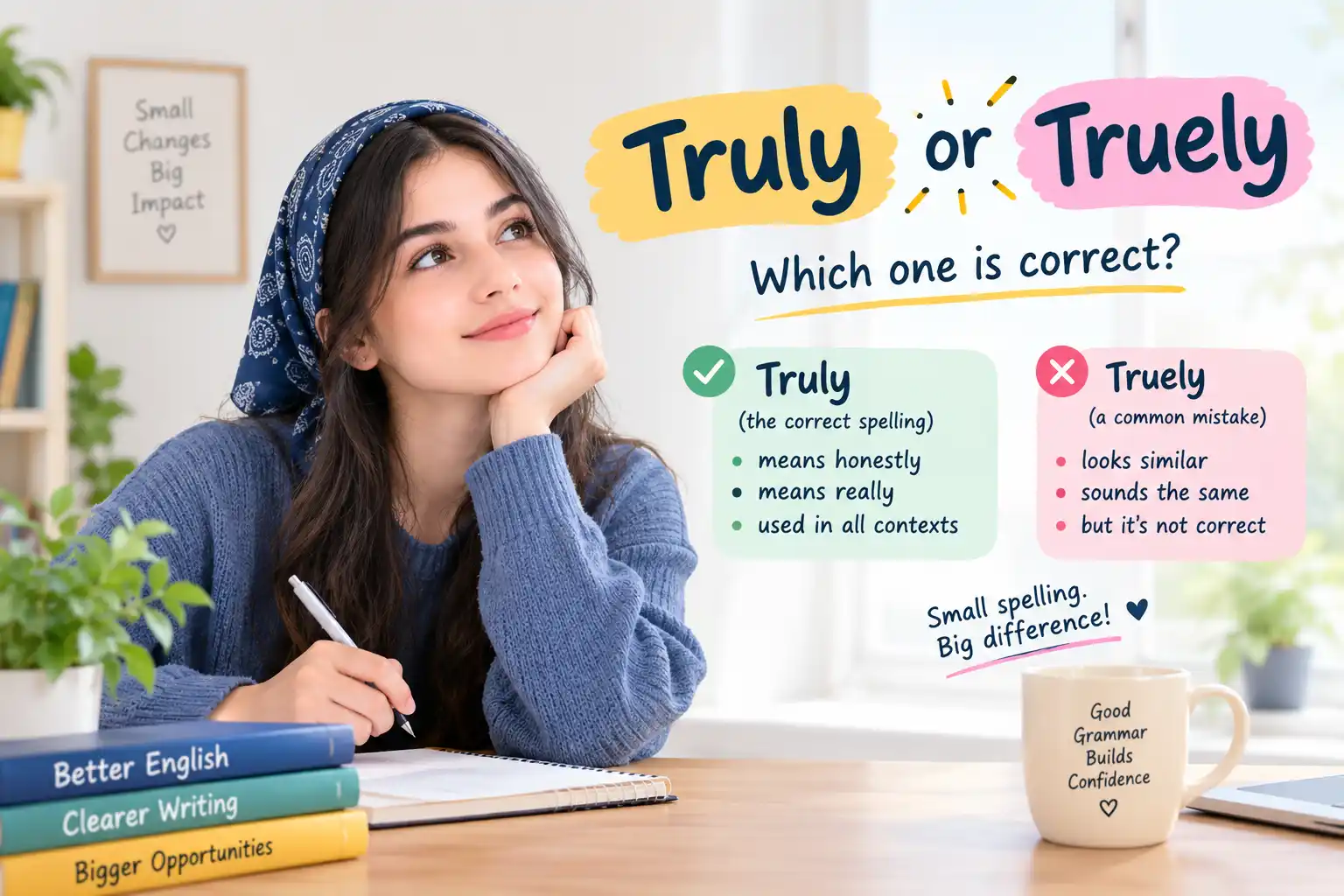
“Truly” is the only correct spelling in modern English. “Truely” is a common misspelling that comes from adding “ly” to “true” without dropping the silent “e.”
I still remember the email that made me question my own spelling for a full minute. A colleague wrote, “I truely appreciate your help,” and something about it looked off. I typed both versions into a blank document, stared at them side by side, and genuinely could not tell which one was right anymore.
That moment sums up why this word trips up so many people. “Truly” breaks a spelling rule that feels automatic. Most of the time, you add “ly” to an adjective and keep every letter intact: “sad” becomes “sadly,” “quick” becomes “quickly,” “brave” becomes “bravely.” Your brain builds a pattern, and “true” plus “ly” should logically give you “truely.”
But English loves exceptions. “True” drops its final “e” before “ly” is added, giving you “truly.” This guide walks through why that happens, where the confusion started, and how to make sure you never second guess it again.
Truly Quick Answer
“Truly” means genuinely, sincerely, or in a true manner. You use it to add emphasis or honesty to a statement, as in “I am truly grateful” or “She truly believes in the cause.”
There is no correct context in standard English where “truely” is the right choice. If you see it in a document, it needs to be corrected to “truly.”
The Origin of the Confusion
The word “truly” comes from the Old English “treowlice,” which combined “treowe” (true, faithful) with the adverbial suffix “lice.” Over centuries, English spelling shifted and simplified, and the modern adjective “true” emerged with its silent final “e.”
Most English adverbs form by simply attaching “ly” to the base adjective. Words like “sincere” and “true” both end in a silent “e,” and English has a small but stubborn group of words that drop that final “e” before adding “ly.” “True” became “truly.” “Due” became “duly.” “Whole” became “wholly.”
The confusion happens because these exceptions are rare. Learners memorize the “add ly and keep everything” rule first, and it works for the vast majority of words. “Truely” is a completely understandable guess. It just happens to be wrong.
This is not a modern typo either. Historical texts show that even before spellcheck existed, writers occasionally slipped into “truely” simply because the eye expects consistency. Once you understand that “truly” belongs to a small family of exceptions, the spelling stops feeling random and starts feeling like a rule you can actually remember.
Truly Explained: Key Differences and Common Variants
There is really only one correct spelling here, but people encounter several related forms and often mix them up. Here is how they compare.
| Term | Meaning | When to Use | Region/Context |
| Truly | Genuinely, sincerely, in a true manner | Formal and informal writing everywhere | Standard in US, UK, Australian, and Canadian English |
| Truely | Misspelling of truly | Never; always incorrect | Not accepted anywhere |
| Truthfully | Honestly, in accordance with the truth | When emphasizing honesty specifically | Standard everywhere |
| Sincerely | With genuine feeling, often used to close letters | Formal correspondence and emotional statements | Standard everywhere |
Notice that “truly” and “truthfully” are related but not interchangeable in every sentence. “Truly” often expresses degree or intensity (“truly amazing”), while “truthfully” leans toward honesty in speech (“truthfully, I forgot”).
A quick memory trick helps here. Picture the word “true” losing its tail before it puts on its “ly” coat. If you can picture that small image, the correct spelling tends to stick far better than any grammar rule explained in the abstract. Many teachers use similar visual tricks for exception words, since a picture often outlasts a rule in memory.
Which Version Should You Use?
For everyday writing, always use “truly.” There is no audience, region, or style guide that accepts “truely” as a valid alternative.
For students and English learners, treat “truly” as a spelling exception worth memorizing on its own, separate from the general “ly” rule.
For professional and business writing, “truly” appears often in phrases like “yours truly,” so getting it right matters for anything client facing, including emails and letters.
For global or neutral use, “truly” works identically across American, British, Australian, and Canadian English. There is no regional variant to worry about here, unlike words such as “color” versus “colour.”
For content creators and copywriters, small spelling slips like “truely” can quietly hurt credibility. A reader may not consciously notice the error, but a single misspelling in a headline or intro can make the entire piece feel less trustworthy. Running a final proofread pass specifically for exception words like this one is a habit worth building into any writing routine.
Common Mistakes With Truly
Mistake: Truely Correction: Truly Why it happens: Writers apply the standard “add ly, keep the base word” rule that works for most adjectives, forgetting that “true” is an exception.
Mistake: Yours truely (in letter closings) Correction: Yours truly Why it happens: This phrase is often typed quickly at the end of an email, and autocorrect does not always catch it on every device.
Mistake: Truley Correction: Truly Why it happens: Some writers substitute “ey” for the final sound, likely influenced by words like “money” or “honey.”
Mistake: Trully Correction: Truly Why it happens: Doubling the “l” is a common typing slip, especially for fast typists who are used to double consonants in other words.
Mistake: Using “truely” in formal documents after spellcheck missed it Correction: Truly Why it happens: Some older or basic spellcheck tools do not always flag every misspelling, especially in less common software or quick note taking apps.
Mistake: Confusing “truly” with “true,” as in “I true believe you” Correction: I truly believe you Why it happens: Writers sometimes drop the “ly” entirely under time pressure, forgetting that the adjective “true” needs the adverb form “truly” to modify a verb like “believe.”
Truly in Real World Examples
In a professional email: “Thank you for the update. I truly appreciate the extra effort your team put into this project.”
In a news headline: “Local Teacher Truly Changes Lives, Students Say”
In a social media post: “This sunset is truly one of the best I have seen all year 🌅”
In a formal document or report: “The committee truly believes this initiative will benefit the entire community.”
In each case, “truly” adds emphasis and sincerity without changing the core meaning of the sentence. Swap in “truely” and the sentence instantly looks unpolished, even if the rest of the writing is strong.
Consider one more scenario that comes up constantly in customer facing writing. A support agent replying to a frustrated customer might write, “I truly understand your frustration, and I will make this right.” That single word carries real emotional weight. Replace it with a misspelled version and the sentence loses some of its credibility right when credibility matters most.
The same principle applies to marketing copy. A tagline that reads “Truly the best coffee in town” feels confident and polished. The same line with a spelling slip feels like it skipped a proofreading step, which can quietly undercut an otherwise strong pitch.
Truly: Data, Trends, and Usage
Spelling questions like “truly or truely” are searched constantly by students, professionals, and English language learners who want to double check their writing before sending an email or submitting an assignment. This kind of search falls into the informational category, meaning people want a fast, clear answer rather than a product or service.
Search interest tends to spike around common triggers: writing a formal letter, drafting a cover letter that ends with “yours truly,” or proofreading an assignment before a deadline. English as a second language learners search this pairing especially often, since the silent “e” drop rule is rarely taught explicitly in early grammar lessons.
This matters now because so much writing happens quickly, in emails, chats, and social posts, often without a careful second read. A quick, reliable answer helps writers fix the mistake in seconds instead of guessing or leaving it unresolved.
There is also a growing audience of people writing in English as a second or third language who rely on quick reference guides like this one instead of full grammar textbooks. For that audience, a clear example and a short memory trick often work better than a long explanation of historical spelling shifts. Keeping the answer simple and visual tends to serve both native speakers brushing up and learners building confidence.
Truly vs Truely Comparison Table
| Term/Variant | Meaning | Region/Context | Best Used When |
| Truly | Genuinely or sincerely | All English speaking regions | Any formal or casual writing |
| Truely | Incorrect spelling | Not used anywhere | Never, this is always a mistake |
| Yours truly | A traditional letter closing | Formal and semi formal correspondence | Ending letters or emails |
| Truthful | Honest or accurate | All English speaking regions | Describing statements or people |
Frequently Asked Questions
Q: What does truly mean? A: Truly means genuinely, sincerely, or in accordance with the truth. It is used to add emphasis to a statement, such as “I am truly sorry” or “This is truly remarkable.”
Q: How do you use truly correctly in a sentence? A: Place “truly” before an adjective or verb to intensify or add sincerity, as in “She is truly talented” or “He truly understands the problem.” It also appears in the closing phrase “yours truly.”
Q: Truly vs truely, what is the difference? A: There is no real difference in meaning because “truely” is not a word. It is simply a misspelling of “truly,” and only “truly” should ever appear in written English.
Q: Is truely ever acceptable in formal writing? A: No. “Truely” is not recognized as a correct spelling in any major dictionary or style guide, so it should never be used in formal, academic, or professional writing.
Q: Which version is correct, truly or truely? A: “Truly” is correct. “Truely” is an incorrect spelling that results from mistakenly keeping the final “e” in “true” before adding the “ly” suffix.
Q: Where does the word truly come from? A: Truly traces back to the Old English “treowlice,” built from “treowe,” meaning true or faithful, combined with an adverb forming suffix. The modern spelling dropped the silent “e” from “true” when forming the adverb.
Q: Can truly be used to close a letter or email? A: Yes. “Yours truly” is a classic, professional way to close a letter or email, and it remains widely used today in both formal and semi formal correspondence.
Final Thoughts
“Truly” is the only correct spelling, and “truely” should always be corrected on sight. The confusion makes sense because English usually keeps the full spelling of a base word when adding “ly,” but “true,” “due,” and “whole” are notable exceptions that drop their silent “e” first.
Remember these key points: “truly” means genuinely or sincerely, it works the same way across every major English speaking region, and it commonly appears in phrases like “yours truly.” Watch out for close cousins like “truley” and “trully,” which are typing slips rather than genuine spelling debates. Keep the small mental image of “true” dropping its final letter before “ly” joins on, and this spelling should never trip you up again.
Now you know exactly how to spell it and why. Bookmark this guide so you never second guess “truly” again, and share it with anyone who has typed “truely” without realizing the mistake, whether that is a classmate, a coworker, or a friend drafting an important email.
Read More: Defense or Defence: The Correct Spelling Explained

I’m Zain. I got interested in commonly confused words while helping non-native English speakers prep for writing exams, where a single misused word could cost real marks. That experience shaped how I write now: I try to explain not just which spelling is correct, but why the confusion exists in the first place, since understanding the reason is what actually makes it stick.