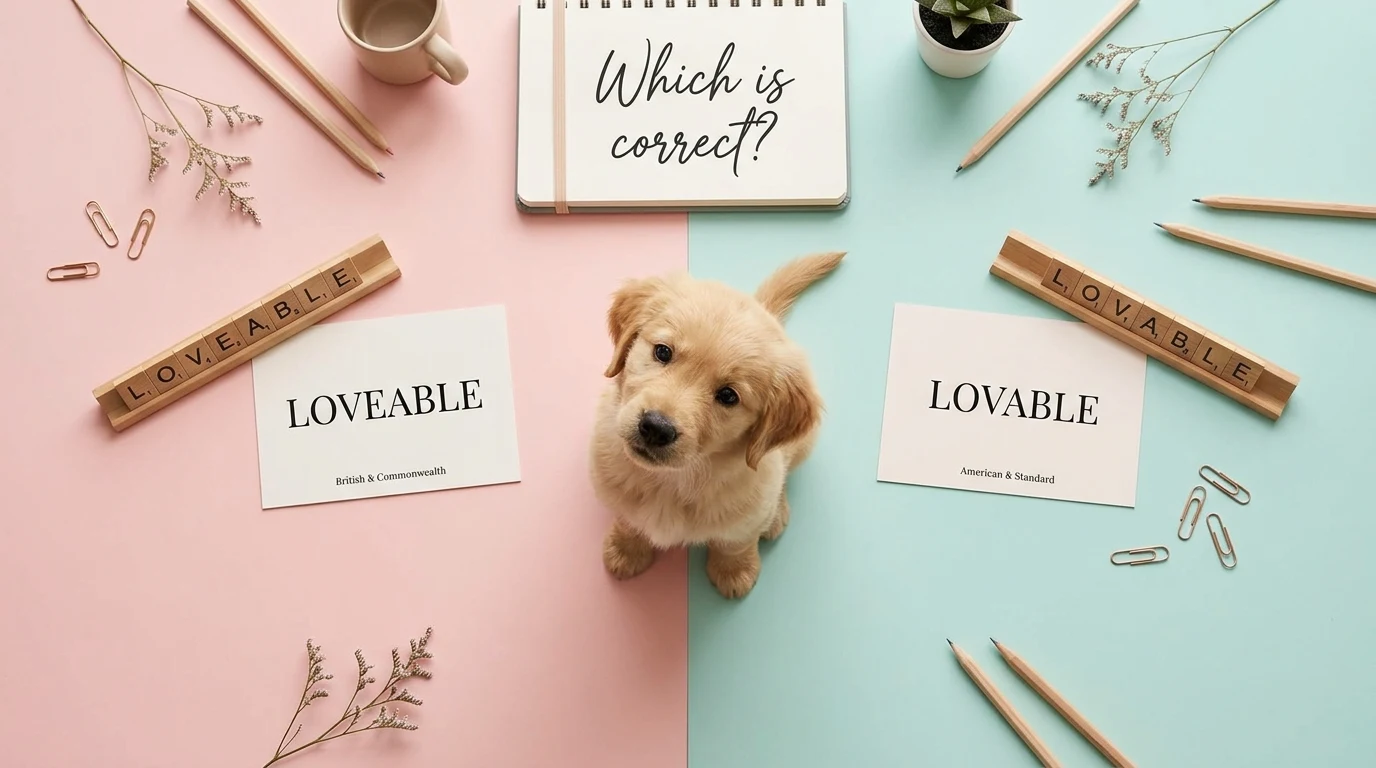
Loveable and lovable are both correct spellings of the same word. They mean “easy to love” or “worthy of love.” Lovable is the main spelling in American English, and it is the safest pick for any audience.
I still remember the birthday card. A student of mine, a sweet ten year old, wrote “You are the most loveable teacher ever” on it. I smiled. Then my red pen twitched.
Was it wrong? I wasn’t sure. I had taught English for more than ten years, and I froze for a second. So I did what any teacher does. I went and checked.
Here is what I found. The card was fine. But so is the other spelling. That is why you are here. You typed loveable or lovable into a search bar because you saw both and could not tell which one was right.
You are not alone. This pair trips up students, bloggers, copywriters, and even editors. The confusion comes from one tiny letter: the silent e.
In this guide, you will learn what each spelling means, where each one comes from, and which one to use in your own writing. You will also get cheat sheets, real examples, and answers to the questions people ask most. Let’s clear this up for good.
Loveable or Lovable: Quick Answer
Both spellings are correct. They are two forms of one word.
Lovable drops the silent e from “love” before adding “able.” Loveable keeps it. That is the whole difference.
Here are two simple examples:
- Your puppy is so lovable that strangers stop to pet him.
- The loveable old shopkeeper always gave kids a free sweet.
Both sentences are correct. Neither one has a different meaning. If you want one rule to remember, use this: pick lovable unless you have a reason to pick loveable.
What the word actually means
Lovable describes a person, pet, or thing that is easy to love. It points to charm, warmth, and a kind nature. A lovable person makes others feel good.
You can use it for babies, grandparents, cartoon characters, and clumsy best friends. It is a gentle, friendly word.
The Origin and Background of Loveable and Lovable
The word is old. It goes back to Middle English, the form of English used many hundreds of years ago. English speakers built it by joining two parts: the verb love and the ending able.
The ending “able” means “can be” or “worthy of.” So lovable means “can be loved” or “worthy of being loved.” Simple.
Why two spellings exist
English has a habit. When you add “able” to a word that ends in a silent e, you often drop that e. Look at these:
- Move becomes movable
- Use becomes usable
- Love becomes lovable
- Excuse becomes excusable
The e disappears because “able” starts with a vowel. Two vowels back to back look messy, so writers cut one.
But English never plays fair. Some writers kept the e. They felt it showed the root word more clearly. They wanted readers to see “love” sitting right there inside the word. So loveable was born.
Why the confusion lasts
Spelling in English was not fixed for a long time. People wrote what looked right to them. Later, dictionary makers stepped in and chose favorites. In America, lovable won. In Britain, both stayed in use, and loveable never really went away.
That is why you still see both spellings today. Neither one is a mistake. One is simply more popular.
Loveable or Lovable Explained: Key Differences and Variations
Let’s put the two spellings side by side. This table gives you the full picture in one glance.
| Term | Meaning | When to Use | Region or Context |
| Lovable | Easy to love, charming | Most writing, all audiences | Standard in American English, common in British English |
| Loveable | Easy to love, charming | Casual writing, British style pieces | Accepted in British English, seen in Canada and Australia |
| Lovably | In a way that is easy to love | Describing actions or behavior | Standard everywhere |
| Loveably | Same as lovably, with the e kept | Rare, matching a loveable style | Less common |
| Lovability | The quality of being lovable | Formal or descriptive writing | Standard everywhere |
Examples for each form
Short examples help the rule stick. Read them out loud.
- Lovable: The lovable giant of a dog slept on every guest’s feet.
- Loveable: She was a loveable mess, always late and always laughing.
- Lovably: He lovably forgot his own birthday again.
- Lovability: Her lovability came from how she listened.
The big idea behind the silent e
Here is a cheat sheet for the silent e rule. Keep it handy.
Cheat Sheet One: The Silent E Rule
- If a word ends in a silent e, you usually drop the e before adding “able.”
- Drop the e: love becomes lovable, move becomes movable, use becomes usable.
- Keep the e if it protects a soft sound. Notice becomes noticeable. Manage becomes manageable.
- When in doubt, check a dictionary. Many words allow both forms.
That third rule is why English feels tricky. The letter c in “notice” would turn hard without the e. So the e stays to keep the “s” sound. But in “love,” no sound is at risk. The e is free to go.
Other word pairs that work the same way
You may have seen these twins as well. Each pair has a main choice and an accepted option.
| Main Spelling | Accepted Variant | Notes |
| lovable | loveable | Lovable is more common |
| likable | likeable | Both widely used |
| sizable | sizeable | Both widely used |
| movable | moveable | Movable is more common |
| saleable | salable | Both seen, regional tastes differ |
| rateable | ratable | Rateable is common in British use |
Once you see this pattern, the confusion fades. Loveable and lovable are not special. They are one more pair in a long English tradition.
Which Version or Approach Should You Use?
You need a clear answer. So here it is. Match the spelling to your audience.
For American readers
Use lovable. American dictionaries list it first. It looks clean, and your readers will not blink at it.
For British, Canadian, or Australian readers
Use lovable or loveable. Both are fine. Many British writers lean toward loveable, because it feels warm and soft. Still, lovable is never wrong.
For a global or neutral audience
Use lovable. It is the safest choice. It works in every country, and no editor will flag it.
For students and exams
Use lovable. Teachers and test graders expect it. If your school uses British spelling rules, check your style guide. But lovable will rarely lose you a mark.
For brand names and creative writing
Use whatever fits your style. A children’s book can use loveable for charm. A brand can choose either one, as long as it stays consistent across every page.
The golden rule is consistency. Pick one spelling for your whole article, book, or website. Do not mix them.
Common Mistakes with Loveable and Lovable
Most errors come from guessing. Here are the mistakes I see most often, with the fix beside each one.
| Mistake | Correction | Why It Happens |
| Loveble | Lovable or loveable | The writer drops the wrong letters |
| Lovabel | Lovable | Letters get swapped when typing fast |
| Luvable | Lovable | Texting habits sneak into formal writing |
| Lovealbe | Lovable or loveable | The writer mixes up the order of the ending |
| Using both in one article | Choose one and keep it | The writer does not check for consistency |
Mistake one: thinking one spelling is wrong
This is the big one. Many people think loveable is a typo. It is not. Please do not “fix” it in someone else’s work unless their style guide says so.
Mistake two: mixing spellings
Imagine an article that says lovable in paragraph one and loveable in paragraph five. Readers notice. It feels sloppy. Search a document for both forms before you publish.
Mistake three: confusing it with “loving”
Loving describes someone who gives love. Lovable describes someone who earns it. A loving mother is kind to her kids. A lovable mother is easy for her kids to adore. The words are related, but they are not twins.
Mistake four: misspelling the ending
People often write “able” as “ible” or “abel.” Remember this: lovable ends with able, just like capable and reliable.
Why these errors happen
English spelling does not follow clean rules. We say words one way and write them another. Add a silent letter, and the brain gets nervous. Slow down, look at the ending, and say the word out loud in two parts: love plus able.
Loveable and Lovable in Real World Examples
Let’s see how the word behaves in real situations. Notice how the keyword feels natural in each one.
In a professional email
Hi Mark, thank you for hosting our team. Your dog was the most lovable part of the meeting. We hope to see him again soon.
In a news headline
Lovable Rescue Pup Becomes Fire Station Mascot
In a social media post
My grandma is the most loveable person on earth. She sends cookies and zero judgment. #blessed
In a formal report
Survey results suggest that the lovable traits of the main character, such as humor and kindness, raised audience trust by a wide margin.
In a book review
The author gives us a lovable villain, one we almost cheer for.
In a product description
Meet Bubbles, a soft and lovable plush bear made for bedtime hugs.
Look at how easy each one reads. The word does its job without any fuss. That is what you want from good spelling.
Loveable or Lovable: Data, Trends and Usage
People search this pair every day. The reason is simple: the two spellings look equally right, so readers want a referee.
Who searches for it
Students, bloggers, writers, and non native English speakers search for this the most. Readers in the United States, the United Kingdom, India, Pakistan, Australia, and Canada all show interest. Learners often check spellings online, so this topic travels well across the world.
Search intent
The intent here is informational. The reader wants a quick, trusted answer. They are not trying to buy something. They want to fix a sentence, finish an assignment, or settle a debate with a friend.
How the spellings compare in print
In books and news articles, lovable usually appears more often than loveable. That pattern holds in both American and British publishing. For a live look, you can use Google Trends or the Google Books Ngram Viewer. They let you compare the two spellings across years and countries.
Why this matters right now
Here is one fresh insight. Today, Lovable is also the name of a well known AI app building company. That has pushed many people to type the word into search engines. Some want the company. Others want the spelling. Writers should know the difference, because a brand name may use its own style, while everyday writing follows the dictionary.
Online writing also moves fast. Autocorrect, social media, and AI tools all influence how people spell. A clear guide like this one gives readers a calm place to land.
Standalone Comparison Table
Here is the full comparison in one place. Save it for later.
| Term or Variant | Meaning | Region or Context | Best Used When |
| Lovable | Easy to love or adore | American English, global use | You want the safest and most common choice |
| Loveable | Easy to love or adore | British, Canadian, Australian casual writing | Your audience prefers a softer, older look |
| Lovably | In an adorable way | Everywhere | You describe actions or habits |
| Lovability | The quality of being lovable | Everywhere | You write formal or descriptive text |
| Loving | Showing love to others | Everywhere | You describe someone who gives love |
| Adorable | Delightful, very cute | Everywhere | You want a stronger, cuter word |
Words that sit close to lovable
Sometimes, the best fix is a different word. Here are some friends of lovable you can swap in:
- Adorable: very cute, often used for babies and pets
- Endearing: wins your heart through small charms
- Charming: pleasant and attractive in manner
- Sweet: kind and gentle
- Cuddly: soft and nice to hug
- Winsome: attractive in a quiet, innocent way
Use these when “lovable” starts to repeat too often in your piece.
Cheat Sheet Two: The Fast Decision Guide
Print this or screenshot it. It will save you time.
Cheat Sheet Two: Which Spelling Do I Pick?
- Writing for America or the world? Lovable.
- Writing for British readers in a relaxed tone? Lovable or loveable.
- Sitting an exam or writing for school? Lovable.
- Writing a brand name? Follow the brand’s own spelling.
- Unsure about anything else? Lovable.
And a three step check before you hit publish:
- Search your text for “loveable.”
- Search your text for “lovable.”
- Keep only one of them.
Frequently Asked Questions
Q: What does loveable or lovable mean?
A: Both words mean easy to love or worthy of love. They describe a person, pet, or thing with a charming and kind nature. The meaning is the same for each spelling.
Q: How do you use lovable correctly in a sentence?
A: Place it before a noun or after a linking verb. For example, “She is a lovable child” or “That child is lovable.” Pair it with warm words like friendly, gentle, or goofy.
Q: Loveable vs lovable: what is the difference?
A: There is no difference in meaning. The only change is the silent e. Lovable drops it, and loveable keeps it. Lovable is more common worldwide.
Q: Is loveable acceptable in formal writing?
A: Yes, it is accepted, especially in British English. Still, lovable is the safer choice for formal work. It matches most dictionaries and style guides.
Q: Which version is correct, loveable or lovable?
A: Both are correct. Pick lovable if you want the main standard spelling. Pick loveable if your style guide or audience prefers it, and then stay consistent.
Q: Where does the word lovable come from?
A: It comes from Middle English. It joins the verb “love” with the ending “able,” which means “can be” or “worthy of.” That makes it “worthy of love.”
Q: Can lovable be used for objects, not just people?
A: Yes. You can call a cozy old sweater or a quirky little cafe lovable. The word works whenever something earns your affection. It is warm and flexible.
Conclusion
You now know the truth about loveable or lovable. Let’s wrap up the key points.
First, both spellings are correct. Second, lovable is the more common choice, especially in American English. Third, loveable is a fine option in British style writing, as long as you use it the same way every time. Fourth, the silent e rule explains the whole mystery. Most words drop it before “able,” and lovable follows that path.
My final advice is simple. Use lovable. It is clean, safe, and understood everywhere. If you ever want the softer look of loveable, go for it, but keep it consistent.
That little card from my student taught me something. A spelling question is never silly. It shows a writer who cares. And caring about words is how good writing begins.
So now you know exactly how to use this word. Bookmark this guide so you never second guess loveable or lovable again. And share it with a friend who is still wondering which one is right.
Read More: Elves or Elfs: The Complete Guide to the Right Plural

I’m Zain. Through Wordiums.com, I write clear, accurate word comparison guides that show the difference between similar words, spellings, and phrases, so readers can choose the right word in seconds.