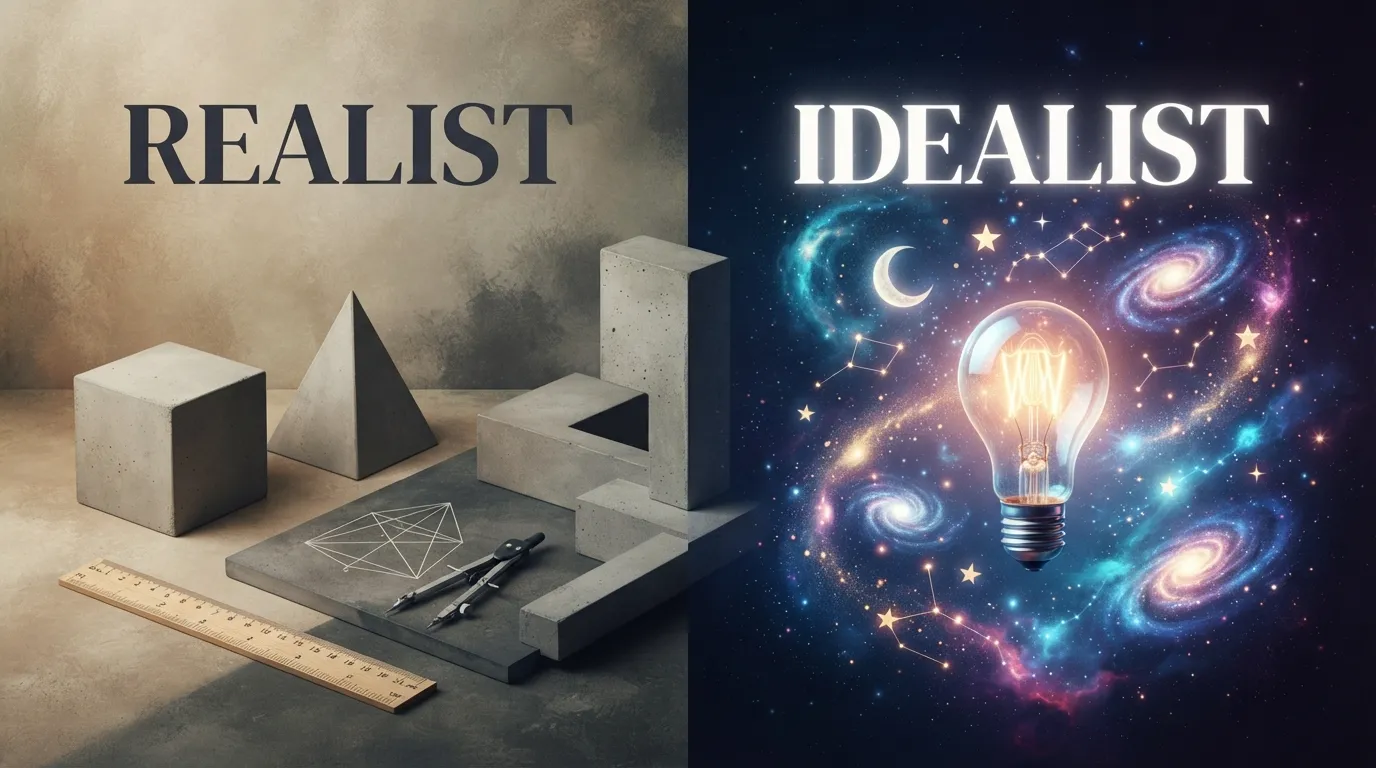
A realist focuses on facts and practical outcomes as they truly are, while an idealist focuses on how things could or should be, often guided by principles and hopeful vision.
During a college group project, one teammate kept insisting we could finish an ambitious plan in half the time everyone else predicted. Another teammate quietly built a backup schedule based on how these projects usually actually go. We finished late, exactly as the second teammate expected. That single experience taught me something important about people. Some of us naturally lean toward idealism, and some of us naturally lean toward realism, and neither approach is automatically right.
These two words get thrown around constantly in personality discussions, workplace debates, and even political conversations, yet many people use them loosely without understanding the real distinction. This article explains where each term came from, how they actually differ, and how to recognize which mindset fits a person, a plan, or a piece of writing. By the end, you will use realist and idealist with real precision.
Realist or Idealist, Quick Answer
A realist evaluates situations based on facts, evidence, and likely outcomes, often prioritizing what is achievable over what is preferred. An idealist evaluates situations based on principles, values, and a vision of how things ought to be, sometimes prioritizing meaning over immediate practicality.
For example, a realist manager might say a deadline is impossible based on team capacity, while an idealist manager might push forward anyway, believing motivation and effort can close the gap.
The Origin of Realist and Idealist
Realist comes from the Latin word res, meaning thing, combined with a suffix describing a person who focuses on that concept. Philosophical realism developed as a way of describing thinkers who believed external reality exists independently of human perception or belief.
Idealist comes from the Greek word idea, referring to form or essence, later shaped through Latin and philosophical traditions that argued reality is fundamentally connected to ideas, consciousness, or mental experience.
Both terms grew from serious philosophical movements before expanding into everyday language describing personality types and general outlooks on life.
Realist or Idealist, Key Differences and Mindsets
| Term | Meaning | When to Use | Region or Context |
| Realist | Focuses on facts, evidence, and practical outcomes | Describing pragmatic decision making or philosophical positions about objective reality | Common in psychology, business, and philosophy discussions |
| Idealist | Focuses on values, vision, and how things should be | Describing principle driven thinking or philosophical positions about mind dependent reality | Common in ethics, politics, and personal development writing |
A helpful example: in a debate about climate policy, a realist might argue for gradual, economically feasible changes, while an idealist might argue for immediate, sweeping reform regardless of short term cost.
Which Version Should You Use?
Use realist when describing someone or something grounded in evidence, practical constraints, or measurable outcomes, especially in business, strategy, or philosophical arguments about objective truth.
Use idealist when describing someone or something driven by principle, hope, or a vision of improvement, especially in ethics, leadership, or discussions about long term goals.
For balanced writing, remember that most people blend both traits depending on context, so avoid framing the two as strictly opposing personality categories without nuance.
Common Mistakes with Realist and Idealist
Mistake: Assuming realist always means pessimistic. Correction: Realism focuses on accuracy, not negativity. A realist can still expect positive outcomes if evidence supports them.
Mistake: Assuming idealist always means unrealistic or naive. Correction: Idealism focuses on values and vision, and many idealists achieve real, measurable change through persistence.
Mistake: Treating these terms as fixed personality labels. Correction: Most people shift between realist and idealist thinking depending on the situation, so avoid rigid labeling.
Mistake: Confusing philosophical idealism with everyday optimism. Correction: Philosophical idealism is a specific theory about the nature of reality, not simply a hopeful attitude.
Mistake: Using realist and cynic interchangeably. Correction: A realist relies on evidence, while a cynic assumes the worst regardless of evidence, which are different mindsets entirely.
Realist or Idealist in Real World Examples
Professional email: “As a realist, I want to flag that our current timeline does not account for supply chain delays.”
News headline: “Idealist Founders Push Ambitious Climate Startup Despite Investor Doubts.”
Social media post: “Some days I feel like a total idealist, other days a strict realist. Guess that’s just being human.”
Formal report: “The proposal reflects an idealist framework, prioritizing long term community benefit over short term cost savings.”
These examples show realist language tied closely to caution and evidence, while idealist language often connects to ambition, vision, and long term purpose.
Realist or Idealist, Data and Trends
Search interest in personality related terms like realist and idealist often rises alongside workplace culture discussions, self improvement content, and career advice searches. People frequently search these terms while exploring communication styles, decision making frameworks, and leadership approaches.
This matters for writers covering psychology, business strategy, or self development, since audiences often search these terms while trying to understand themselves or improve team dynamics.
Realist or Idealist Comparison Table
| Term or Variant | Meaning | Region or Context | Best Used When |
| Realist | Grounded in fact and practical outcomes | Business, philosophy, psychology | Describing evidence based thinking |
| Idealist | Guided by principle and vision | Ethics, politics, leadership development | Describing values based thinking |
Frequently Asked Questions
Q: What does realist mean compared to idealist? A: A realist focuses on facts and achievable outcomes, while an idealist focuses on values and how things could ideally become.
Q: How do you use realist and idealist correctly? A: Use realist to describe evidence based, practical thinking, and use idealist to describe vision driven, principle based thinking.
Q: Realist vs idealist, what is the real difference? A: The core difference lies in priority. Realists prioritize what is achievable now, while idealists prioritize what should be true eventually.
Q: Is idealist acceptable in professional writing? A: Yes, idealist is a standard, respected term often used to describe visionary leadership and long term strategic thinking.
Q: Which version is correct, realist or idealist? A: Both are correct and describe valid mindsets. Neither term is inherently better, since each fits different situations and goals.
Q: Where does the word idealist come from? A: Idealist comes from the Greek word idea, meaning form or essence, later developed through philosophical traditions focused on the mind and consciousness.
Q: Can someone be both a realist and an idealist? A: Yes, many people blend both mindsets, applying idealist vision to long term goals while using realist thinking for daily decisions.
Final Thoughts
Realist and idealist describe two different ways of approaching life, decisions, and problems. Realists ground themselves in facts and practical limits, while idealists focus on values and future possibility.
Neither approach is wrong on its own, and most people use a mix of both depending on the moment. Bookmark this guide so you always use realist and idealist accurately, and share it with someone who debates this exact topic often.
Read More: Silk or Satin: The Real Difference Explained

Hi, I’m Zara. Words that look almost identical but mean different things have always fascinated me, and that is what pulled me into writing about spelling and usage. Every guide gives you the answer first, then explains it clearly enough that you won’t need to look it up again.