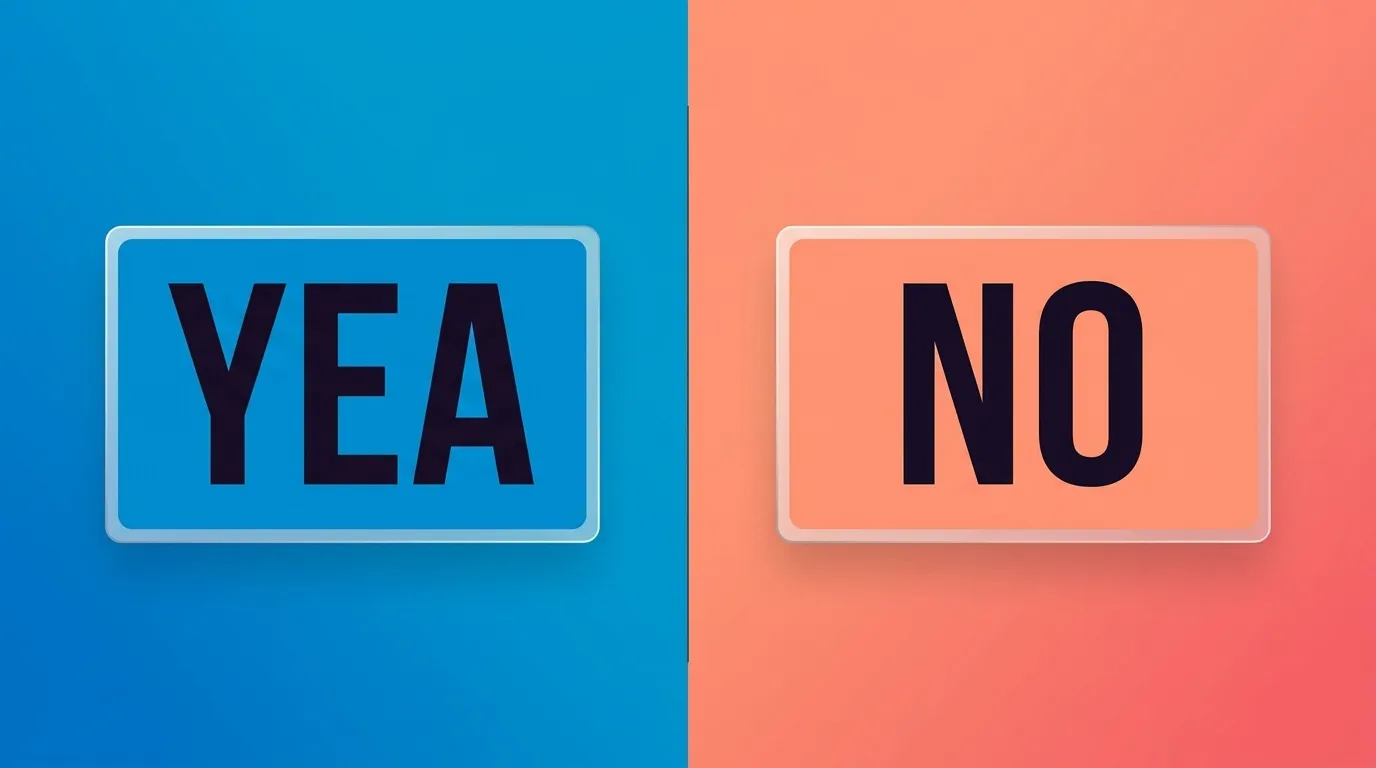
Yea is a formal way of saying yes, most often used in voting, while its true opposite is nay, not no. In everyday casual speech, people usually say yeah and no instead.
The Vote That Left Me Confused
I once sat in a community meeting where the chairperson called out, “All in favor, say yea.” A few people said yeah. A few people said yes. One person said no by mistake, thinking she was voting against something she actually supported. The room paused, and everyone laughed, but the confusion was real.
That small moment stuck with me. Three words that sound almost the same, yea, yeah, and yes, all crowd into the same space in our heads, and the true opposite of yea, which is nay, barely gets used outside of voting rooms and old movies.
If you have ever typed “yea or no” into a search bar, wondering which word actually belongs where, this guide will clear it up completely. You will get a simple breakdown, a printable cheat sheet, and a short quiz to lock the difference into memory for good.
Yea or No Quick Answer
Yea means yes, and it shows up mainly in formal voting, historical text, and traditional ceremonies. Its direct opposite is nay, which means no in that same formal context.
No is the everyday word for a negative answer, and its casual counterpart on the positive side is yeah, not yea.
Two quick examples:
- “The board members voted, and the yeas outnumbered the nays by a wide margin.” (formal voting)
- “Do you want pizza tonight?” “No, let’s order tacos instead.” (everyday conversation)
Notice how yea and nay travel together as a pair, while yeah and no travel together as a completely separate, more casual pair.
The Origin Behind Yea and No
Yea comes from Old English “gea,” an ancient affirmative word that has survived for over a thousand years, mostly inside formal and ceremonial language. It once served as the everyday word for yes, long before yeah or yep ever existed.
No traces back to Old English as well, from “na,” a straightforward negative that has stayed remarkably stable across centuries of language change.
The real twist in this story involves nay, another old affirmative style word borrowed from Old Norse, which became the true formal opposite of yea. Over time, casual speech drifted toward yeah and no, leaving yea and nay behind as somewhat old fashioned, formal leftovers used mainly in legislatures, courtrooms, and religious readings.
Yea or No Explained Key Differences
| Term | Meaning | When to Use | Region or Context |
|---|---|---|---|
| Yea | Formal yes | Voting, ceremonies, historical or poetic text | Used worldwide in formal and legislative settings |
| Nay | Formal no | Voting, ceremonies, historical or poetic text | Used worldwide in formal and legislative settings |
| Yeah | Casual yes | Everyday conversation, texting, informal writing | Used worldwide in casual speech |
| No | Everyday no | Everyday conversation, formal writing, most contexts | Used worldwide in nearly every setting |
A simple trick that works almost every time: if your sentence involves a formal vote or ceremony, reach for yea and nay together. If your sentence is everyday conversation, reach for yeah and no together, since these two pairs rarely mix.
Which Version Should You Use
Context decides everything here, far more than personal preference.
- For legislative writing, minutes, or ceremonies: Use yea and nay together as your voting pair, since this matches formal and legal tradition.
- For business emails and professional writing: Use yes and no, since yea and nay sound outdated outside voting contexts, and yeah feels too casual for most workplace writing.
- For texting, social media, or casual conversation: Use yeah and no, since these match how people naturally speak and write informally today.
- For students studying government or civics: Learn the yea and nay pairing specifically, since it appears constantly in descriptions of legislative votes and historical records.
Common Mistakes with Yea and No
- Mistake: “The vote ended with more yeas than nos.” Correction: “The vote ended with more yeas than nays.” Why it happens: writers know yea belongs to voting language, but forget that its true partner is nay, not no.
- Mistake: Using yea in casual texting, like “yea, I’ll be there at six.” Correction: “Yeah, I’ll be there at six.” Why it happens: yea and yeah look similar in writing, so writers grab the shorter spelling without noticing the missing h.
- Mistake: Assuming yea and yeah are simply two spellings of the same word. Correction: They are related but distinct, yea belongs to formal voting language, while yeah belongs to casual speech. Why it happens: both words sound almost identical out loud, blurring the line between them in a writer’s memory.
- Mistake: Writing “yea or nay” when the actual sentence is casual, not a formal vote. Correction: Use “yes or no” instead for everyday questions. Why it happens: writers sometimes borrow formal sounding phrases to add flair, without realizing the mismatch in tone.
- Mistake: Confusing the pronunciation, saying yea to rhyme with tea, when the intended word was actually yeah, which rhymes with the word bed. Why it happens: yea and yeah share nearly every letter, so speakers occasionally blend the pronunciation too.
Spot the Mistake Exercise
Read this sentence and find the error. “The committee counted twelve yeas and eight nos before closing the vote.” Did you catch it? The word nos should be nays, since yea always pairs with nay in formal voting language, never with no.
Yea and No in Real World Examples
A professional email: “Please confirm with a simple yes or no by end of day tomorrow.”
A news headline: “Senate Passes Bill After Yea and Nay Votes Are Finally Counted”
A social media post: “Yeah, I’m definitely coming to the concert this weekend, count me in.”
A formal document or report: “The board recorded seven yeas, two nays, and one abstention during the final vote.”
Yea and No Data Trends and Usage
Searches for “yea or no” spike heavily among students studying civics, government, or history, along with writers trying to describe formal voting scenes accurately. This search sits mostly in the informational category, since people want a clear explanation, not a product or service.
Interestingly, many searchers land on this topic while trying to write dialogue, scripts, or historical fiction, since voting scenes appear often in courtroom dramas and political stories. Getting the yea and nay pairing right adds authenticity to that kind of writing, while getting it wrong tends to stand out immediately to careful readers.
This topic matters right now because voice assistants and casual texting have pushed yeah and no into nearly every corner of digital communication, while yea and nay quietly survive only in formal, structured settings. That gap between casual and formal English keeps this word pair searched consistently, especially among students and writers working across both styles.
Standalone Comparison Table
| Term or Variant | Meaning | Region or Context | Best Used When |
|---|---|---|---|
| Yea | Formal yes | Legislative and ceremonial settings worldwide | Your sentence involves a formal vote or record |
| Nay | Formal no | Legislative and ceremonial settings worldwide | Your sentence involves a formal vote or record |
| Yeah | Casual yes | Everyday speech and informal writing worldwide | Your sentence is casual conversation or texting |
| No | Everyday no | Nearly every setting worldwide | Your sentence needs a plain, direct negative |
Quick Cheat Sheet You Can Save
Keep this short list nearby whenever you write:
- Formal vote or ceremony? Use yea and nay together.
- Everyday conversation or texting? Use yeah and no together.
- Never pair yea with no, since its true opposite is always nay.
- Yea rhymes with tea. Yeah rhymes with bed. Say both out loud if you feel unsure.
- Business writing usually prefers plain yes and no over yea, nay, or yeah.
- When in doubt, picture a courtroom or legislature for yea and nay, and picture a text message for yeah and no.
Print this list, save it as a note on your phone, or pin it above your desk. It turns a confusing word pair into a five second check.
Test Your Knowledge Yea or No Quiz
Try these five sentences. Pick the correct word from yea, nay, yeah, or no, then check your answers below.
- The council recorded nine ___ votes and three ___ votes on the new law.
- “Want to grab coffee later?” “___, sounds good to me.”
- “Are you coming to the party?” “___, I already have plans.”
- During the ceremony, the crowd shouted ___ in agreement with the announcement.
- The judge asked for a simple ___ or ___ answer from the witness.
Answers: 1 yea and nay, 2 yeah, 3 no, 4 yea, 5 yes and no
How did you score?
- Five correct: You have mastered this word pair completely.
- Three to four correct: Review the cheat sheet once more before your next project.
- Zero to two correct: Save the cheat sheet and try the quiz again tomorrow.
Frequently Asked Questions
Q: What does yea mean? A: Yea means yes, and it appears mainly in formal voting, ceremonies, and historical or poetic writing. It comes from Old English and has survived for over a thousand years in formal contexts.
Q: What is the actual opposite of yea? A: The true opposite of yea is nay, not no. Yea and nay travel together as a formal pair, especially in voting and legislative records.
Q: Yea vs yeah, what is the real difference? A: Yea is formal and tied to voting or ceremony, while yeah is casual and used constantly in everyday speech, texting, and informal writing. They sound similar but serve very different tones.
Q: Is yea acceptable in formal writing? A: Yes, yea is standard in formal writing, especially in legislative minutes, historical documents, and any text describing an official vote.
Q: Which version is correct in a business email, yea or yes? A: Yes is correct in a business email, since yea sounds outdated and overly formal outside of actual voting contexts.
Q: Where does the word nay come from? A: Nay comes from Old Norse, and it became the standard formal opposite of yea, especially in English voting traditions that continue today.
Q: Can yeah be used in professional writing? A: Generally no, yeah is too casual for most professional writing, and yes remains the safer, more polished choice in workplace emails and reports.
Final Thoughts
Yea and no are not actually a matching pair at all, and that single realization solves most of the confusion. Remember the core idea: yea pairs with nay in formal settings, while yeah pairs with no in everyday conversation. Match your word choice to your setting, and this pair will never trip you up again.
You now know exactly how to use yea, nay, yeah, and no with confidence. Bookmark this guide so you never second guess these words again, and share it with a friend or classmate studying government, writing, or public speaking.
See More: Which or That: The Complete Grammar Guide

Hi, I’m Zara. Words that look almost identical but mean completely different things have always fascinated me, that’s what pulled me toward writing about spelling and usage. I focus on digging into where these mix-ups actually come from, whether it’s a British-American split or just a rule English never bothered to make consistent. My goal with every guide is simple: give you the answer fast, then explain it well enough that you never have to look it up again.