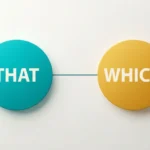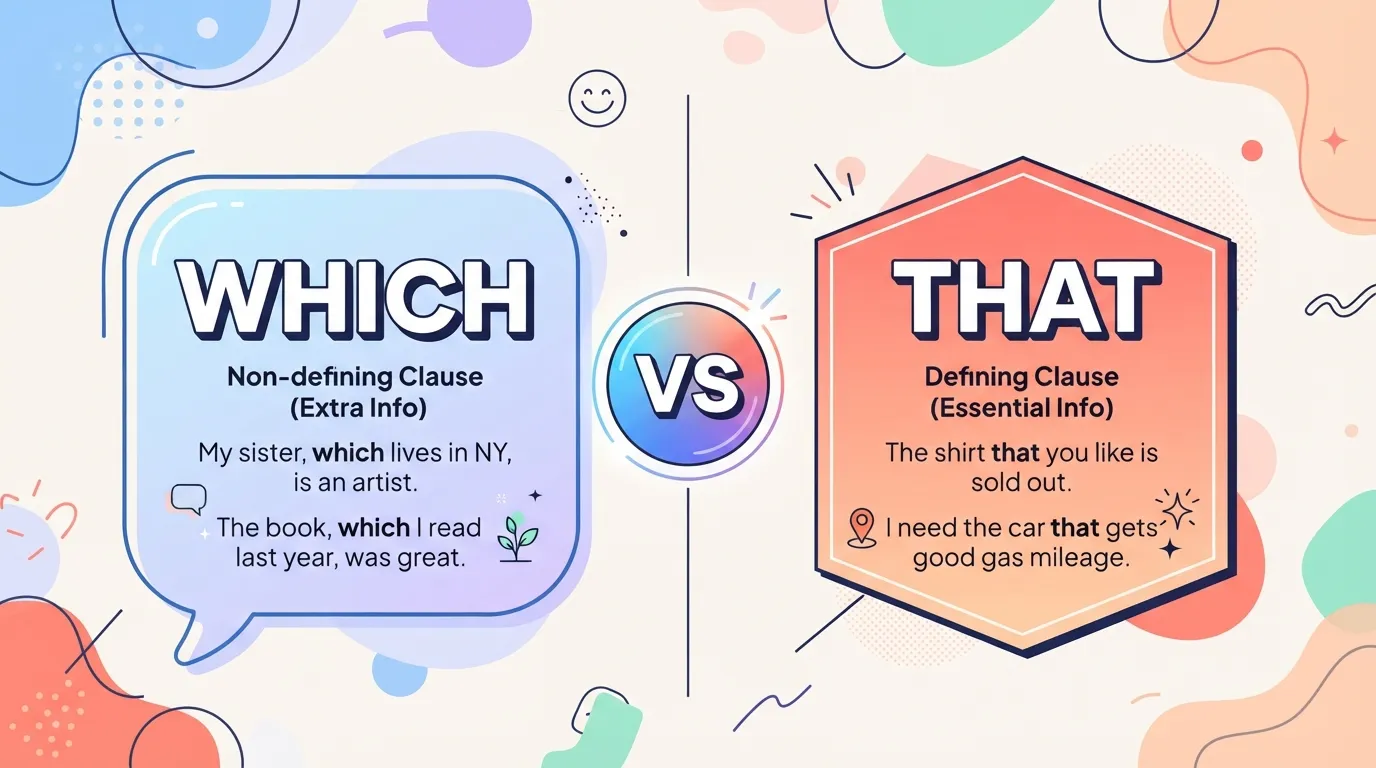
‘That’ introduces essential information needed to understand a sentence. ‘Which’ introduces extra, nonessential information and is usually set off by a comma.
The Red Pen Moment I Never Forgot
I once submitted an essay covered in red circles around every single “which.” My professor wrote one note at the top. “This sentence falls apart without this clause, so it needs that.” I stared at the page, completely lost.
At the time, I thought “which” and “that” were interchangeable. Most people do. They sound similar, they connect ideas in almost the same way, and spell check never flags either one.
The truth is, this small choice changes meaning. It tells your reader whether a detail is required or simply extra.
This guide breaks the rule down clearly, with real examples you can copy into your own writing today.
Let’s get into it.
Which or That, Quick Answer
That introduces a clause the sentence cannot live without. Remove it, and the meaning changes or breaks entirely.
Which introduces a clause the sentence can live without. Remove it, and the core meaning stays the same.
For example, “The car that has a dent is mine” tells you exactly which car, since there might be several. “My car, which has a dent, is parked outside” simply adds extra detail about one specific car already identified.
The Origin of Which and That
Both words trace back to Old English, though they developed along different paths.
That comes from the Old English word þæt, originally a demonstrative pronoun meaning “the one.” It pointed directly at something specific, a role it still plays today when it introduces essential information.
Which comes from hwilc, an Old English word closer in meaning to “what kind” or “of what sort.” It carried a slightly more descriptive, exploratory tone from the very beginning.
Over centuries, English speakers blurred the line between these two words in casual speech. Formal grammar rules, especially in American English, later drew a clearer boundary, separating essential clauses from extra, descriptive ones.
This is why the distinction feels stricter in edited writing than in everyday conversation. Style guides tightened a rule that spoken English never fully enforced.
Grammarians in the early twentieth century, including influential figures behind popular American style guides, pushed hard for this separation. They argued that clear writing depended on readers knowing instantly whether a clause was essential or extra.
British English never adopted the rule as strictly. Many British writers still use “which” for essential clauses, especially in casual or journalistic writing, which explains why readers sometimes feel unsure which rule actually applies to their own writing.
Which and That Explained, Key Differences
The core difference comes down to restrictive versus nonrestrictive clauses.
That introduces a restrictive clause. This clause limits or defines the noun it follows, and the sentence needs it to make sense.
Which introduces a nonrestrictive clause. This clause adds extra information, almost like a side note, and the sentence still works without it.
| Term | Meaning | When to Use | Region/Context |
| That | Introduces essential information | Restrictive clauses, no comma needed | Used worldwide, strict in American English |
| Which | Introduces extra information | Nonrestrictive clauses, comma required | Used worldwide, common in British English |
For example, “Books that are overdue must be returned” narrows the group down to only overdue books. “Books, which are wonderful, deserve more attention” simply adds a comment about books in general.
Which Version Should You Use?
For American English writers, follow the strict rule. Use that for essential clauses and which for extra, nonessential clauses set off by commas.
For British English writers, the rule relaxes slightly. Many British style guides accept which in essential clauses too, though following the American rule still reads as more precise.
For academic and professional writing, always follow the strict rule. It keeps sentences clear and avoids ambiguity in formal documents.
For casual writing or dialogue, some flexibility exists, since spoken English rarely enforces this distinction strictly.
For students preparing for grammar exams, treat this rule as a fixed test. Ask whether the clause could be deleted without changing the sentence’s core meaning, then choose the word based on that answer alone.
For editors reviewing submissions, flag every “which” without a preceding comma. This single check catches most restrictive clause errors before a piece goes to print.
Common Mistakes with Which and That
Mistake 1: Using “which” without a comma for essential information. Correction: Say “The book that changed my life,” not “The book which changed my life,” since the clause is essential here.
Mistake 2: Forgetting the comma before “which” in nonessential clauses. Correction: Say “My phone, which is brand new, already has a scratch,” always adding a comma before “which” in this context.
Mistake 3: Assuming “that” always sounds less formal. Correction: “That” is often the more precise, grammatically correct choice for essential clauses, even in formal writing.
Mistake 4: Overusing “which” to sound sophisticated. Correction: Choose the word based on meaning, not tone. Precision matters more than how formal a word sounds.
Mistake 5: Mixing British and American rules within the same document. Correction: Pick one style guide and apply the restrictive versus nonrestrictive rule consistently throughout.
Mistake 6: Using “that” to refer to people instead of “who.” Correction: Say “The employee who finished first,” not “The employee that finished first,” when the subject is a person.
Mistake 7: Placing a comma before “that” in essential clauses. Correction: Say “The house that sold quickly was renovated,” with no comma, since the clause is required to identify the house.
These slips rarely confuse a reader completely, but sharp editors and careful readers notice them right away. Fixing this one rule adds real polish to your writing.
Which and That in Real World Examples
Professional email: “Please review the report that covers last quarter’s sales figures before Friday.”
News headline: “New Policy, Which Takes Effect Monday, Impacts Thousands of Workers”
Social media post: “Just tried the recipe that everyone keeps talking about, and it did not disappoint.”
Formal document: “The clause that limits liability appears in Section 4, which also outlines payment terms.”
Each example shows how the correct word shifts meaning, narrowing information with “that” and adding extra detail with “which.”
Which and That, Data, Trends, and Usage
Searches comparing “which or that” spike heavily among students, editors, and content writers working on formal pieces.
Search intent here is mostly informational. People want a clear, applicable rule they can use immediately while proofreading or writing.
This distinction matters more now, since AI writing tools and grammar checkers do not always catch the difference correctly. Writers who understand this rule personally can catch mistakes that automated tools miss, keeping their work polished and precise.
Editors working across American and British audiences also search this topic often, since style expectations shift depending on the target readership. Understanding both conventions helps writers adapt their tone for different regions without sacrificing clarity.
Content marketers and SEO writers make up another growing share of this search traffic. Search engines reward clear, well structured sentences, and a misplaced “which” can quietly muddy an otherwise strong piece of content.
Legal and technical writers also rely heavily on this rule. A single misplaced comma before “which” can change how a contract clause gets interpreted, which makes this small grammar point far more important than it first appears.
Which vs That, Standalone Comparison
| Term/Variant | Meaning | Region/Context | Best Used When |
| That | Introduces essential, defining information | American English, strict rule | The clause is required to identify the noun |
| Which | Introduces extra, nonessential information | Worldwide, often paired with a comma | The clause adds detail but is not required |
| Who | Introduces clauses about people | Worldwide, used instead of that or which | The subject of the clause is a person |
| Whose | Shows possession within a clause | Worldwide, used for people or things | The clause describes ownership or belonging |
A Simple Way to Remember It
Picture a locked door. That is the key. Without it, you cannot open the sentence and reach its true meaning.
Which is more like a window you glance through on your way past. It shows you something interesting, but the door still opens just fine without it.
There is also a small trick worth remembering. If you can remove the clause and place it in parentheses without losing meaning, reach for “which.” If removing it breaks the sentence, reach for “that.”
The connotation of that feels direct and necessary, almost like a firm instruction. Which, on the other hand, feels more conversational and descriptive, adding color without changing the core message.
Frequently Asked Questions
Q: What does that mean in a sentence? A: That introduces a clause the sentence cannot live without, narrowing down exactly which person or thing is being described.
Q: How do you use which correctly? A: Use which to introduce extra, nonessential information, almost always separated from the main sentence with a comma.
Q: Which vs that, what’s the difference? A: That introduces essential, defining clauses with no comma. Which introduces extra, nonessential clauses that require a comma before them.
Q: Is which acceptable in formal writing? A: Yes, which is acceptable and common in formal writing, as long as it introduces nonessential information and includes a comma.
Q: Which version is correct, which or that? A: Both are correct, depending on the clause. Use that for essential information and which for extra, nonessential detail.
Q: Where does the confusion between which and that come from? A: It comes from overlapping historical usage in Old and Middle English, later separated by stricter modern style guides.
Q: Can which be used without a comma? A: In strict American English style, no. Which should almost always follow a comma when introducing a nonessential clause.
Final Thoughts
That carries the weight of necessity, defining exactly what a sentence means. Which adds extra color, offering detail the sentence could technically live without.
Picture the locked door and the passing window, and this rule will stick with you for good.
Now you know exactly how to use which or that, go try it in your next piece of writing.
Bookmark this guide so you never second guess which or that again, and share it with someone who could use the reminder.
See More: Yea or Yeah: The Simple Rule You Need to Know

Hey, I’m Ayeza. I started this site because I kept hitting the same wall over and over: typing a word, freezing, and not trusting my own instinct on the spelling. Now I research these mix-ups properly so you don’t have to, and I write every guide the way I wish these explanations had been written for me.