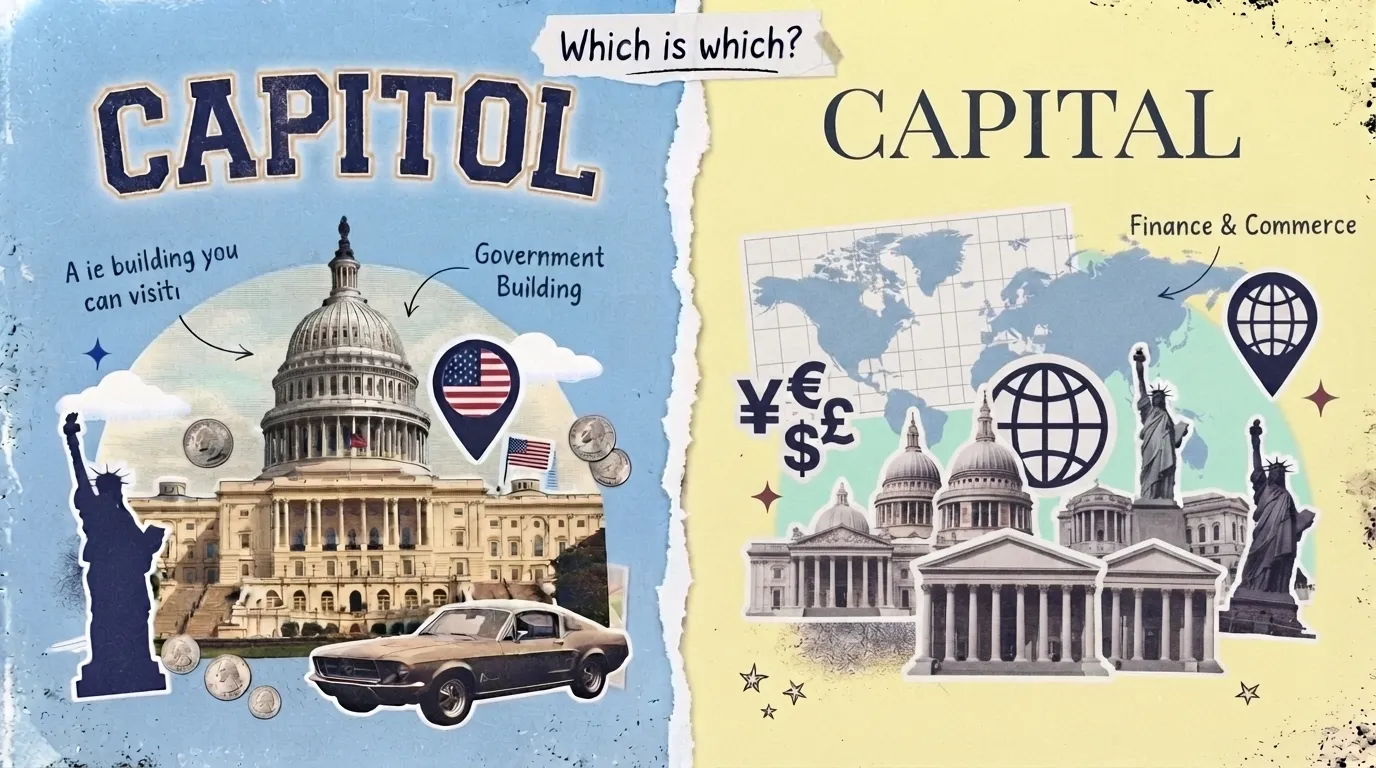
Capital refers to a city that serves as the seat of government, or to money and resources. Capitol refers specifically to the actual building where lawmakers meet. One letter changes the meaning completely.
I once wrote “the Capital building” in a college paper and got the entire sentence circled in red ink. My professor wrote one word next to it: “building?” That single comment taught me more about English spelling than an entire semester of lectures.
Here is why this mix up happens so often. Capital and capitol sound completely identical when spoken. Only the spelling separates a governing city from a physical building, and most people never learned the distinction clearly in school.
This guide fixes that gap for good. You will learn exactly which word applies in which situation, why the confusion exists in the first place, and a simple trick to lock in the correct spelling permanently. No more guessing, no more red pen corrections.
Let’s break down the difference clearly.
Capitol or Capital: Quick Answer
Capital has multiple meanings. It can refer to a city that functions as a seat of government, such as “Paris is the capital of France.” It can also mean financial resources, as in “the company raised capital for expansion.” It also refers to uppercase letters.
Capitol has one specific meaning. It refers to the actual building where a legislature meets, such as “Protesters gathered outside the Capitol building.”
Example one: “Washington DC is the capital of the United States.” Example two: “Senators debated the bill inside the Capitol.”
The Origin of Capital and Capitol
Capital comes from the Latin word “caput,” meaning “head.” This makes sense once you think about it, since a capital city acts as the head of a country’s government, much like a head sits at the top of the body directing everything below it. The same root gives us words like “capitalize” and “captain,” all connected to the idea of leadership or a top position.
Capitol traces back to a very specific place in ancient Rome: the Capitoline Hill, home to the Temple of Jupiter and the center of Roman religious and political life. When the founders of the United States designed their new government buildings, they borrowed this name directly, calling the legislative building “the Capitol” as a nod to Roman political tradition.
So these words share a Latin ancestor, sort of, but they branched off for very different reasons. One describes a role (the head city), while the other describes a specific historical reference (a Roman hill turned building name). That branching is exactly why native speakers still mix them up centuries later.
Capitol vs Capital: Key Differences
| Term | Meaning | When to Use | Region/Context |
| Capital | A city that serves as a seat of government, or money and financial resources | Naming a country’s or state’s government city, discussing finances, referring to uppercase letters | Universal, used in every English speaking country |
| Capitol | A specific government building where lawmakers meet | Referring to the physical structure housing a legislature | Most common in the United States, especially Washington DC and state capitols |
A simple memory trick: Capitol has an O, just like the dome on top of the actual Capitol building. Capital relates to almost everything else, cities, money, and letters.
Which Word Should You Use?
The right choice depends entirely on what you are describing.
For naming a city that hosts a government: use capital. Every country and state has one, and this word applies whether you are discussing Sacramento, Ottawa, or Tokyo.
For discussing money, business funding, or financial resources: use capital. Investors, business owners, and economists rely on this word constantly, as in “venture capital” or “capital investment.”
For referring to the actual physical building where lawmakers meet: use capitol. This word applies almost exclusively to legislative buildings, particularly in the United States, where each state has its own capitol building alongside the national one in Washington DC.
For global or neutral writing outside government contexts: capital covers nearly every use case, since capitol has such a narrow, specific meaning.
Common Mistakes with Capitol and Capital
Mistake: “Protesters marched to the Capital building.” Correction: “Protesters marched to the Capitol building.” Why it happens: Capital is simply the more commonly used word overall, so people default to it even when describing the physical structure.
Mistake: “Austin is the capitol of Texas.” Correction: “Austin is the capital of Texas.” Why it happens: Writers sometimes assume capitol applies to any government related noun, when it actually refers only to the building itself.
Mistake: “The company needs more capitol to grow.” Correction: “The company needs more capital to grow.” Why it happens: Financial contexts almost never involve the word capitol, but the visual similarity between the two words still trips people up.
Mistake: Capitalizing capitol or capital inconsistently when referring to specific buildings or cities. Correction: Capitalize “Capitol” when referring to a specific named building, like “the United States Capitol,” but keep it lowercase in general references, like “a state capitol building.” Why it happens: Proper noun rules feel inconsistent to many writers, especially with words that also function as common nouns.
Mistake: Using capital when referring to the actual physical structure in formal writing, such as legal or government documents. Correction: Always use capitol when the physical building is the specific subject of a sentence, since this distinction matters in official writing. Why it happens: Casual speech rarely distinguishes between the two, so the habit carries over into more formal writing without notice.
Capitol and Capital in Real World Examples
In a professional email: “Our meeting with state officials will take place at the capitol building next Tuesday.”
In a news headline: “Lawmakers Return to the Capitol as Budget Debate Continues”
In a social media post: “Visited the state capitol today. That dome is even more impressive in person.”
In a formal document or report: “The city of Springfield serves as the capital of Illinois, and its capitol building has stood since the late 1800s.”
Notice how the city or financial references always use capital, while the physical structure always uses capitol.
Capitol or Capital: Data and Usage Trends
Search demand for this comparison spikes noticeably during major political events, elections, protests, or news coverage involving government buildings. Students also search this term consistently, since it appears often in history, civics, and geography lessons.
Search intent is almost entirely informational, with people wanting a fast, clear answer rather than a deep grammatical breakdown. American audiences search this term far more than other English speaking regions, largely because the word capitol applies almost exclusively to United States government architecture.
This distinction matters more today than ever, especially given how often news coverage references government buildings by name. Getting this word right protects your credibility, whether you are writing a school paper, a news article, or a professional report.
Standalone Comparison Table
| Term/Variant | Meaning | Region/Context | Best Used When |
| Capital | Government city, financial resources, or uppercase letters | Universal, used worldwide | Naming a city, discussing money, referring to uppercase text |
| Capitol | Specific legislative building | Mostly United States | Referring to the physical structure where lawmakers meet |
| Capitole | Incorrect spelling | None | Never use this spelling |
| Capitel | Incorrect spelling | None | Never use this spelling |
Frequently Asked Questions
Q: What does capital actually mean? A: Capital most commonly refers to a city that serves as a seat of government. It can also mean financial resources or uppercase letters, depending on context.
Q: How do you use capitol correctly in a sentence? A: Use capitol only when referring to the actual building where a legislature meets, such as “The governor spoke inside the state capitol.”
Q: Capitol vs capital, what is the real difference? A: Capital refers broadly to government cities, money, or uppercase letters. Capitol refers narrowly and specifically to a legislative building.
Q: Is capitol acceptable in formal writing? A: Yes, and it is actually required in formal writing whenever you specifically mean the physical government building rather than the city itself.
Q: Which version is correct, capitol or capital, when naming a state’s main city? A: Capital is always correct for naming a state’s main city, since capitol refers only to the building, never the city itself.
Q: Where does the word capitol come from? A: It comes from the Capitoline Hill in ancient Rome, home to an important temple. American founders borrowed this name for the country’s legislative building.
Q: Can capitol be used outside of American government buildings? A: Rarely. The word is almost exclusively tied to United States legislative architecture, though some other countries occasionally borrow the term for similar buildings.
Final Thoughts
Here is what matters most. Capital covers government cities, financial resources, and uppercase letters. Capitol refers only to the physical building where lawmakers meet, most often in the United States.
The confusion exists because these words sound identical and share a distant Latin connection, even though they now serve completely different purposes. Once you remember that O for Capitol, O for the dome on top of the building, the correct spelling clicks into place automatically.
Next time you write about government cities or buildings, pause for a second and ask yourself which one you actually mean, the city or the structure. That question alone will guide you to the right word every time.
Bookmark this guide so you never second guess capitol or capital again. Share it with a friend who still mixes them up.
Read More: Woah or Whoa: The Correct Spelling Revealed

Hi, I’m Zara. Words that look almost identical but mean completely different things have always fascinated me, that’s what pulled me toward writing about spelling and usage. I focus on digging into where these mix-ups actually come from, whether it’s a British-American split or just a rule English never bothered to make consistent. My goal with every guide is simple: give you the answer fast, then explain it well enough that you never have to look it up again.