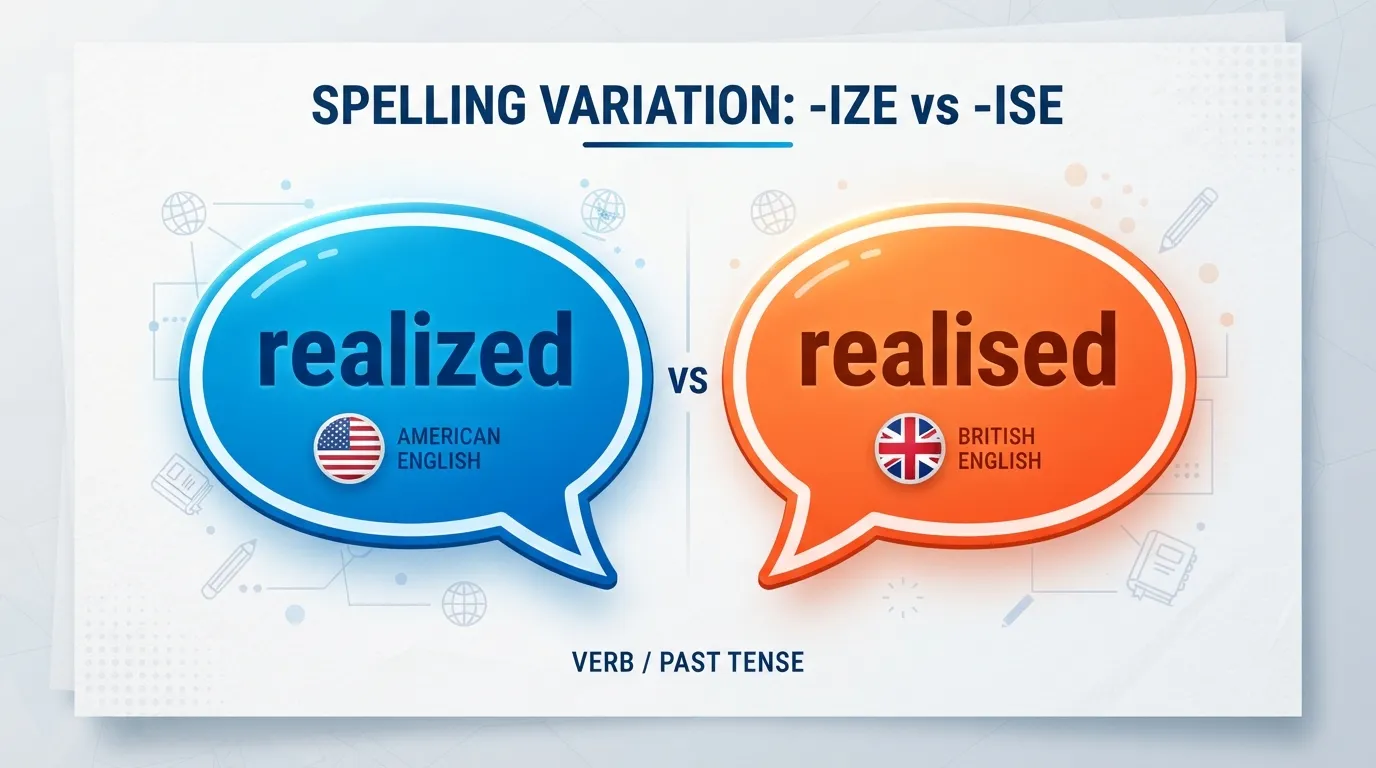
Realized is the American English spelling, while realised is the British English spelling. Both mean the exact same thing, becoming aware of something or making something happen, and the only real difference is which side of the ocean you are writing for.
I once sent a client in London a report using “realized” throughout. She emailed back asking if I had used the wrong software, since her whole team writes “realised.” Nothing was broken. I had simply written in American English for a British reader.
That one email taught me something most writers never think about. Spelling with a z or an s is not a mistake either way. It is a signal of which English you are writing in.
Millions of people search realized or realised every year, and most of them are not confused about meaning. They are confused about which one is correct for their audience, their employer, or their exam board.
This guide settles that question for good. You will learn exactly which spelling fits your writing, why both exist, and how to stay consistent no matter which one you choose.
Realized or Realised Cheat Sheet
Short on time? Use this before you write anything.
| Your Situation | Use This Spelling |
|---|---|
| Writing for US readers | Realized |
| Writing for UK, Australian, or most Commonwealth readers | Realised |
| Writing a school essay in the US | Realized |
| Writing a school essay in the UK | Realised |
| Posting on a global social media account | Either, but stay consistent |
| Writing for a UK based company with US clients | Follow the style guide, not personal preference |
| Unsure who your reader is | Realized, since it is the more common spelling worldwide online |
Realized or Realised Quick Answer
Realized uses a z because American English generally prefers the Latin influenced ize ending for verbs like this one.
Realised uses an s because British English adopted the French influenced ise ending for the same group of verbs.
Example in US style: “She realized the meeting had already started.” Example in UK style: “She realised the meeting had already started.” Same sentence, same meaning, only the spelling shifts.
Why Two Spellings Exist for the Same Word
The z spelling is actually older than most people assume. Many British dictionaries, including the Oxford English Dictionary, still list realize as an acceptable, historically rooted spelling, since it comes from the Greek ending izo through Latin.
The s spelling grew popular in Britain more recently, largely through the influence of French spelling patterns and printing house preferences during the 1800s and 1900s.
American English standardized around the z spelling partly because of Noah Webster, who pushed for simpler, more phonetic spelling in his early dictionaries. He favored realize, along with other z spellings, to create a cleaner, more American identity for the language.
Britain never fully agreed on one version. Some UK publishers, including Oxford University Press, still use realize internally, which is why you may spot both spellings even within British writing.
Realized or Realised Explained: Key Differences
The core difference is regional, not grammatical. Both spellings are verbs, both follow the same tense rules, and both carry identical meaning.
| Term | Meaning | When to Use | Region or Context |
|---|---|---|---|
| Realized | Became aware of, or made something happen | American English, global business, informal international writing | United States, Canada in casual use |
| Realised | Became aware of, or made something happen | British English, formal UK writing, most Commonwealth countries | United Kingdom, Australia, India, South Africa |
Canada sits in an interesting middle ground. Canadian English often mixes both, though realized appears more frequently in everyday and business writing.
Which Version Should You Use?
For American readers, use realized. It matches every major US style guide, including AP and Chicago.
For British readers, use realised. It matches Oxford style in most modern British publishing, along with newspapers like The Guardian and BBC content.
For Australian and New Zealand readers, realised is standard, following British spelling conventions taught in schools.
For international business writing, pick one spelling based on your company’s primary market, then stay consistent across every document.
Also, for academic writing, follow your institution’s required style guide rather than personal habit, since universities often specify British or American spelling explicitly.
And For social media and blogs with a global audience, realized tends to reach a slightly wider readership online, simply because American platforms and algorithms are so dominant.
Common Mistakes with Realized or Realised
Mistake 1: Mixing both spellings in the same document. Correction: Choose one spelling at the start and use a find and replace check before publishing.
Mistake 2: Assuming British English never uses the z spelling. Correction: Oxford style guides still accept realize, so both appear in serious British writing.
Mistake 3: Believing one spelling is more “correct” than the other. Correction: Neither spelling is wrong. Correctness depends entirely on regional context.
Mistake 4: Letting autocorrect silently switch your spelling mid document. Correction: Set your word processor’s language and region settings before you start writing, not after.
Mistake 5: Using realised in an American college essay because it looks more formal. Correction: US academic style always expects realized, regardless of how formal the writing feels.
Mistake 6: Forgetting that related words follow the same pattern. Correction: Words like organize or organise, and recognize or recognise, follow the identical regional rule as realized or realised.
Realized or Realised in Real World Examples
In a:
US news headline: “Company Realized Major Growth After Product Launch.”
UK news headline: “Firm Realised Significant Growth Following Product Launch.”
American professional email: “I realized the deadline had moved up after checking the calendar.”
British professional email: “I realised the deadline had moved up after checking the calendar.”
Social media caption aimed at a global audience: “Sometimes you realize the best plans happen by accident.”
Each example carries the exact same meaning. Only the audience changes the spelling choice.
Realized or Realised: Data, Trends, and Usage
Search interest for realized or realised spikes heavily among students, writers, and non native English speakers trying to confirm which version fits their assignment or workplace.
American search volume for realized is significantly higher worldwide, largely because of the sheer size of the US internet audience and American style dominance in global publishing software.
British, Australian, and South Asian search volume shows stronger interest in realised, matching regional schooling and media standards.
This search falls firmly into the informational category. Readers want a fast, confident answer, not a long grammar lecture.
One trend worth noting right now is that global companies increasingly default to American spelling in software interfaces and documentation, which is quietly pushing realized into wider daily use even among British writers who grew up using realised.
Frequently Asked Questions
Q: What does realized mean? A: Realized means becoming aware of something, or successfully making something happen. It is the American English spelling of the word.
Q: How do you use realised correctly in a sentence? A: Use realised the same way you would use realized, since the meaning is identical. Example: “She realised her mistake too late.”
Q: Realized vs realised, what is the real difference? A: The only difference is region. Realized is American English, and realised is British English, both sharing the same meaning and grammar rules.
Q: Is realised acceptable in formal writing? A: Yes, realised is the standard, expected spelling in formal British, Australian, and most Commonwealth writing.
Q: Which version is correct, realized or realised, for a US college paper? A: Realized is correct for US academic writing, since American style guides consistently expect the z spelling.
Q: Where does the z versus s spelling difference come from? A: It comes from historical influences, with American English favoring Latin and Greek rooted ize endings, and British English shifting toward French influenced ise endings over time.
Q: Can realized be used in British writing? A: Yes, since some British style guides, including Oxford style, still accept realize as a valid alternative to realised.
Final Thoughts
Realized and realised mean exactly the same thing, and neither spelling is more correct than the other. The real decision comes down to your audience, your region, and your required style guide.
Remember the simple rule. Use realized for American readers, and realised for British, Australian, and most Commonwealth readers. Whichever you pick, stay consistent throughout your writing.
Bookmark this guide so you never second guess realized or realised again, and share it with a colleague who keeps mixing the two.
See More: DoorDash or Uber Eats: Which Delivery App Is Right for You?

I’m Zain. I got interested in commonly confused words while helping non-native English speakers prep for writing exams, where a single misused word could cost real marks. That experience shaped how I write now: I try to explain not just which spelling is correct, but why the confusion exists in the first place, since understanding the reason is what actually makes it stick.