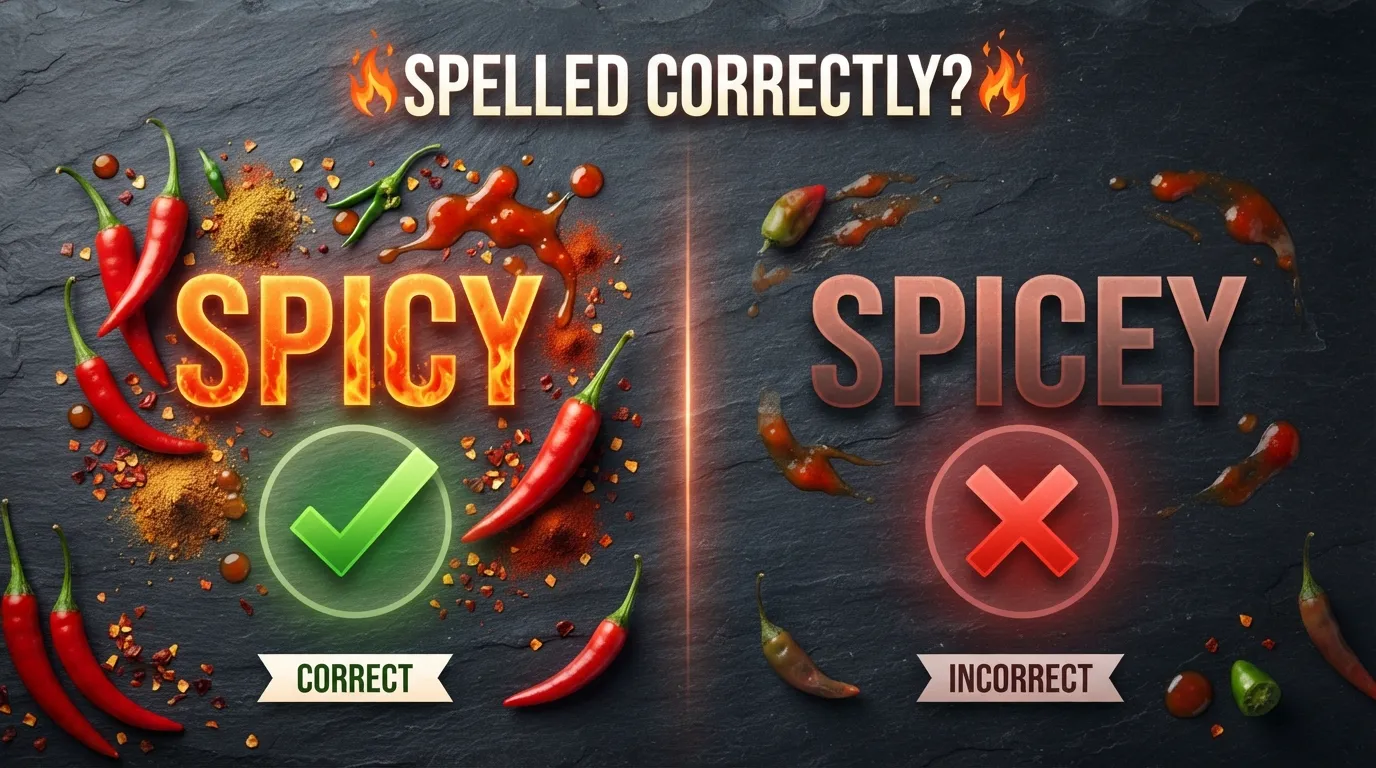
Spicy is the correct and standard spelling. Spicey is a common misspelling, though it appears often enough online that many people assume it is an acceptable alternative.
Last summer, I was helping a friend write the menu for her new food truck. She typed out “extra spicey sauce” on the specials board, stepped back, and looked at it for a long moment. Something felt slightly wrong, but she could not explain why. We stared at that chalkboard together for a solid minute before I finally said it out loud. It is spicy, not spicey.
She is not alone. This exact moment happens constantly, in restaurant menus, recipe blogs, and text messages about last night’s dinner. Spicy and spicey look almost identical, and the extra “e” feels harmless enough that most spell checkers barely blink at it in casual writing.
This guide clears up the confusion once and for all. You will learn why spicy is correct, why spicey keeps spreading anyway, and exactly how to use the word with total confidence in any kind of writing.
Spicey or Spicy: Quick Answer
Spicy is the only spelling recognized by every major English dictionary, including Merriam Webster, Oxford, and Cambridge. It describes food, flavors, or situations with a strong, often hot or intense quality.
Spicey shows up frequently in casual writing, social media captions, and even some restaurant menus, but it is not a standard or accepted spelling in formal English.
For example, “The curry was too spicy for my taste” is correct. “The curry was too spicey for my taste” would be flagged as an error in any edited publication or academic paper.
The Origin of Spicy
Spicy comes directly from the noun “spice,” which traces back to the Old French word “espice,” itself rooted in the Latin word “species,” originally referring to a type or kind of goods, often used for valuable trade items like pepper, cinnamon, and cloves.
English regularly forms adjectives by adding the suffix “y” directly to a noun, as seen in words like rain becoming rainy, or wind becoming windy. Spice simply follows this exact same pattern, becoming spicy without adding any extra letters in between.
The extra “e” in spicey likely spreads because of similar sounding words like “icy,” which some writers mentally connect to spice through sound rather than actual spelling logic. Icy already ends in “y” without an extra “e,” which actually supports the correct pattern for spicy, but the visual habit of adding “e” before certain suffixes in other words still trips people up.
Spicy Explained: Key Differences and Variations
There is only one standard modern spelling here, though understanding the surrounding vocabulary helps writers use the word with more precision and confidence.
Spicy describes food or flavors containing strong spices, often ones that create a hot or burning sensation, such as chili peppers. Example: “This salsa is extremely spicy.”
Spicey is simply an incorrect spelling. It does not appear in any recognized dictionary and should be avoided in all professional or academic writing.
Hot overlaps with spicy in casual speech, particularly in American English, though hot can also simply mean high in temperature, which creates occasional ambiguity that spicy does not have.
Fiery works as a stronger, more intense alternative, often used to describe extremely spicy food or, figuratively, a passionate personality or heated argument.
| Term | Meaning | When to Use | Region or Context |
| Spicy | Correct spelling, containing strong spice | All writing, formal and casual | Standard everywhere |
| Spicey | Common misspelling | Never | Not a valid word |
| Hot | Overlaps with spicy in casual speech | Informal conversation | Common in American English |
| Fiery | Stronger, more intense flavor or tone | Descriptive or emphatic writing | Standard everywhere |
Which Version Should You Use?
For food bloggers and recipe writers, spicy is essential. Search engines and readers both expect the correct spelling, and spicey can quietly hurt search visibility for recipe content.
For restaurant owners and menu writers, spicy signals professionalism and attention to detail, while spicey can look like a careless typo to customers reading closely.
For casual social media posts, spicy remains the safest choice, though the informal misspelling occasionally slips through without much consequence in low stakes captions.
And For students and professionals writing essays, reports, or emails, spicy is the only acceptable option, with no real exceptions in edited or graded writing.
Common Mistakes with Spicy
Mistake: “This soup is way too spicey for me.” Correction: “This soup is way too spicy for me.” Writers often add the extra “e” out of habit, influenced by similar looking words that do follow different spelling patterns.
Mistake: “We sell spicey chicken wings.” Correction: “We sell spicy chicken wings.” This mistake appears frequently on menus, where fast, informal writing skips careful proofreading.
Mistake: Assuming spicey is simply a British spelling variant. Correction: There is no regional variant. Spicy is standard in both American and British English.
Mistake: “Her spicey sense of humor caught everyone off guard.” Correction: “Her spicy sense of humor caught everyone off guard.” The figurative use of spicy, meaning bold or provocative, follows the exact same spelling rule as the literal food related meaning.
Mistake: Trusting autocorrect to catch the error automatically. Correction: Many autocorrect systems do not flag spicey as wrong, since it resembles other valid English spelling patterns closely enough to slip past automated checks.
Spicy in Real World Examples
Professional email: “Our new spicy chicken sandwich has become the top seller on the seasonal menu.”
News headline: “Local Chef Wins Award for Bold, Spicy Regional Cuisine”
Social media post: “Ordered the spicy ramen tonight and my mouth is still on fire, no regrets.”
Formal document: “Consumer surveys indicate a growing preference for spicy flavor profiles among younger demographics.”
Across every one of these examples, spicy fits naturally without ever needing an extra letter, whether the tone is playful, professional, or purely descriptive.
Spicy: Data, Trends and Usage
Searches for “spicey or spicy” remain consistently high year round, though they noticeably spike alongside seasonal food trends, spicy food challenges on social media, and new restaurant menu launches.
This search intent is almost entirely informational, driven by writers and home cooks who want spelling confirmation before publishing a recipe, menu, or review. A smaller portion of searches come from curiosity about the word’s origin rather than pure spelling confusion.
Food and lifestyle content creators search this term especially often, since a misspelled word in a recipe title or headline can quietly reduce how easily search engines match that content to what readers are actually looking for.
Comparison Table
| Term or Variant | Meaning | Region or Context | Best Used When |
| Spicy | Correct spelling, containing strong spice | Global standard | Any writing situation |
| Spicey | Common misspelling | Not applicable | Never, avoid entirely |
| Hot | Overlaps casually with spicy | Informal, American English | Casual food conversation |
| Fiery | Stronger, more intense version | Global standard | Emphatic or descriptive writing |
Frequently Asked Questions
Q: What does spicy mean? A: Spicy describes food or flavors containing strong spices, often producing a hot or burning sensation, and it can also describe something bold or provocative in a figurative sense.
Q: How do you use spicy correctly in a sentence? A: Place it directly before a noun, such as “spicy food,” or after a linking verb, such as “the dish is spicy.”
Q: Spicey vs spicy, what is the difference? A: Spicy is the only correct spelling. Spicey is simply a common misspelling with no dictionary support.
Q: Is spicy acceptable in formal writing? A: Yes, spicy is fully acceptable in formal writing, including food science reports, professional menus, and published articles.
Q: Which version is correct, spicey or spicy? A: Spicy is correct. Spicey should be avoided in professional, academic, or published writing of any kind.
Q: Where does spicy come from? A: It comes from the noun spice, itself rooted in the Latin word species, combined with the standard English adjective suffix y.
Q: Can spicy be used to describe something other than food? A: Yes, spicy often describes bold personalities, provocative content, or heated situations in a figurative rather than literal sense.
Conclusion
Spicy is the correct spelling, and spicey is a mistake, plain and simple, no matter how often it appears in casual writing online. The word follows a completely regular English spelling pattern, forming an adjective from the noun spice by simply adding the letter y. Whether you are writing a recipe, a menu, a review, or a casual caption, spicy is always the safe, correct, professional choice. Understanding where the word comes from makes the correct spelling much easier to remember than relying on guesswork or habit.
Now you know exactly how to use spicy correctly. Bookmark this guide so you never second guess it again, and share it with anyone who still types spicey without realizing the mistake.
Read More: Tomatoes vs Tomatos: Fixing the Plural Everyone Gets Wrong

My name is Ayesha Sadiqah, the writer behind this website. I write in-depth articles on English spelling, word comparisons, grammar, and vocabulary to help learners make better language choices. Every guide is carefully researched and designed to provide accurate, practical, and easy-to-understand information.