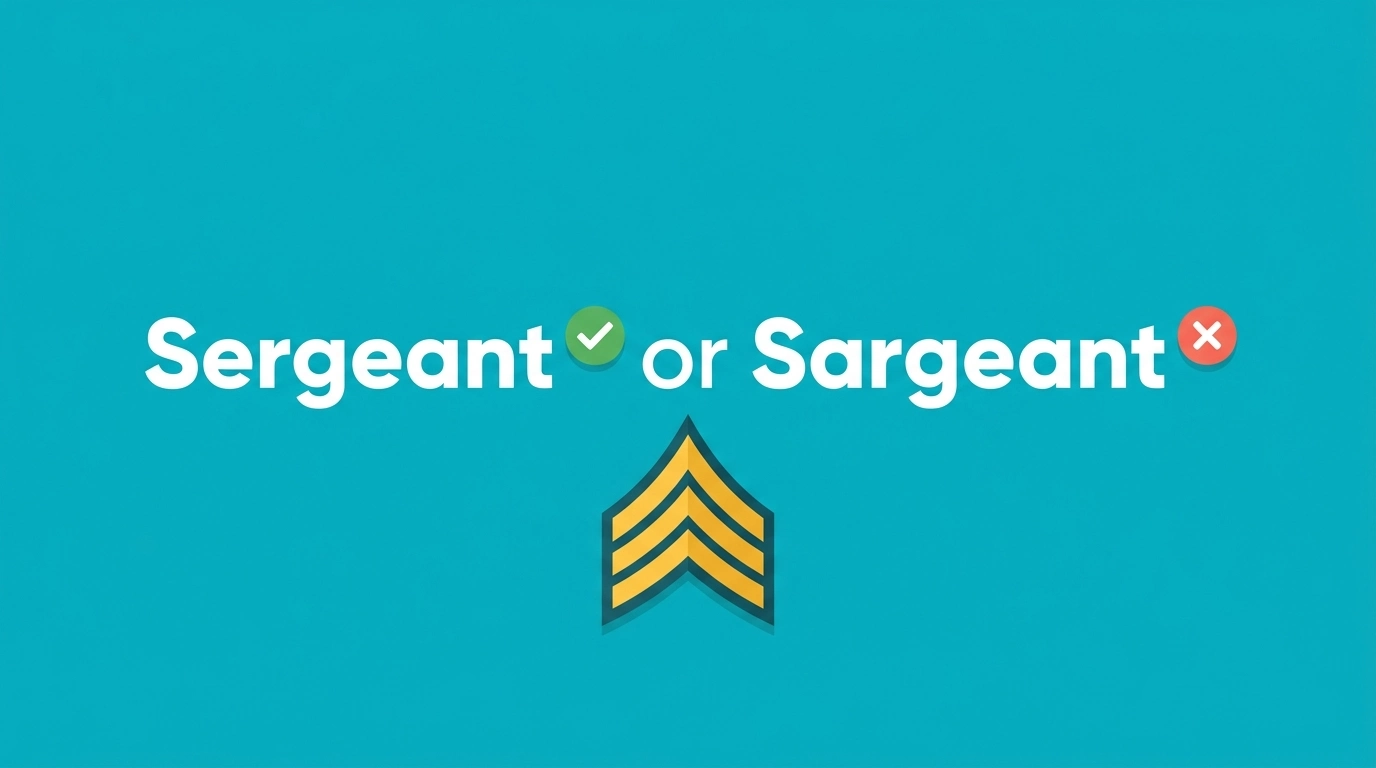
- ✅ Sergeant is the correct spelling of the rank.
- ❌ Sargeant is a common misspelling, written the way the word sounds.
- 🗣️ Say it “SAR jent,” but spell it with “ser.”
- 🧠 Memory trick: think of servant, because both words come from the idea of serving.
- 📛 Sargent is a real surname, not the rank, so copy a person’s name exactly as they spell it.
My uncle served in the army for twenty years. When I was small, I made him a card. On the front I proudly printed, “To my favorite Sargeant.” He framed it anyway.
Years later, I became an English teacher. A student handed me an essay about her grandfather, a police officer. Every single time, she had written “sargeant.” I knew why. I had made the same mistake.
Here is the trap. You hear “sar.” You write “sar.” But English hides an old secret inside this word.
You searched sergeant or sargeant because you needed to be sure. Here you will get a clear answer, the reason behind it, and simple tricks to remember it.
Sergeant or Sargeant: Quick Answer
Only one is correct. Sergeant is the right spelling, and every dictionary uses it. Sargeant is an error that appears because the first syllable sounds like “sar.”
Two simple examples:
- The sergeant gave clear orders before sunrise.
- Our neighbor is a police sergeant in the city.
One rule covers it: say “sar,” but write “ser.”
Names are the exception. Sargent is a well known surname, as in the painter John Singer Sargent. Always copy a person’s name exactly as they spell it.
The Origin and Background of Sergeant
The word comes from Old French sergent. Its root is a Latin idea meaning “to serve,” which makes sergeant a close cousin of servant. Long ago, a sergeant was simply someone who served a lord. Later the word came to mean a trusted soldier or a police supervisor.
Why we say “sar” but write “ser”
About five hundred years ago, many English speakers began saying “er” as “ar” in some words. Some words changed their spelling to match. Others, like sergeant, kept the old spelling while the sound moved on.
You can hear the same split in other words:
- Clerk is said “clark” in British English.
- Derby is said “darby” in Britain.
The spelling shows the old word. The sound shows the new one. That gap is why “sargeant” feels natural.
Sergeant or Sargeant Explained: Key Differences and Variations
| Term | Meaning | When to Use | Region or Context |
| Sergeant | A rank in armies and police forces | All writing about the rank | Worldwide |
| Sargeant | Not a rank, an error | Only if a person spells their name so | Names only |
| Sargent | A surname | Only for a person or place with that name | Names, such as Sargent the painter |
| Serjeant | Older or ceremonial spelling | Some UK legal and ceremonial titles | Formal UK usage |
| Sgt. | Short form | Lists and military style writing | Military and police documents |
What a sergeant is today
A sergeant is usually a noncommissioned officer, a leader who rose through the enlisted ranks to train and supervise others.
- In the US Army and Marine Corps, Sergeant is pay grade E5.
- In the US Space Force, E5 is also called Sergeant. Junior members there are called specialists.
- In the US Air Force, the matching E5 rank is Staff Sergeant.
- In police forces, a sergeant supervises officers and ranks above a constable.
Rank charts change, so check the current one for the service you cover.
Which Version Should You Use?
Use sergeant every time you mean the rank.
- Students and teachers: use sergeant. Teachers mark sargeant as an error.
- Journalists and bloggers: use sergeant, or Sgt. before a name in headlines.
- Military and police writing: follow the force’s style. Capitalize it before a name, as in Sergeant Lee.
- Fiction: use sergeant in narration and Sarge only in dialogue.
- Global or neutral use: sergeant. No editor will question it.
Common Mistakes with Sergeant
| Mistake | Correction | Why It Happens |
| Sargeant | Sergeant | The first syllable sounds like “sar” |
| Sargent | Sergeant | Mixed up with the surname |
| Sergent | Sergeant | The writer drops the a, like the French form |
| Sergant | Sergeant | The e after g gets lost in fast typing |
Most of these come from spelling by ear. When the sound seems off, trust the dictionary. Watch the surname trap too, because a spellchecker may not flag Sargent.
Sergeant in Real World Examples
In a professional email
Dear Chief Adams, Sergeant Rivera has completed the training report and attached it for your review.
In a news headline
Veteran Sergeant Honored for Twenty Years of Service
In a social media post
Proud of my dad, a retired sergeant. Thank you for everything you taught me. #veterans
In a formal report
The unit was commanded by a staff sergeant, who reported directly to the platoon leader.
Sergeant or Sargeant: Data, Trends and Usage
People search this pair because the sound and the spelling disagree. Students, writers, military families, and new police recruits all look it up. Readers in the United States, the United Kingdom, Canada, Australia, India, and Pakistan often check rank titles.
The intent is informational. The reader wants a fast answer before they publish or submit something.
Why does it matter now? Many people write from voice notes and autocorrect, and tools can miss a surname like Sargent. A wrong rank looks careless in official writing.
Standalone Comparison Table
| Term or Variant | Meaning | Region or Context | Best Used When |
| Sergeant | Noncommissioned officer or police supervisor | Worldwide | You mean the rank |
| Sargeant | A misspelling of the rank | None | Never for the rank |
| Sargent | A surname | Names and places | You write about a person with that name |
| Sgt. | Abbreviation | Military, police, news | You need a short form before a name |
Cheat Sheet One: Which Spelling Do I Pick?
- Writing about the rank? Sergeant.
- Need a short form? Sgt.
- Writing a nickname in dialogue? Sarge.
- Writing a last name? Copy the person’s spelling.
- Unsure? Sergeant.
Cheat Sheet Two: Memory Tricks
- Think servant. Both words start with “ser” because both come from the idea of serving.
- Say it, then spell it. Say “SAR jent.” Then spell it “ser, gea, nt.”
- Keep the e. The soft g sound comes from “ge.”
- Check names. A surname keeps its owner’s spelling.
Frequently Asked Questions
Q: What does sergeant mean?
A: A sergeant is a rank held by a leader in an army, marine corps, space force, or police force. It often marks a noncommissioned officer who trains and supervises others.
Q: How do you use sergeant correctly?
A: Write it in full in sentences. Capitalize it before a name, as in Sergeant Lee. Use Sgt. in lists and short notes.
Q: Sergeant vs sargent: what is the difference?
A: Sergeant is the rank. Sargent is mostly a surname. They sound the same but are not interchangeable.
Q: Is sargeant acceptable in formal writing?
A: No. It is a spelling error for the rank. Use sergeant in all formal work.
Q: Which version is correct, sergeant or sargeant?
A: Sergeant is correct. Sargeant appears only as a rare surname spelling.
Q: Where does sergeant come from?
A: It comes from Old French sergent, which grew from a Latin root meaning to serve. That makes it a relative of servant.
Q: Can sergeant be used outside the military?
A: Yes. Police forces use it, and so do civic titles such as sergeant at arms.
Conclusion
You now know the truth about sergeant or sargeant. Sergeant is the only correct spelling for the rank. Sargeant is a mistake that comes from spelling by sound. The odd mix of “ser” in writing and “sar” in speech is about five hundred years old. And Sargent is a surname, so do not swap it in for the rank.
My advice is simple. Say “sar,” write “ser.” Think of servant, and the spelling will stay with you.
Bookmark this guide so you never second guess sergeant or sargeant again. And share it with a friend who still writes it the old way.
Read More: Elves or Elfs: The Complete Guide to the Right Plural

I’m Zain. Through Wordiums.com, I write clear, accurate word comparison guides that show the difference between similar words, spellings, and phrases, so readers can choose the right word in seconds.