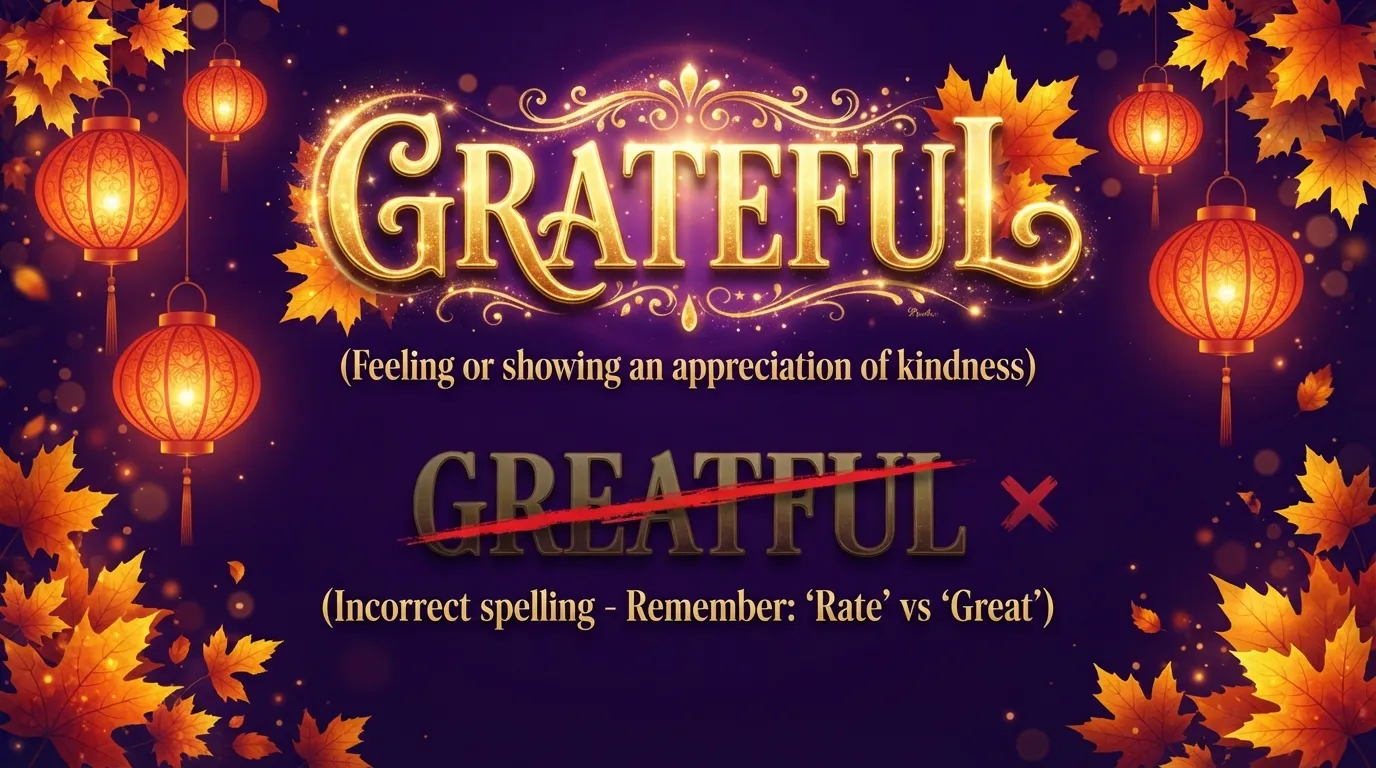
Grateful is the only correct spelling. Greatful is a common misspelling that does not exist in standard English dictionaries, even though it looks logical to many writers.
I still remember the exact moment I got caught out by this word. I was proofreading a friend’s thank you card before she sent it to her boss, and there it sat in the second line: “I am so greatful for this opportunity.” It looked completely normal at first glance. My eyes almost skipped right past it. Then something felt off, and I paused.
That tiny pause is exactly why so many people search for this word every single day. Grateful and greatful look like they should both be valid. One seems to come from “great,” and the other seems to come from some older root nobody quite remembers. The confusion is real, and it is more common than most people admit, even among strong writers.
This guide settles the question for good. You will learn why grateful is correct, why greatful keeps showing up anyway, and how to make sure you never second guess yourself again in an email, an essay, or a heartfelt note.
Grateful or Greatful: Quick Answer
Grateful is the standard, dictionary approved spelling used in every form of English writing, from casual texts to formal reports. It means feeling or showing appreciation for something.
Greatful is not a recognized word. It shows up because writers connect the idea of gratitude to the word “great,” assuming the spelling should follow that pattern.
Here is a simple example. “She was grateful for her team’s support” is correct. “She was greatful for her team’s support” would be marked as a spelling error in any professional or academic setting.
The Origin of Grateful
Grateful comes from the Latin word “gratus,” meaning pleasing or thankful. English absorbed this root centuries ago, and it later combined with the suffix “ful,” meaning full of. Put those pieces together, and you get a word that literally means full of thankfulness.
This is actually where the confusion begins. Many English speakers assume “grateful” must be built from “great,” since both words look similar and both carry a positive feeling. But there is no historical link between them. Great comes from an entirely separate Old English root related to size and importance, not gratitude.
Once you know the real origin, the spelling starts to make more sense. Grateful was never meant to carry an extra “e” from great. It was built from gratus, and that single letter difference is the whole story behind this common mistake.
Grateful Explained: Key Differences and Variations
There really is only one correct modern spelling here, but it helps to understand exactly why the incorrect version feels so tempting.
Grateful is the standard adjective form, used to describe a person who feels thankful. Example: “He felt grateful after the surgery went well.”
Greatful is a spelling error, not a regional variant or an older form. It does not appear in Merriam Webster, Oxford, Cambridge, or any other major dictionary.
Gratitude is the noun form of the same idea, used when you want to talk about the feeling itself rather than describe a person. Example: “Her gratitude was obvious in every word of the letter.”
Some writers also confuse grateful with related words like thankful or appreciative. These are close in meaning but not identical in tone. Thankful often feels slightly more casual, while grateful tends to carry a bit more emotional weight, especially in formal writing.
| Term | Meaning | When to Use | Region or Context |
| Grateful | Feeling thankful | All writing, formal and casual | Standard everywhere |
| Greatful | Misspelling | Never | Not a valid word |
| Gratitude | The feeling itself, as a noun | Reflective or formal writing | Standard everywhere |
| Thankful | Feeling thankful, slightly lighter tone | Casual speech and writing | Common in everyday English |
Which Version Should You Use?
For students, always use grateful. Teachers and grading systems will mark greatful as a spelling mistake every time, with no exceptions.
For professionals writing emails, reports, or cover letters, grateful is the only safe option. A single misspelling like greatful can quietly damage your credibility in a job application or client message.
For casual writers and social media users, grateful still remains correct, though thankful can work as a slightly more relaxed alternative depending on tone.
For non native English speakers, memorizing grateful as a fixed spelling is easier than trying to reason it out through logic, since the connection to “great” is misleading rather than helpful.
Common Mistakes with Grateful
Mistake: “I am so greatful for your help.” Correction: “I am so grateful for your help.” This happens because writers mentally link gratitude to greatness, assuming the spelling should match.
Mistake: “She wrote a greatful message to her mentor.” Correction: “She wrote a grateful message to her mentor.” The extra letter slips in because “great” is such a common, familiar word that autocorrect and muscle memory both work against you.
Mistake: “We are greatful for this opportunity.” Correction: “We are grateful for this opportunity.” This one appears often in job applications and cover letters, where a small spelling slip can look careless to a hiring manager.
Mistake: Confusing grateful with gratefull, adding a double L at the end. Correction: Grateful only ever takes one L. This mistake often comes from confusion with British spelling patterns in other words, even though grateful does not follow that pattern.
Mistake: Using greatful in formal documents without spell check catching it. Correction: Always run a spell check, since many writers do not notice the error visually, even after reading the sentence twice.
Grateful in Real World Examples
Professional email: “I am truly grateful for the time you took to review my proposal this week.”
News headline: “Community Grateful After Local Firefighters Save Historic Building”
Social media post: “Feeling so grateful today for my family, my health, and this beautiful weather.”
Formal document: “The board expresses its sincere gratitude to all volunteers who contributed to this year’s fundraising campaign.”
Notice how grateful adapts smoothly to every tone, from a casual social post to a formal board statement, without ever needing to change its spelling.
Grateful: Data, Trends and Usage
Searches for “grateful or greatful” spike consistently throughout the year, with noticeable increases around Thanksgiving in the United States and during graduation season, when students write thank you notes and speeches.
This search intent is almost entirely informational. People are not shopping or comparing products. They are trying to confirm correct spelling before sending an important message, which means accuracy matters more here than almost anywhere else in casual writing.
English learners in particular search this term often, since many languages do not have a direct one to one word for the specific emotional weight that grateful carries in English. That search pattern explains why clear, simple explanations matter so much for this topic.
Comparison Table
| Term or Variant | Meaning | Region or Context | Best Used When |
| Grateful | Correct spelling, feeling thankful | Global standard | Any writing situation |
| Greatful | Common misspelling | Not applicable | Never, avoid entirely |
| Gratitude | Noun form of the feeling | Global standard | Reflective or formal tone |
| Thankful | Similar meaning, lighter tone | Global standard | Casual conversation |
Frequently Asked Questions
Q: What does grateful mean? A: Grateful describes a person who feels thankful or appreciative for something they received, experienced, or were given.
Q: How do you use grateful correctly in a sentence? A: Place it after a form of the verb “to be,” such as “I am grateful,” or use it before a noun, such as “a grateful heart.”
Q: Grateful vs greatful, what is the difference? A: Grateful is the only correct spelling. Greatful is simply a mistake, with no dictionary support anywhere in standard English.
Q: Is grateful acceptable in formal writing? A: Yes, grateful is fully acceptable and even preferred in formal writing, including business letters, academic papers, and official statements.
Q: Which version is correct, grateful or greatful? A: Grateful is correct. Greatful should never appear in any professional, academic, or published writing.
Q: Where does grateful come from? A: It comes from the Latin word gratus, meaning pleasing or thankful, combined with the English suffix ful, meaning full of.
Q: Can grateful be used in casual texting or messaging? A: Yes, grateful works perfectly in casual messages, though shorter alternatives like thanks or thankful sometimes fit a quick text better.
Conclusion
Grateful is the correct spelling, every single time, in every context you will ever write in. Greatful is a misspelling built on a false connection to the word great, not a real variant you need to worry about. Understanding the Latin root behind grateful makes the correct spelling far easier to remember than trying to guess based on how the word sounds. Whether you are writing a thank you card, a cover letter, or a quick social media caption, grateful will always be the safe, correct choice.
Now you know exactly how to use grateful. Bookmark this guide so you never second guess this word again, and share it with a friend who has been quietly typing greatful for years.
Read More: Tomatoes vs Tomatos: Fixing the Plural Everyone Gets Wrong

I’m Zain. I got interested in commonly confused words while helping non-native English speakers prep for writing exams, where a single misused word could cost real marks. That experience shaped how I write now: I try to explain not just which spelling is correct, but why the confusion exists in the first place, since understanding the reason is what actually makes it stick.