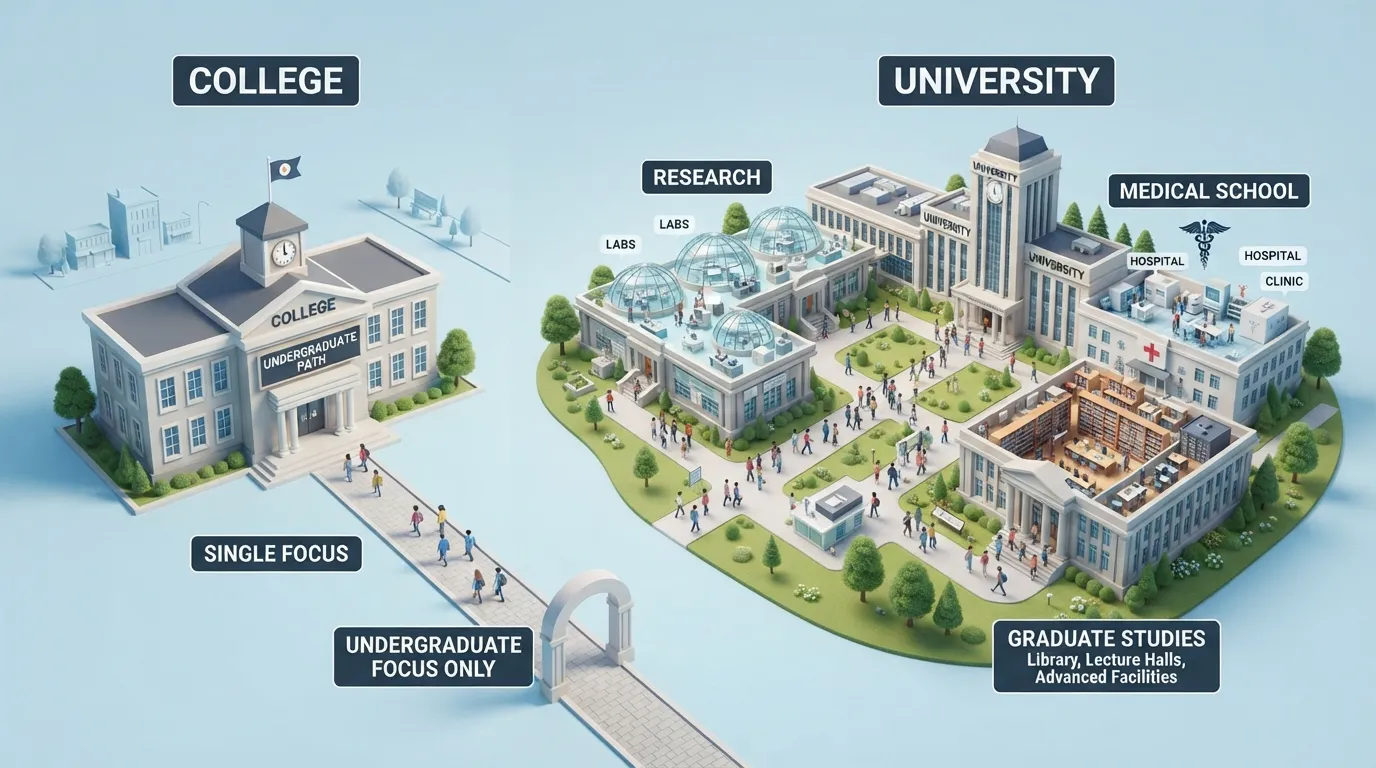
College and university both mean a place of higher education, but a university offers full degree programs including graduate study, while a college often refers to a smaller school, a specific division within a university, or in some countries, a school for teenagers before university level.
I still remember the confusion on my student’s face when she asked me, “Am I going to college or university next year?” She had been accepted into a four year program at a large institution with multiple schools inside it, yet everyone around her used the two words like they meant the exact same thing. That single question turned into a full lesson, because the truth is, college and university do not always mean the same thing, and the difference changes depending on where you live.
If you have ever felt unsure about which word fits your situation, you are not alone. Students, parents, and even professionals mix these terms up constantly, especially when talking to people from another country. This guide will walk you through exactly what each word means, where the confusion comes from, and which one you should use depending on your audience and location. By the end, you will never have to pause and wonder again.
College or University Quick Answer
In simple terms, a university is a large institution that offers both undergraduate and graduate degrees, often across many fields of study. A college can mean several things depending on the country. In the United States, people often use college as a general word for any higher education institution, including universities. In the United Kingdom, Canada, and several other countries, a college is usually a separate and smaller institution, often focused on vocational training or the years before university.
For example, an American student might say “I’m going to college” even if they are attending a full university. A British student, on the other hand, would say “I’m going to university” because college there often refers to something different, like a sixth form college for younger students.
The Origin and Background of College and University
Both words come from Latin roots, but they developed differently over time. University comes from the Latin word universitas, which referred to a whole community or guild of teachers and scholars. This is why universities were historically built around the idea of a complete community of learning, covering many subjects under one roof.
College comes from the Latin word collegium, which meant a group of colleagues or a society bound by a common purpose. Early colleges were smaller communities, often attached to a larger university, where students lived and studied together in a more intimate setting.
This history explains a lot about today’s confusion. In places like the United Kingdom, colleges kept their original identity as smaller units within or alongside a university. In the United States, the word college gradually became a casual, catchall term for any higher education, which is why Americans often use it loosely, even for large universities.
College or University Explained: Key Differences and Variations
The core difference lies in size, structure, and what each institution can offer.
A university typically includes several colleges or schools inside it. For example, a single university might have a college of engineering, a college of business, and a college of arts and sciences, all operating under one university name. This is why you might hear someone say “college of medicine” even though the overall institution is a university.
A standalone college, especially outside the United States, usually offers a narrower range of programs. Community colleges in the United States and Canada, for instance, often provide two year associate degrees or vocational certificates rather than full four year degrees.
| Term | Meaning | When to Use | Region or Context |
| University | Large institution offering undergraduate and graduate degrees across many fields | When referring to full degree granting institutions | Used globally, especially in UK, Canada, Australia |
| College | Casual term for higher education, or a smaller specific institution | When referring to general higher education informally, or vocational schools | Common in US as general term, distinct meaning in UK and Canada |
| Community College | Two year institution offering associate degrees or certificates | When referring to shorter, affordable programs | Mostly used in the US and Canada |
| Sixth Form College | School for students aged sixteen to eighteen preparing for university | When referring to pre university education | Used mainly in the UK |
Notice how the same word can point to very different experiences depending on where the conversation is happening. This is exactly why context matters so much.
Which Version Should You Use?
The right word depends heavily on your audience and location.
For American readers or casual conversation, college works well as a general term. Saying “I’m applying to college” is perfectly normal even when talking about a large research university.
For British, Irish, Australian, or Canadian audiences, university is the safer and more accurate word when referring to a full degree granting institution. Using college there might confuse people, since it often implies something smaller or aimed at younger students.
For academic or formal writing, especially international content, university tends to be the clearer choice, since it avoids ambiguity across different English speaking countries.
For content aimed at a global audience, such as blog posts, articles, or marketing copy, consider using university as your primary term and mentioning college as an alternative, so readers from different backgrounds understand you clearly.
Common Mistakes with College and University
Mistake 1: Using college and university interchangeably in formal international writing. Correction: Use university when referring to full degree granting institutions in a global context, and reserve college for its specific regional meaning.
Mistake 2: Assuming college always means a lower level of education. Correction: In the United States, elite institutions like Boston College or Dartmouth College are full universities in practice, despite having college in their name.
Mistake 3: Forgetting that college can mean something entirely different outside the US. Correction: Always clarify your audience’s country before assuming which meaning applies.
Mistake 4: Writing “university degree” and “college degree” as if they always mean the same level of achievement. Correction: Check whether the source refers to a two year associate degree from a community college or a four year bachelor’s degree from a university, since these are not equal in scope.
Mistake 5: Overusing one term throughout an entire article without adjusting for regional readers. Correction: Vary your phrasing and clarify meaning where needed, especially in SEO content meant for a worldwide audience.
College and University in Real World Examples
In a professional email: “I am pleased to share that I recently graduated from the University of Manchester with a degree in economics.”
Also In a news headline: “Local college expands vocational training programs to meet rising demand.”
Then In a social media post: “Officially a college freshman! So excited to start this new chapter.”
In a formal document or report: “Applicants must hold a bachelor’s degree from an accredited university or equivalent institution.”
Each example shows how naturally the word choice shifts depending on tone, region, and purpose, without ever feeling forced.
College or University: Data, Trends, and Usage
Search data consistently shows that people search for both terms heavily, often comparing tuition costs, admission requirements, and program length. Students in the United States frequently search “community college vs university,” trying to decide the most affordable path toward a degree.
Meanwhile, international students search “university” far more often than “college,” since most non US education systems use university as the standard term for higher education.
This topic falls mostly under informational search intent, meaning most searchers want a clear explanation rather than a product or service. However, there is also a strong commercial angle, since many searches lead directly into decisions about where to apply and enroll.
This distinction matters now more than ever, as international education continues to grow and students frequently apply to schools outside their home country, where terminology can create real confusion during the admissions process.
College vs University Comparison Table
| Term or Variant | Meaning | Region or Context | Best Used When |
| College | General higher education or smaller specific school | United States casually, UK and Canada specifically | Referring to two year programs, sixth form, or informal US usage |
| University | Full degree granting institution with undergraduate and graduate programs | Global, especially UK, Australia, Canada | Referring to formal, complete higher education |
Frequently Asked Questions
Q: What does college mean? A: College generally refers to an institution of higher education. In the United States it is often used casually for any school offering degrees, while in other countries it usually means a smaller or more specific type of school.
Q: How do you use university correctly? A: Use university when referring to a large institution offering both undergraduate and graduate degrees across multiple fields of study, especially in formal or international writing.
Q: College vs university, what’s the difference? A: The main difference is scope and structure. Universities usually offer a full range of degrees and include multiple colleges within them, while a standalone college often focuses on a narrower set of programs.
Q: Is college acceptable in formal writing? A: Yes, but only when it fits the context clearly. In American formal writing, college is widely accepted. In international or British formal writing, university is usually the more precise choice.
Q: Which version is correct, college or university? A: Neither is universally correct or incorrect. The right word depends on your country, your audience, and the specific institution you are describing.
Q: Where does the word university come from? A: University comes from the Latin word universitas, meaning a whole community of teachers and scholars, reflecting its broad, multi subject structure.
Q: Can college be used to describe a division within a university? A: Yes, many universities are organized into colleges, such as a college of engineering or a college of arts, all operating under the larger university name.
A Closer Look at Regional Differences
Understanding the regional split makes this whole topic much easier to remember. In the United States, the word college often carries a warm, familiar tone. People talk about “college life,” “college football,” and “college friends,” even when the school in question is technically a large research university. This casual habit has become part of everyday American culture, so much so that even university administrators use college and university interchangeably in everyday speech.
In the United Kingdom, the picture looks quite different. University refers to institutions that grant full undergraduate and postgraduate degrees, such as Oxford, Cambridge, or the University of Leeds. College, meanwhile, usually points to something else entirely. A sixth form college prepares students aged sixteen to eighteen for university entrance exams. Some historic universities, like Oxford and Cambridge, are also organized into individual colleges, which adds another layer of meaning that can confuse newcomers.
Canada sits somewhere in between. Canadian colleges typically offer diplomas, certificates, and applied programs, while universities grant full bachelor’s, master’s, and doctoral degrees. Many Canadian students choose a college pathway first, then transfer credits into a university program later, which shows how the two systems often work together rather than competing.
Australia follows a pattern closer to the UK. University clearly refers to full degree granting institutions, while college often describes vocational education providers, private training schools, or in some cases, a residential hall attached to a university campus.
Why This Confusion Matters for International Students
For students planning to study abroad, this small vocabulary difference can carry real consequences. Imagine an international student who searches only for “college” while researching study options in Australia. They might overlook major universities entirely, simply because the word did not match what they expected to find. The opposite can happen too, where a student searching only for “university” in the United States misses valuable community college pathways that could save them significant tuition costs before transferring into a four year school.
Education counselors and university websites increasingly acknowledge this gap by explaining both terms clearly on admissions pages. If you are creating content, advising students, or simply trying to communicate clearly, taking a moment to define your terms early can prevent unnecessary confusion later in the conversation.
Final Thoughts
College and university are close cousins, not identical twins. Understanding their differences helps you communicate clearly no matter who you are talking to. If you are writing for an American audience, college often works fine as a general term. If your readers come from the UK, Canada, or Australia, university tends to be the safer, clearer choice.
The next time you write about higher education, think about your audience first. Choose the word that matches their expectations, and your message will land exactly the way you intend.
Bookmark this guide so you never second guess college or university again, and share it with anyone who has ever felt puzzled by these two familiar words.
Read More: Kilogram vs Pound: Never Get Confused Again

My name is Ayesha Sadiqah, the writer behind this website. I write in-depth articles on English spelling, word comparisons, grammar, and vocabulary to help learners make better language choices. Every guide is carefully researched and designed to provide accurate, practical, and easy-to-understand information.