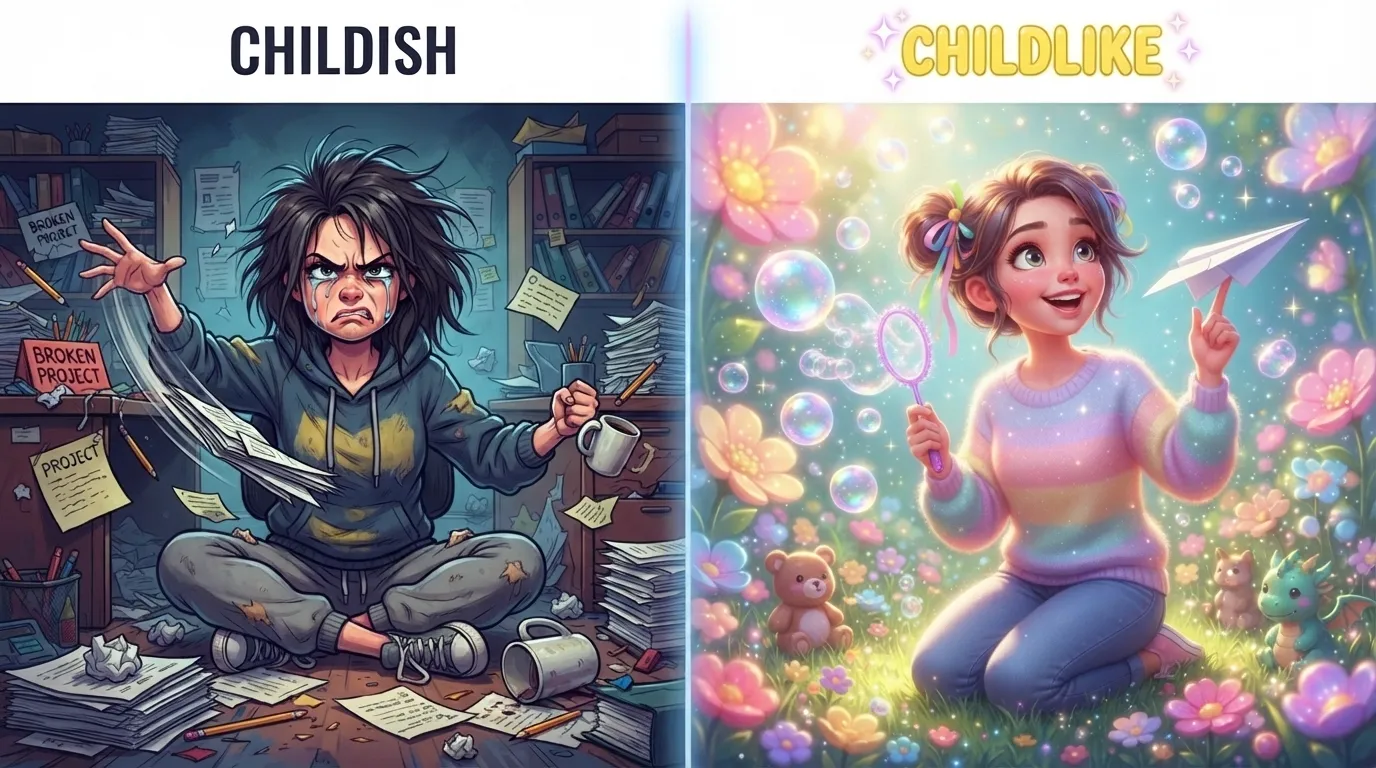
Childish means acting in an immature or foolish way, while childlike means having innocent, pure qualities similar to a child.
My aunt once called my cousin’s painting childish. She meant it as a compliment. He did not take it that way.
His face fell. The room went quiet. What she meant to say was childlike.
One word ruined a moment that should have felt proud. That mix up happens more than people realize.
Childish and childlike share the same root, but they carry completely different feelings. One is an insult. The other is often praise.
If you have ever paused before choosing between these two words, you already know the risk. Pick wrong, and you might hurt someone without meaning to.
This guide breaks down the real difference. You will learn exactly when to use each word, and how to avoid the awkward moment my cousin faced.
By the end, you will know exactly which word fits your sentence, every single time.
Childish or Childlike Quick Answer
| Feature | Childish | Childlike |
|---|---|---|
| Meaning | Immature, silly, or inappropriate for an adult | Innocent, curious, or full of wonder |
| Connotation | Negative | Positive |
| Common Use | Criticizing someone’s behavior | Praising someone’s personality or attitude |
| Typical Context | Tantrums, selfishness, lack of maturity | Creativity, kindness, imagination, optimism |
| Example | His childish behavior annoyed everyone. | She has a childlike sense of wonder. |
Childish describes behavior that seems immature, silly, or unreasonable for someone’s age.
Childlike describes qualities that feel innocent, curious, or pure, often admired rather than criticized.
Example: “His childish outburst embarrassed everyone at the meeting.” Compare that to: “Her childlike wonder made the museum trip magical.”
The Origin and Background of Childish or Childlike
Both words grew from the same root word, child, but English shaped them into opposites over time.
Childish first appeared with a negative tone. Writers used it to criticize adults who acted foolish or immature, much like a young child throwing a tantrum.
Childlike developed later as a softer, more positive term. It captured the innocent, curious side of childhood, the part adults often miss.
The confusion exists because both words look almost identical. English speakers assume similar spelling means similar meaning. Here, that assumption backfires completely.
Dictionaries from the 1800s already show this split. Childish appeared in essays criticizing petty behavior among grown men. Childlike showed up in poetry, praising the innocence adults lose as they age.
That gap has only grown wider over time. Modern writers lean on childish for satire and criticism. They save childlike for warmth, nostalgia, and sincere praise.
Children’s book authors often chase the childlike quality on purpose. They want readers to feel wonder again, the same way a five year old feels seeing snow for the first time. That feeling rarely gets described as childish, even though both words point back to the same early years of life.
Childish or Childlike Explained: Key Differences
The suffix makes all the difference.
Ish often signals something negative or exaggerated, like foolish or selfish. That pattern carries into childish, giving it a critical tone.
Like usually signals comparison or similarity, without judgment. Words like lifelike or dreamlike follow this same pattern, and childlike fits right in.
Think about other pairs that follow this same rule. Womanish sounds critical, while womanly sounds respectful. Boyish can go either way depending on tone, but boylike leans gentle and descriptive.
Once you notice this pattern, you start spotting it everywhere in English. Suffixes carry emotional weight, even when the root word stays exactly the same.
| Term | Meaning | When to Use | Region/Context |
|---|---|---|---|
| Childish | Immature or foolish behavior | Criticizing behavior, describing tantrums | Used worldwide, common in US and UK |
| Childlike | Innocent or pure qualities | Praising curiosity, wonder, or simplicity | Used worldwide, common in US and UK |
Which Version Should You Use?
Not sure which word fits your sentence? This quick guide helps.
- For criticizing behavior, use childish. Think tantrums, sulking, or refusing to compromise.
- For praising innocence or wonder, use childlike. Think curiosity, imagination, or trust.
- For neutral or unsure moments, pause and ask yourself if the behavior deserves praise or criticism. That answer picks your word.
If the behavior would embarrass an adult, choose childish. If the quality would make someone smile, choose childlike.
For teachers and parents, the choice matters even more. Calling a student’s question childish can shut down curiosity fast. Calling it childlike keeps the door open for more questions.
For writers and reviewers, the same rule applies to art, books, and films. A childish plot feels lazy or underdeveloped. A childlike storyline feels warm, simple, and intentional.
For workplace communication, stick with childish only when addressing genuine unprofessional behavior. Save childlike for describing creative thinking, playful branding, or fresh ideas that feel refreshingly simple.
For casual conversation with friends, tone matters more than rules. Even childish can land softly if your friend already knows you mean it playfully. Written text loses that tone, so lean toward childlike when in doubt.
Common Mistakes with Childish or Childlike
Mistake 1: Calling someone’s imagination childish when you meant to compliment them. Correction: Use childlike for imagination, wonder, or creativity. It sounds warm, not critical.
Mistake 2: Using childlike to describe a tantrum or immature outburst. Correction: Use childish for negative behavior. Childlike does not fit here.
Mistake 3: Assuming both words are interchangeable since they share the same root. Correction: They are not. The tone shifts completely depending on which suffix you choose.
Mistake 4: Using childish in a review meant to praise simplicity or purity in design. Correction: Use childlike instead, since it highlights simplicity as a strength, not a flaw.
Mistake 5: Overusing either word without checking the emotional weight of the sentence. Correction: Read the sentence aloud. If it sounds like an insult, check that you meant it that way.
Mistake 6: Using childish to soften criticism, hoping it sounds less harsh than it actually is. Correction: Childish still lands as a strong critique. If you want a gentler tone, choose a milder word like immature instead.
These mistakes happen fast, usually in the middle of typing an email or caption. Slowing down for one extra second before hitting send saves you from an awkward correction later.
Childish or Childlike in Real World Examples
In a professional email: “Please avoid childish remarks during client calls, as they undermine our team’s credibility.”
In a news headline: “Artist’s Childlike Approach to Painting Wins Praise from Critics”
In a social media post: “There is something so childlike about watching my dog chase bubbles in the yard.”
In a formal document: “The report criticized the negotiator’s childish refusal to compromise during talks.”
Each example shows how the wrong word could completely flip the meaning of the sentence. Swap childish for childlike in the news headline, and the entire tone of the article changes from praise to criticism.
That is the real power of this word pair. A single suffix decides whether your sentence lands as a compliment or a complaint.
Childish or Childlike Data, Trends, and Usage
Searches for childish or childlike rise whenever people write reviews, essays, or personal reflections involving behavior or personality traits.
Writers, teachers, and parents search this pair often, especially when describing children, art, or emotional reactions. Content creators also search it when reviewing books, films, or products with playful themes.
This search falls into the informational category. Readers want a clear answer they can apply immediately, not a long grammar lecture.
That matters now because more people write reviews, captions, and reflections online, where the wrong word choice can accidentally insult instead of compliment.
Social media has made this mix up even more common. A quick caption written in seconds can carry the wrong tone if the writer grabs childish instead of childlike, or the other way around.
Brands feel this pressure too. Companies selling toys, books, or games often reach for childlike in marketing copy, since it signals joy and imagination rather than immaturity.
Parenting blogs and education sites drive a steady stream of searches for this pair as well. Writers there often need childlike to describe healthy curiosity in students, while reserving childish for behavior that needs correction.
Comparison Table
| Term/Variant | Meaning | Region/Context | Best Used When |
|---|---|---|---|
| Childish | Immature or foolish behavior | Common worldwide | Criticizing tantrums or unreasonable behavior |
| Childlike | Innocent or pure qualities | Common worldwide | Praising curiosity, wonder, or simplicity |
Frequently Asked Questions
Q: What does childish mean? A: Childish means behaving in an immature or unreasonable way. It is often used to criticize adults who act like young children during conflict or frustration.
Q: How do you use childlike correctly in a sentence? A: Use childlike to describe innocent, curious, or pure qualities, such as “She approached the project with childlike enthusiasm.”
Q: Childish vs childlike, what is the real difference? A: Childish carries a negative tone and criticizes immature behavior. Childlike carries a positive tone and praises innocence, wonder, or simplicity.
Q: Is childish acceptable in formal writing? A: Yes, childish appears in formal writing when describing immature behavior. It should still be used carefully since it can sound harsh.
Q: Which version is correct, childish wonder or childlike wonder? A: The correct phrase is childlike wonder, since wonder is a positive quality, not an immature behavior.
Q: Where does the word childlike come from? A: Childlike developed from the root word child combined with the suffix like, which signals comparison rather than judgment, giving it a softer tone.
Q: Can childlike be used to describe adults? A: Yes, childlike often describes adults who show innocent curiosity or pure joy. It is usually meant as a compliment, not an insult.
Q: Why do people confuse childish and childlike so often? A: Both words share the same root and look similar on the page. Readers assume similar spelling means similar meaning, but the suffixes completely change the tone.
Final Thoughts
Childish and childlike may share a root, but they live in different worlds. One criticizes. One praises.
Remember the key points. Childish points to immature or foolish behavior. Childlike points to innocent, pure qualities worth admiring. The suffix changes everything.
Next time you reach for either word, pause and ask if you mean to criticize or compliment. That single question keeps you from an awkward moment like my cousin faced.
Save this guide the next time you write a review, caption, or email involving behavior or personality. One quick check before you hit send can turn a possible insult into a genuine compliment.
Now you know exactly how to use childish or childlike. Go try it in your next piece of writing.
Read More: Peak or Peek: The Easy Way to Never Mix Them Up Again

My name is Ayesha Sadiqah, the writer behind this website. I write in-depth articles on English spelling, word comparisons, grammar, and vocabulary to help learners make better language choices. Every guide is carefully researched and designed to provide accurate, practical, and easy-to-understand information.