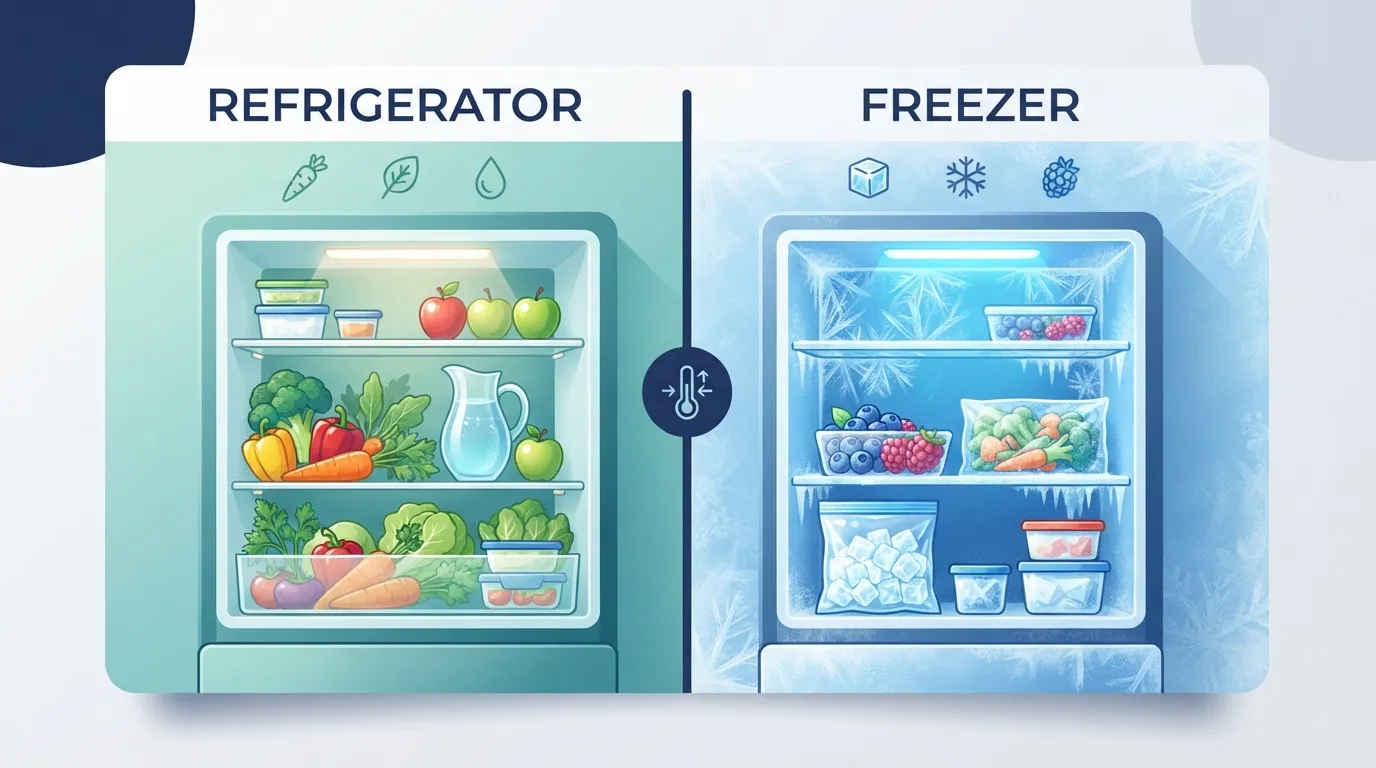
A fridge keeps food cold, usually between 1 and 4 degrees Celsius, to slow spoilage. A freezer keeps food frozen solid, usually around minus 18 degrees Celsius, to store it for much longer.
I once left a tub of ice cream in the fridge overnight instead of the freezer, thinking I’d grabbed the right door. Let’s just say breakfast the next morning involved a very sad, soupy mess.
That tiny mix up happens more often than people admit. Fridge and freezer sit right next to each other in most kitchens, and the words get used loosely, sometimes even swapped by accident in daily conversation.
This guide clears up exactly what separates a fridge from a freezer, why the confusion exists, and how to use both words correctly, whether you’re talking appliances or writing a recipe.
Fridge vs Freezer: Quick Answer
A fridge, short for refrigerator, cools food without freezing it. It keeps milk fresh, cheese firm, and leftovers safe for a few days.
A freezer drops the temperature far below freezing point. It turns food solid, which pauses bacterial growth almost completely, letting food last for months instead of days.
Think of a fridge as a short term pause button for food, and a freezer as a long term storage vault.
The Origin of These Two Words
Fridge is simply a shortened, informal spelling of refrigerator, a word built from the Latin root frigus, meaning cold. Refrigerator entered English in the 1800s to describe early cooling boxes, and fridge became the casual, everyday version once home refrigerators became common in the twentieth century.
Freezer comes directly from the verb freeze, rooted in Old English freosan, describing the natural process of water turning to ice. As mechanical cooling technology developed, freezer became the standard term for any appliance or compartment built specifically to freeze food solid.
Interestingly, early refrigerators often included a small ice compartment, which eventually evolved into the separate, dedicated freezer sections and standalone freezer units we use today.
Key Differences and Variations
| Term | Meaning | When to Use | Region or Context |
| Fridge | Cooling appliance, keeps food cold but not frozen | Everyday storage of milk, vegetables, leftovers | Casual term worldwide, especially British and American English |
| Refrigerator | Formal term for the same cooling appliance | Manuals, formal writing, product listings | Standard formal term globally |
| Freezer | Appliance or compartment that freezes food solid | Long term storage of meat, ice cream, frozen meals | Common worldwide, both standalone and built in units |
| Deep freezer | A separate, often larger standalone freezer unit | Bulk storage, garages, commercial kitchens | Common in American English, especially rural households |
| Icebox | Older term for early refrigeration using ice blocks | Historical or nostalgic references | Mostly outdated, still used casually in the American South |
Notice how fridge and refrigerator mean exactly the same thing, just with different formality levels, while freezer describes a genuinely different function and temperature range.
Which Version or Approach Should You Use?
For everyday spoken English, use fridge. It feels natural, friendly, and universally understood.
For formal writing, product manuals, or professional documents, use refrigerator. It sounds more polished and precise in technical contexts.
For describing long term frozen storage, always use freezer, since fridge never accurately describes freezing temperatures.
For bulk or extra storage needs, especially in garages or basements, deep freezer is the correct, specific term rather than a generic freezer reference.
Common Mistakes with Fridge and Freezer
Mistake 1: Saying “put it in the fridge” when the food actually needs freezing. Correction: Say “put it in the freezer” for anything meant to stay frozen, like raw meat for long term storage. This mistake happens because people use fridge as a general catch all word for any cold storage.
Mistake 2: Assuming freezer temperature stops spoilage completely and forever. Correction: Freezing pauses spoilage significantly but does not stop it forever, since quality still slowly declines over many months.
Mistake 3: Writing “refridgerator” instead of “refrigerator.” Correction: The correct spelling is refrigerator, with no extra d before the g, despite how fridge is spelled with one. This happens because fridge includes a d, leading people to assume refrigerator follows the same pattern.
Mistake 4: Using fridge and freezer interchangeably in recipes. Correction: Recipes depend on precise temperatures, so always follow the exact fridge or freezer instruction given. Swapping them can ruin texture, safety, or shelf life of the food.
Fridge and Freezer in Real World Examples
Professional email: “Please note that the office refrigerator is for daily lunches only, while the freezer compartment should not be used for personal food storage.”
News headline: “New Energy Efficient Fridge and Freezer Models Hit Stores This Spring”
Social media post: “Just organized my whole fridge and freezer and I feel like a completely different person.”
Recipe instructions: “Chill the dough in the fridge for one hour, or freeze it in the freezer for up to three months.”
Notice how professional and technical writing tends to prefer refrigerator, while casual writing almost always defaults to fridge.
Data, Trends, and Usage
Searches for fridge vs freezer temperature spike heavily around food safety concerns, especially after power outages or during summer heat waves.
Searches for fridge organization and freezer meal prep trend consistently among home cooking and lifestyle audiences, particularly on social platforms focused on kitchen tips.
Both terms fall mainly under informational search intent, though best fridge freezer combo style searches lean commercial, aimed at people comparing appliances before buying.
This distinction matters now more than ever, since rising grocery costs have pushed more households toward bulk buying and freezer meal prepping, making accurate fridge and freezer knowledge genuinely practical, not just linguistic trivia.
Standalone Comparison Table
| Term or Variant | Meaning | Region or Context | Best Used When |
| Fridge | Cools food without freezing | Casual, worldwide | Everyday short term food storage |
| Refrigerator | Formal name for the same appliance | Formal writing, worldwide | Manuals, professional documents |
| Freezer | Freezes food solid for long term storage | Worldwide | Long term storage of meat, frozen meals |
| Deep freezer | Standalone extra freezing unit | Common in American households | Bulk or overflow frozen storage |
Frequently Asked Questions
Q: What does fridge mean? A: Fridge is the casual, shortened form of refrigerator, an appliance that keeps food cold without freezing it, usually between 1 and 4 degrees Celsius.
Q: How do you use freezer correctly in a sentence? A: Use freezer whenever referring to food or items stored at freezing temperatures, such as “store the meat in the freezer until you’re ready to cook it.”
Q: Fridge vs refrigerator, what’s the difference? A: There is no difference in meaning. Fridge is simply the informal, shortened version of the formal word refrigerator.
Q: Is fridge acceptable in formal writing? A: Fridge is considered casual, so formal documents, manuals, and professional writing typically use refrigerator instead.
Q: Which version is correct, freezer or freeser? A: Freezer is the correct spelling, following the base verb freeze plus the suffix er, describing something that performs the freezing action.
Q: Where does the word freezer come from? A: Freezer comes from the verb freeze, rooted in Old English freosan, combined with the agent suffix er, meaning something that freezes.
Q: Can fridge and freezer share the same appliance? A: Yes, most home refrigerators include a built in freezer compartment, combining both cooling functions within a single unit.
Final Thoughts
Fridge and freezer might live side by side in your kitchen, but they do completely different jobs. A fridge slows spoilage for a few days. A freezer pauses it for months by freezing food solid.
Remember these key points. Fridge equals casual refrigerator, keeping food cold but not frozen. Freezer means frozen storage for the long haul. And formal writing should always lean toward refrigerator over fridge.
Now you know exactly how fridge and freezer differ, so go check your kitchen and make sure everything is stored exactly where it belongs.
Bookmark this guide so you never second guess fridge or freezer again, and share it with anyone still storing ice cream in the wrong compartment.
Read More: Lone Wolf vs Third Wheel: The Real Difference Explained

I’m Zain. I got interested in commonly confused words while helping non-native English speakers prep for writing exams, where a single misused word could cost real marks. That experience shaped how I write now: I try to explain not just which spelling is correct, but why the confusion exists in the first place, since understanding the reason is what actually makes it stick.