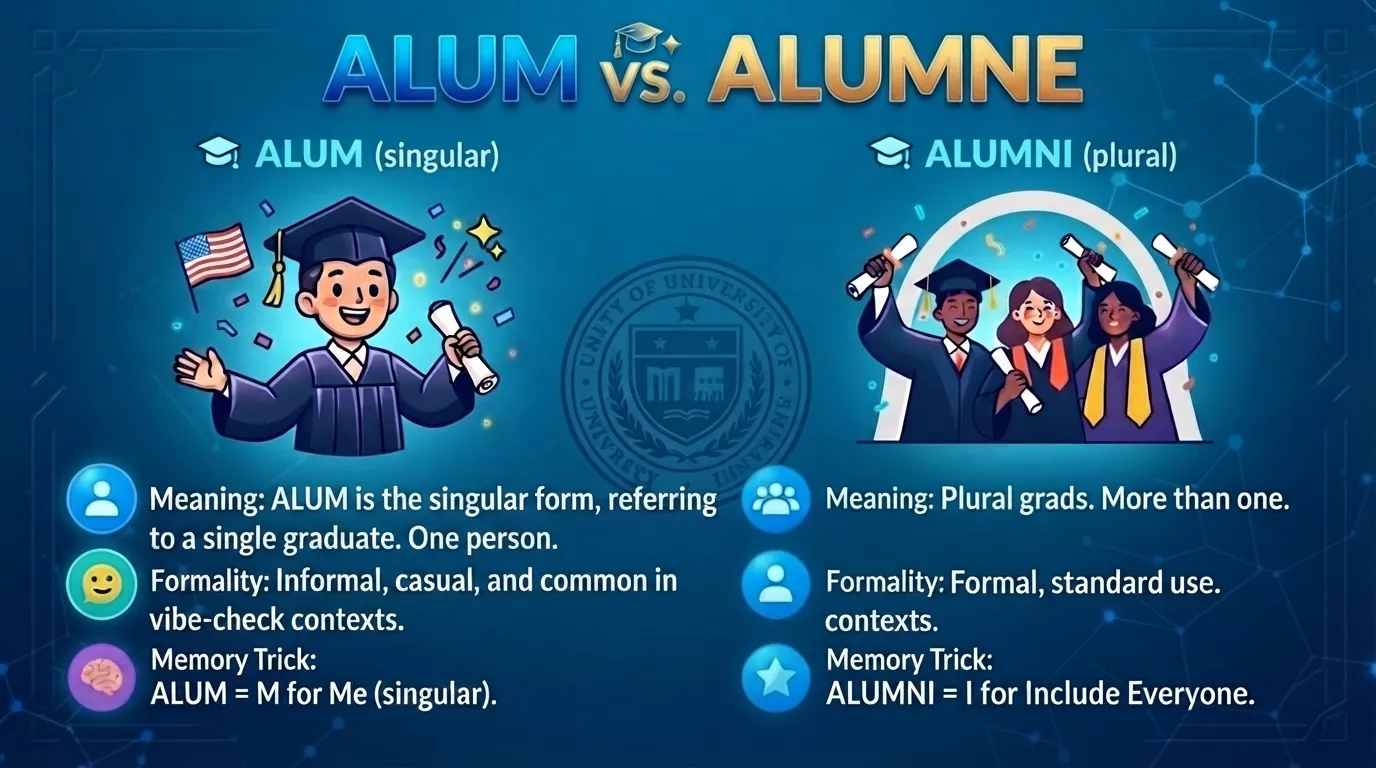
Alum is an informal word for a graduate, while alumni is the correct plural term for a group of graduates. If you are talking about one graduate in a formal setting, words like alumnus or alumna may be more accurate.
A few years ago, I was writing a welcome post for former students. I wanted to thank everyone who had returned for the annual reunion. I almost wrote, “Welcome, alum!” Then I paused. There were hundreds of graduates attending the event. That single word suddenly looked wrong.
If you have ever wondered whether to write alum or alumni, you are not alone. These words appear on university websites, graduation invitations, LinkedIn profiles, and professional emails. Yet many people use them incorrectly because they sound similar and all relate to graduates.
The confusion becomes even greater when you come across words like alumnus, alumna, and alumnae. Which one should you use? Does gender matter? Is alum always acceptable? Can you use alumni for one person?
In this guide, I will answer every common question in simple English. By the end, you will know exactly which word fits every situation and feel confident using it in everyday writing.
What Does Alum or Alumni Mean?
Both alum and alumni refer to people who have graduated from a school, college, or university. However, they are not interchangeable.
Alum is a shortened and informal version of the traditional Latin words. It is commonly used in casual conversations, marketing, social media, and even by many universities.
Alumni is the plural form. It refers to more than one graduate. The group may include men, women, or both.
Simple examples
- Sarah is an alum of Stanford University.
- Thousands of alumni attended the homecoming event.
- The university invited all alumni to celebrate its anniversary.
- As an alum, David often mentors current students.
Although many people use alum casually, formal documents often use the traditional Latin forms instead.
Quick Difference
| Feature | Alum | Alumni |
| Meaning | One graduate in informal English | More than one graduate |
| Number | Singular | Plural |
| Formality | Informal | Formal and standard |
| Common Use | Social media, conversations, marketing | Universities, official documents |
| Gender | Gender neutral | Mixed group or all male group |
The Origin of the Words
The words alum, alumnus, alumna, alumni, and alumnae all come from Latin.
The original Latin word alumnus means foster son, pupil, or student. It comes from the Latin verb meaning to nourish or to raise.
Over time, English adopted these words to describe graduates of schools and universities.
Originally, each word had a specific grammatical meaning.
| Word | Original Latin Meaning |
| Alumnus | One male graduate |
| Alumna | One female graduate |
| Alumni | More than one male or a mixed group |
| Alumnae | More than one female graduate |
As English evolved, many people preferred a simpler word.
That is where alum became popular.
Today, alum is widely accepted in informal English because it is shorter, easier to pronounce, and gender neutral.
Many universities now use alum in newsletters, fundraising campaigns, and social media posts to make communication feel more friendly.
However, official academic publications often continue using the traditional Latin forms.
Why Do People Get Confused?
There are several reasons.
- The words come from Latin instead of modern English.
- Some forms depend on gender.
- One word is singular while another is plural.
- Many universities use both versions.
- Social media has made alum much more common.
As a result, people often mix them up.
For example, many people write:
❌ She is an alumni.
The correct sentence is:
✅ She is an alum.
or
✅ She is an alumna.
Alum Explained: Key Differences
Although all these words describe graduates, each has a different purpose.
| Term | Meaning | When to Use | Context |
| Alum | One graduate | Informal writing | Everyday English |
| Alumnus | One male graduate | Formal writing | Academic |
| Alumna | One female graduate | Formal writing | Academic |
| Alumni | More than one graduate | Formal or informal | Schools and universities |
| Alumnae | More than one female graduate | Formal writing | Academic |
Example 1
Correct
Emily is an alumna of Harvard University.
Also acceptable
Emily is an alum of Harvard University.
Example 2
Correct
The university welcomed over five thousand alumni this year.
Example 3
Correct
Our alumni network supports students around the world.
Example 4
Correct
As an alum, James enjoys speaking at career events.
Pronunciation Guide
Many learners also wonder how these words sound.
| Word | Pronunciation |
| Alum | uh LUM |
| Alumnus | uh LUM nus |
| Alumna | uh LUM nuh |
| Alumni | uh LUM nye |
| Alumnae | uh LUM nee |
Quick Knowledge Box
If you only remember one thing, remember this.
- Alum = One graduate in everyday English.
- Alumnus = One male graduate.
- Alumna = One female graduate.
- Alumni = Two or more graduates or a mixed group.
- Alumnae = Two or more female graduates.
This simple rule will help you avoid the most common mistakes.
Which Version Should You Use?
Choosing between alum, alumnus, alumna, alumni, and alumnae depends on how many people you are talking about, the level of formality, and your audience.
The good news is that once you know these three factors, the choice becomes easy.
For Students
If you are writing a class assignment, school project, or personal statement, alum is usually a safe choice when referring to one graduate in a casual context.
Example
- My sister is an alum of New York University.
If your teacher expects formal writing, use alumnus for a man or alumna for a woman.
For Universities
Universities often use traditional terms in official publications because they are precise.
Examples
- Distinguished alumni will attend the ceremony.
- The university honored its outstanding alumnae.
You will also see many universities use alum in blog posts, newsletters, and social media because it feels more modern and inclusive.
For Business Writing
In resumes, LinkedIn profiles, company websites, and biographies, alum has become very common.
Example
- Google welcomes applications from Stanford alumni.
- Sarah is an Oxford alum.
For Academic Writing
Academic journals and research papers usually follow the traditional forms.
Use:
- Alumnus for one man.
- Alumna for one woman.
- Alumni for multiple graduates or mixed groups.
- Alumnae for a group of women.
For Everyday English
Most native speakers simply use alum or alumni.
You will hear sentences like:
- She is an MIT alum.
- Thousands of alumni came back for homecoming.
These sound natural and are widely understood.
Quick Decision Guide
| Situation | Best Choice |
|---|---|
| One graduate in casual writing | Alum |
| One male graduate in formal writing | Alumnus |
| One female graduate in formal writing | Alumna |
| Mixed group of graduates | Alumni |
| Group of female graduates | Alumnae |
| LinkedIn profile | Alum |
| University report | Traditional Latin form |
Common Mistakes With Alum and Alumni
Even native English speakers make mistakes with these words. Here are the most common ones.
| Mistake | Correct Form | Why It Is Wrong |
|---|---|---|
| She is an alumni. | She is an alumna or alum. | Alumni is plural. |
| John is an alumna. | John is an alumnus or alum. | Alumna refers to one woman. |
| The school invited every alumnus. | The school invited all alumni. | A group needs the plural form. |
| Our alumnae association welcomes everyone. | Our alumni association welcomes everyone. | Alumnae refers only to women. |
| She became an alumni after graduation. | She became an alum or alumna after graduation. | One person cannot be alumni. |
Why Do These Mistakes Happen?
Most people are unfamiliar with Latin grammar. They assume alumni sounds more formal, so they use it for one person. In reality, alumni has always been a plural word.
Memory Trick
Need an easy way to remember?
Think of the Letter I
Alumni ends with I.
Imagine I standing for Individuals together.
That reminds you that alumni means more than one graduate.
Think of the Letter A
Alumna ends with A.
Many feminine words in Latin end with A.
So alumna means one female graduate.
Think of the Letter US
Alumnus ends with US.
That helps you remember one male graduate.
Think of the Short Form
If you cannot remember any Latin rules, use alum in informal situations. It is short, modern, and widely accepted.
Cheat Sheet
Save this table for quick reference.
| Word | Number | Gender | Formality | Example |
|---|---|---|---|---|
| Alum | One | Any | Informal | She is an NYU alum. |
| Alumnus | One | Male | Formal | He is an Oxford alumnus. |
| Alumna | One | Female | Formal | She is a Harvard alumna. |
| Alumni | Many | Mixed or Male | Formal and Informal | The alumni donated books. |
| Alumnae | Many | Female | Formal | The alumnae hosted the event. |
Five Second Rule
One person?
Use alum in everyday writing.
Many people?
Use alumni.
Alum and Alumni in Real World Examples
Seeing these words in context makes them much easier to remember.
Professional Email
Subject: Welcome Back, Alumni
Dear Alumni,
We are excited to invite you to our annual networking event. Your experiences continue to inspire current students.
Kind regards,
Alumni Relations Office
News Headline
Local Alum Wins National Science Award
The university celebrated its former student’s remarkable achievement during this year’s reunion.
Social Media Post
Congratulations to our amazing alumni for reaching incredible career milestones. We are proud of every graduate in our community.
University Website
Meet our inspiring alumni who are making a difference across the world.
Formal Report
The university’s alumni contributed more than five million dollars to scholarship programs last year.
Everyday Conversation
A: Where did Sarah study?
B: She is an alum of Stanford University.
LinkedIn Profile
Proud alum of the University of Michigan with a passion for technology and education.
Grammar Tips
These words become much easier when you know a few grammar rules.
Singular and Plural
| Singular | Plural |
|---|---|
| Alum | Alumni |
| Alumnus | Alumni |
| Alumna | Alumnae |
Possessive Forms
Correct:
- The alumni’s donations funded the library.
- The alumna’s research received international recognition.
- The alumnus’s speech inspired students.
Capitalization
Do not capitalize these words unless they begin a sentence or are part of an official title.
Correct:
- Our alumni network is growing.
Correct:
- Office of Alumni Relations
Pronunciation Reminder
| Word | Sounds Like |
|---|---|
| Alum | uh LUM |
| Alumnus | uh LUM nus |
| Alumna | uh LUM nuh |
| Alumni | uh LUM nye |
| Alumnae | uh LUM nee |
Similar Words You Should Know
Many readers confuse alum with other education related terms.
| Word | Meaning | Same as Alum? |
|---|---|---|
| Graduate | Someone who completed studies | Yes, usually |
| Former student | Someone who attended a school | Not always a graduate |
| Student | Someone currently studying | No |
| Undergraduate | Student before graduation | No |
| Postgraduate | Student studying after graduation | No |
A person can be a former student without graduating.
A person becomes an alum, alumnus, or alumna after completing their studies.
Frequently Asked Questions
What does alum mean?
Alum is an informal, gender neutral word for one graduate of a school, college, or university. It is commonly used in conversations, LinkedIn profiles, university newsletters, and marketing materials because it is short and easy to understand.
What does alumni mean?
Alumni is the plural form that refers to two or more graduates. It refers to two or more graduates, including mixed gender groups. Universities often use this word for alumni associations, reunions, and official announcements.
Is alumni singular or plural?
Alumni is always plural.
If you are talking about one graduate, use alum, alumnus, or alumna instead.
Correct: She is an alum of the university.
Incorrect: She is an alumni of the university.
What is the difference between alum and alumni?
The main difference is the number of people.
- Alum refers to one graduate.
- Alumni refers to two or more graduates.
If you remember this simple rule, you will avoid the most common mistake.
Is alum acceptable in formal writing?
Yes. Many universities and organizations now use alum because it is gender neutral and concise.
However, highly formal academic writing may still prefer alumnus, alumna, or alumni, depending on the context.
Should I write alum or alumnus on my resume?
Both are correct.
Use alum if you prefer modern, natural English.
Use alumnus if you want a more traditional and formal style.
Where do the words alum and alumni come from?
Both words come from Latin.
The original word alumnus meant a foster son, pupil, or student. Over time, English adopted the word to describe graduates, while alum became a shorter and more modern alternative.
Conclusion
Choosing between alum and alumni becomes simple once you know the basic rules. Alum usually refers to one graduate in informal English, while alumni refers to a group of graduates. In formal writing, you may also see alumnus, alumna, and alumnae, depending on gender and number.
When writing emails, resumes, social media posts, or university content, think about your audience before choosing the word. If your goal is clear and modern communication, alum is an excellent choice for one graduate. If you are referring to several graduates, alumni is the correct term.
Remember these three key points:
- Alum means one graduate.
- Alumni means multiple graduates.
- Traditional Latin forms are best for formal academic contexts.
Now you know exactly how to use alum and alumni with confidence. Bookmark this guide so you never second guess these words again, and share it with anyone who has ever been confused by them.
Explore More: Journeys or Journies: The Complete Guide to Getting It Right

Hi, I’m Zara. Words that look almost identical but mean completely different things have always fascinated me, that’s what pulled me toward writing about spelling and usage. I focus on digging into where these mix-ups actually come from, whether it’s a British-American split or just a rule English never bothered to make consistent. My goal with every guide is simple: give you the answer fast, then explain it well enough that you never have to look it up again.