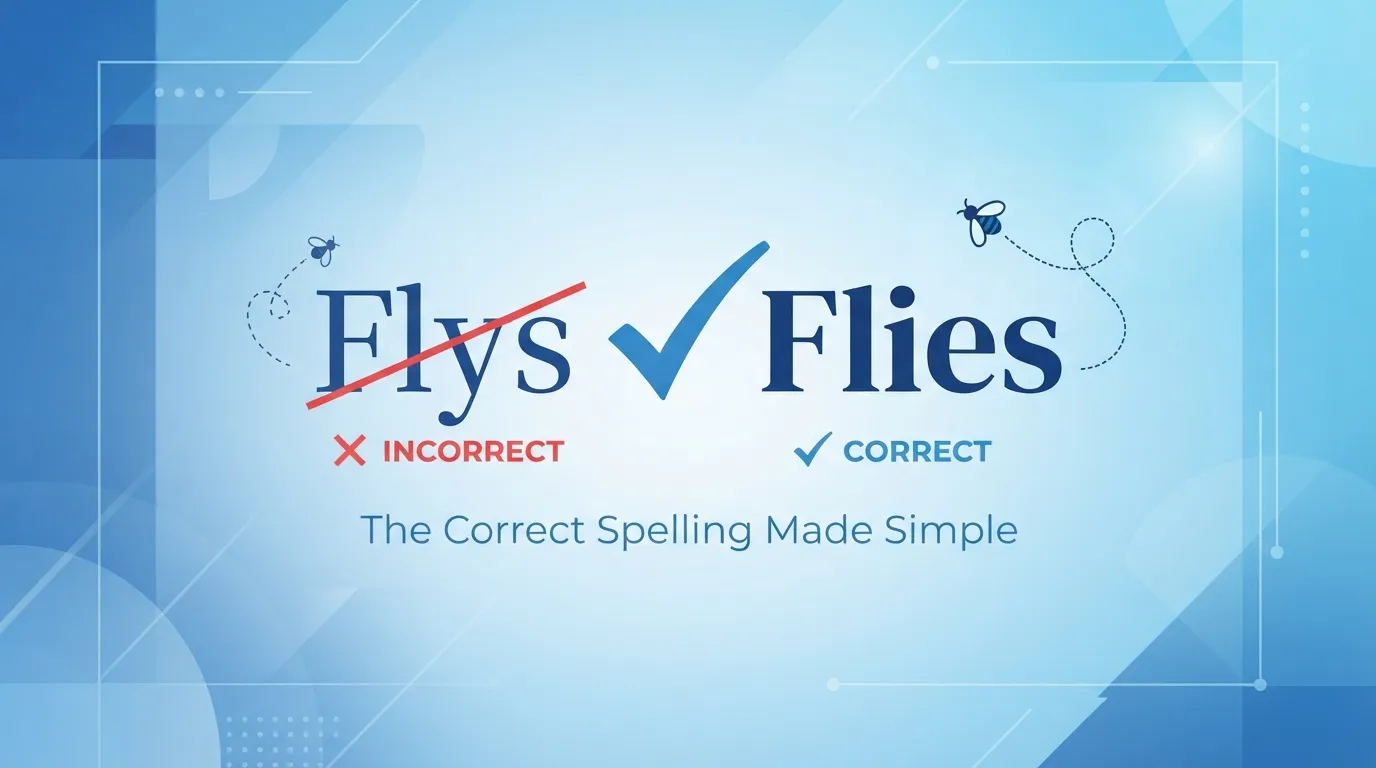
Flies is the correct spelling for the plural of fly, and for the verb form used with he, she, or it. Flys is almost always a misspelling, though it does show up as a brand name or a surname in rare cases.
I remember editing a friend’s resume years ago. She had written, “This role also flys drones for aerial photography.” I paused. Something looked off. So I read it out loud, and the word just felt wrong on my tongue. That is when I realized she needed flies, not flys.
This mix up happens more often than you would think. After all, English spelling rules do not always feel logical. Words that end in y often confuse writers when they try to make them plural or turn them into a verb. So people search for the correct form every single day, hoping to avoid an embarrassing typo in an email, a post, or a school paper.
This guide will clear up the confusion for good. First, you will learn the actual rule behind this spelling change. Next, you will see real examples in sentences. Then, you will learn the rare cases where flys is actually correct. By the end, you will never second guess yourself again.
So let’s get started.
Flys or Flies: Quick Answer
In almost every case, flies is correct. You use flies as the plural of the insect fly, and you also use flies as the verb form for he, she, or it, such as “the plane flies every morning.”
Flys, on the other hand, is rarely correct. For example, it shows up mainly as a brand name or a surname, such as “The Flys,” a rock band from the 1990s.
Here is a simple test. If you mean more than one fly, or you are describing an action someone or something does, use flies. If you are naming a specific brand, title, or person, then flys might apply.
Where the Flys or Flies Rule Comes From
To begin with, English follows an old spelling pattern for words that end in a consonant plus y. When you make these words plural, or change them into a verb form, the y typically changes to ies.
Think about other words that follow this same pattern, such as baby becoming babies, or try becoming tries. Fly follows the exact same path. As a result, fly becomes flies, both as a plural noun and as a present tense verb.
However, confusion creeps in because plenty of other words simply add an s without any change. For instance, boys, toys, and days all keep the y and just add an s. That happens because those words end in a vowel plus y, not a consonant plus y. This difference is the real reason so many writers get stuck.
Flys or Flies Explained: Key Differences
Overall, here is how each spelling actually works in real sentences.
| Term | Meaning | When to Use | Region or Context |
|---|---|---|---|
| Flies | Plural of fly, or the verb form for he, she, or it | Talking about insects, planes, birds, or actions | Used worldwide in standard English |
| Flys | A brand name, title, or surname | Talking about a specific proper noun | Rare, appears mostly in names and titles |
In short, flies covers nearly everything you will ever write. Flys only applies when you are referring to something with that exact spelling built into its name.
For example, look at these sentences:
- “There are three flies buzzing around the kitchen.” This is the plural of the insect.
- “She flies to Chicago every other week.” This is the verb form.
- “He collects vinyl records from The Flys.” This is a proper noun, so the spelling stays as is.
Which Spelling Should You Use?
- For students and everyday writers: always default to flies. In fact, you will almost never need flys unless you are writing about a specific brand or name.
- For content writers and bloggers: use flies for both the plural noun and the verb form. Therefore, double check your draft for a stray flys before you publish.
- For business writers: flies fits nearly all professional writing, whether you mean insects, travel schedules, or software that runs smoothly.
- For fans of music or pop culture: flys may be correct only when referring to an actual band, brand, or name that spells itself that way on purpose.
Common Mistakes with Flys or Flies
For instance, “The bird flys south every winter” is wrong. Instead, write “The bird flies south every winter.” This happens because writers forget the y changes to ies after a consonant.
Similarly, “There are two flys on the window” is wrong. Instead, write “There are two flies on the window.” This mistake happens often because flys looks like it should just add an s, the same way many other plural words do.
Also, “The company flys packages overnight” is wrong. Instead, write “The company flies packages overnight.” This happens because writers apply the wrong rule when a word ends in a consonant plus y.
Next, “He flys to Paris every summer” is wrong. Instead, write “He flies to Paris every summer.” This error happens because the verb form gets confused with simpler words like boys or toys.
Finally, “Time really flys when you are busy” is wrong. Instead, write “Time really flies when you are busy.” This mistake happens because this common phrase gets typed quickly, and the wrong spelling slips through without a second look.
Flys or Flies in Real World Examples
In a professional email, you might write, “Our team flies out to the client site every Monday morning.”
In a news headline, you might see, “Airline Flies New Route Between Two Major Cities.”
On social media, someone might post, “Time flies when you are having fun. Cannot believe summer is already over.”
In a formal document, you might read, “The aircraft flies at a maximum altitude of forty thousand feet under normal conditions.”
In every case, each example uses flies correctly, since the sentence involves either a plural noun or a verb action.
Flys or Flies: Data, Trends and Usage
Overall, many people search for “flys or flies” every month. Students search it while writing essays. Bloggers search it while drafting posts. Non native English speakers search it too, since this spelling rule does not exist in every language.
Notably, searches for this phrase rise during back to school season, when students write more essays and reports. Interest also rises among travel writers and airlines, since the word flies appears constantly in schedules, ads, and updates.
This matters more today than ever before. After all, so much writing happens quickly through social posts, emails, and chat messages. Therefore, a small spelling slip can make a message look careless. Ultimately, using flies correctly keeps your writing sharp and professional.
Flys or Flies: Comparison Table
In summary, here is a side by side look at both spellings.
| Term or Variant | Meaning | Region or Context | Best Used When |
|---|---|---|---|
| Flies | Plural of fly, or the verb form for a singular subject | Standard English, worldwide | Talking about insects, travel, or actions |
| Flys | A brand name, title, or surname | Rare, mostly names and titles | Referring to a specific proper noun only |
Flies as a Noun vs Flies as a Verb
Interestingly, flies actually does two separate jobs in English, and understanding both makes the whole topic much easier.
First, flies works as a plural noun. In this case, it simply means more than one fly, the small buzzing insect. For example, “The flies gathered near the open trash can.” Here, flies names a group of living creatures.
Second, flies works as a present tense verb. In this case, it describes an action performed by a singular subject, such as he, she, it, or a specific name. For example, “My brother flies to Denver twice a year.” Here, flies describes what someone does.
So how do you tell the difference while reading? Simply look at the words around it. If flies follows the, some, many, or a number, it is almost always the noun form. If flies follows a name, a singular pronoun, or a singular subject, it is almost always the verb form.
This distinction matters because both forms follow the exact same spelling rule, yet they serve completely different grammar purposes. Once you understand this, spelling the word becomes almost automatic.
Regional Notes on Flys or Flies
Across most English speaking regions, flies remains the standard spelling with no real regional variation. American English, British English, Canadian English, and Australian English all treat flies the same way, both as a noun and as a verb.
However, flys does show up occasionally in brand names, product titles, and creative writing across different regions. For instance, some tent and camping gear brands use flys as a stylized spelling for extra flaps or covers, even though the correct grammatical term remains rain flies or tent flies in standard usage.
Because of this, you may spot flys in casual product listings or marketing copy. Even so, formal writing, academic papers, and professional communication should stick with flies unless you are directly quoting a brand name that intentionally uses the alternate spelling.
Frequently Asked Questions
Q: What does flies mean?
A: In simple terms, flies means more than one fly, the small flying insect. It also works as the verb form used with he, she, or it, such as “the bird flies.”
Q: How do you use flies correctly?
A: Basically, use flies any time you talk about more than one fly, or describe an action for a singular subject. For example, “The plane flies every day at noon.”
Q: Flys vs flies, what is the difference?
A: In short, flies is the correct spelling almost every time, while flys is mainly a proper noun, such as a band name or surname. Therefore, they are not interchangeable in normal writing.
Q: Is flys ever correct in formal writing?
A: Rarely. Flys only appears correctly when it names something specific, like a brand or title that uses that spelling on purpose.
Q: Which spelling is correct, flys or flies, for the plural of fly?
A: Flies is always correct for the plural of the insect fly. Flys is a spelling mistake in this context.
Q: Where does the spelling rule for flies come from?
A: This rule comes from a general English pattern. Words ending in a consonant plus y change the y to ies when they become plural or shift into certain verb forms.
Q: Can flys be used in a business or academic paper?
A: Generally, no. Stick with flies in academic and business writing, unless you are referring to an actual proper noun that spells itself as flys.
Final Thoughts
Overall, flies is the spelling you will use almost every single time. It covers the plural of the insect, and it covers the verb form for he, she, or it. Flys, on the other hand, only fits specific proper nouns, like a band or a brand name.
So try this simple test. If you mean more than one fly, or an action someone performs, use flies. If you are naming something that spells itself as flys on purpose, then flys applies.
Therefore, bookmark this guide so you can check it any time this spelling trips you up. Also, if you know a friend or coworker who mixes up flys and flies, share this with them. After all, it might save them from an awkward typo in their next email or post.
Read More: Insure or Ensure: The Real Difference Explained💡

I’m Zain. I got interested in commonly confused words while helping non-native English speakers prep for writing exams, where a single misused word could cost real marks. That experience shaped how I write now: I try to explain not just which spelling is correct, but why the confusion exists in the first place, since understanding the reason is what actually makes it stick.