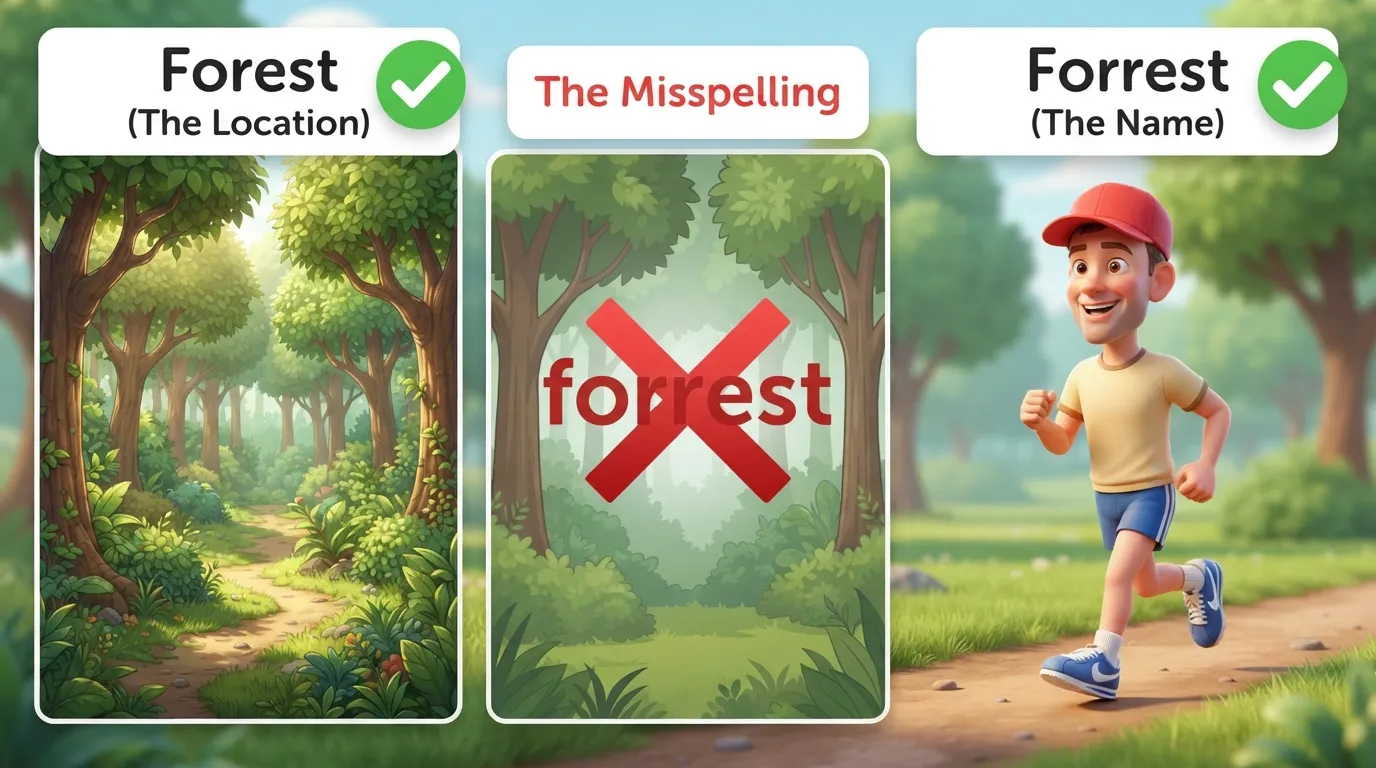
Forest is the correct spelling for a large area of trees, while forrest is a misspelling, except when used as a proper name like Forrest Gump.
I once wrote a school report about the Amazon forrest. My teacher circled it in red ink three separate times.
I stared at the page, confused. The word looked right to me. It even sounded right in my head.
That small mix up taught me something I never forgot. Forest and forrest are not interchangeable, even though they sound identical when spoken.
Millions of people type this word every single day, and a surprising number get it wrong. Search engines see this mistake so often that they quietly correct it before showing results.
If you have ever paused mid sentence, unsure which spelling looks right, you are not alone. This guide clears up the confusion for good.
You will learn the correct spelling, why the mistake happens so often, and when forrest actually belongs in a sentence.
By the end, you will never second guess this word again.
Forrest or Forest Quick Answer
Forest is the only correct spelling when referring to a large area covered in trees.
Forrest is not a real word on its own. It only appears correctly as a proper noun, like a person’s name or a place name.
Example: “We hiked through the dense forest for hours.” Compare that to: “Forrest Gump is one of the most quoted movies ever made.”
The Origin and Background of Forrest or Forest
Forest comes from the Old French word “forest,” which itself traces back to Latin roots tied to land outside city boundaries.
Over centuries, English absorbed the word with its double letter pattern intact. That spelling stuck, and it never changed into a single r.
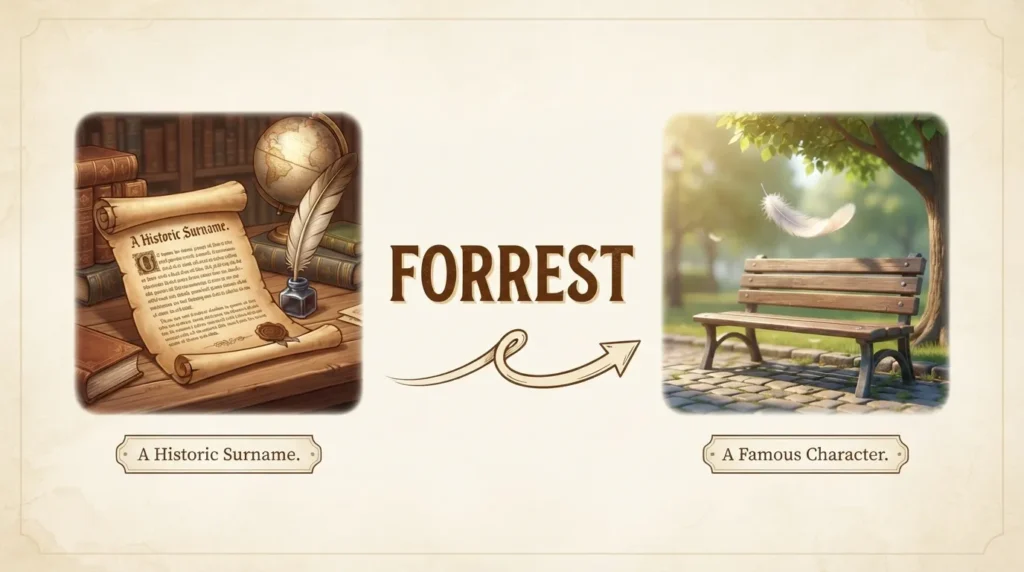
Forrest, on the other hand, grew popular mainly through names. Confederate general Nathan Bedford Forrest carried the double r spelling, and later, the fictional character Forrest Gump made the name globally famous.
That mix of a common noun and a well known proper noun creates constant confusion. People see Forrest in movie titles and assume it applies to trees too.
Autocorrect adds another layer of confusion. Some keyboards briefly suggest Forrest as a name correction, even when someone meant to type the plain word forest.
Historical records show the double r spelling was rare before the twentieth century outside of surnames. Once Hollywood and popular culture picked up names like Forrest, the spelling gained visibility it never had for describing trees or land.
This is a common pattern in English. A rare surname becomes famous through media, and suddenly people start second guessing spellings they once knew instinctively.
Forrest or Forest Explained: Key Differences
The difference comes down to double letters and context.
Forest uses a single r and a single s, describing trees, wildlife, and natural landscapes.
Forrest uses a double r, and it almost always refers to a name, whether a person, a character, or a place.
Think of other name based spelling traps in English. Adam and Addam, or Steven and Stephen, follow similar patterns where extra letters signal a proper noun, not a common word.
Doubling a letter often feels like it should carry extra meaning or emphasis. In reality, it usually just marks a name, a brand, or a specific spelling choice made generations ago by a particular family.
Once you separate the noun from the name in your mind, the confusion mostly disappears. Trees and land always use the single r spelling, without exception.
| Term | Meaning | When to Use | Region/Context |
|---|---|---|---|
| Forest | Large area of trees | Nature writing, geography, environmental topics | Used worldwide, common in US and UK |
| Forrest | Proper name only | Referring to a person or character named Forrest | Used worldwide, mainly in names |
Which Version Should You Use?
Not sure which spelling fits your sentence? This quick guide helps.
- For describing nature, always use forest. Think forest fires, forest trails, or forest animals.
- For referring to a name, use forrest, but only when capitalized and tied to a specific person or character.
- For general or unsure writing, default to forest. It covers almost every situation you will ever write about.
If you can replace the word with “woods” or “trees,” use forest. If you are naming a specific person, use forrest.
For students and writers, double checking this word before submitting an essay saves you from an easy, avoidable correction.
For content creators, using forest correctly builds trust with readers, since spelling mistakes make articles look rushed or careless.
For businesses in travel or nature niches, forest appears constantly in marketing copy, so getting it right protects your brand’s credibility.
For teachers and editors, flagging this mistake early helps students build a habit of pausing on double letter words before submitting final drafts.
For social media managers, captions move fast, and a misspelled word like forrest can slip past quick proofreading. Building a habit of a final read through catches this error before it goes public.
Common Mistakes with Forrest or Forest
Mistake 1: Writing forrest when describing trees or nature. Correction: Use forest for anything related to trees, wildlife, or natural land.
Mistake 2: Assuming forrest is simply an alternate spelling of forest. Correction: Forrest is not an alternate spelling. It only works as a proper name.
Mistake 3: Lowercasing forrest when referring to a person’s name. Correction: Always capitalize Forrest when it refers to a specific name, just like any proper noun.
Mistake 4: Trusting autocorrect to catch the mistake automatically. Correction: Autocorrect sometimes misses this error, especially in casual typing or messaging apps.
Mistake 5: Overcorrecting forest into forrest after seeing the name in movies or books. Correction: Familiarity with a name does not change the spelling rule for the common noun.
Mistake 6: Assuming British and American English spell forest differently. Correction: Both regions use the exact same spelling, forest, with a single r, for the common noun.
These mistakes happen fast, especially while typing quickly on a phone. Slowing down for a second before hitting send saves you from an easy correction later.
Forrest or Forest in Real World Examples
In a professional email: “Our team will begin the forest restoration project next month, focusing on the northern region.”
In a news headline: “Wildfires Threaten Thousands of Acres of Protected Forest Land”
In a social media post: “Spent the weekend hiking through the most peaceful forest trail I have ever found.”
In a formal document: “The environmental report highlights declining forest coverage across three counties.”
Each example shows forest used correctly, since every sentence describes trees, land, or nature, never a name.
That distinction matters more than people realize. A single misspelled letter can make a professional document look unpolished.
Readers notice spelling errors faster than most writers expect, especially in published content meant to build authority or trust.
Forrest or Forest Data, Trends, and Usage
Searches for “forrest or forest” spike whenever students write essays, reports, or geography assignments involving nature topics.
Writers, bloggers, and students search this pair most often, especially when double checking spelling before publishing content. Environmental organizations also care deeply about this word, since it appears constantly in their materials.
This search falls into the informational category. People want a fast, clear answer, not a long grammar lecture.
That matters right now because climate change coverage has increased forest related content across news sites, blogs, and reports, making correct spelling more important than ever.
Search engines also track this misspelling closely. Many results automatically redirect forrest searches toward forest content, since so few pages legitimately use the double r spelling for trees.
Publishing platforms and content editors increasingly flag this word automatically, which helps writers catch the mistake before an article goes live. Even with that help, plenty of casual writing still slips through with the wrong spelling.
Comparison Table
| Term/Variant | Meaning | Region/Context | Best Used When |
|---|---|---|---|
| Forest | Large area of trees | Common worldwide | Describing nature, land, or wildlife |
| Forrest | Proper name only | Common worldwide | Referring to a specific person or character |
Frequently Asked Questions
Q: What does forest mean? A: Forest means a large area of land covered mostly with trees, often home to wildlife and diverse plant life.
Q: How do you use forrest correctly in a sentence? A: Use forrest only as a capitalized proper name, such as referring to a person named Forrest or a character like Forrest Gump.
Q: Forrest vs forest, what is the real difference? A: Forest describes trees and natural land. Forrest only works as a name. They are not interchangeable spellings.
Q: Is forrest ever acceptable in formal writing? A: Yes, but only when referring to a proper name. Using forrest to describe trees is always incorrect in formal writing.
Q: Which version is correct, forest fire or forrest fire? A: The correct phrase is forest fire, since it describes a natural event involving trees, not a name.
Q: Where does the word forest come from? A: Forest comes from Old French, tracing back to Latin roots describing land outside city boundaries, later adopted directly into English.
Q: Can forrest be used to describe a national park? A: No, national parks and protected woodland areas always use forest, never forrest, since they involve trees and land.
Q: Why do people confuse forest and forrest so often? A: The two spellings sound identical when spoken, and the popularity of names like Forrest Gump makes the double r version feel more familiar than it should for describing trees.
Final Thoughts
Forest and forrest look similar, but only one belongs in most sentences. Forest covers trees, land, and nature. Forrest belongs only to names.
Remember the key points. Forest is the correct spelling for nature related writing. Forrest works only as a proper noun, always capitalized. Mixing them up is one of the easiest spelling slips to avoid once you know the rule.
Next time you write about trees, pause for a second and check that double letter. That quick check keeps your writing clean and professional.
Save this guide the next time you write about nature, hiking, or environmental topics, and you will never second guess this spelling again.
Now you know exactly how to use forrest or forest. Go try it in your next piece of writing.
Explore More: Childish or Childlike: The Complete Guide to Using Both Right

I’m Zain. I got interested in commonly confused words while helping non-native English speakers prep for writing exams, where a single misused word could cost real marks. That experience shaped how I write now: I try to explain not just which spelling is correct, but why the confusion exists in the first place, since understanding the reason is what actually makes it stick.