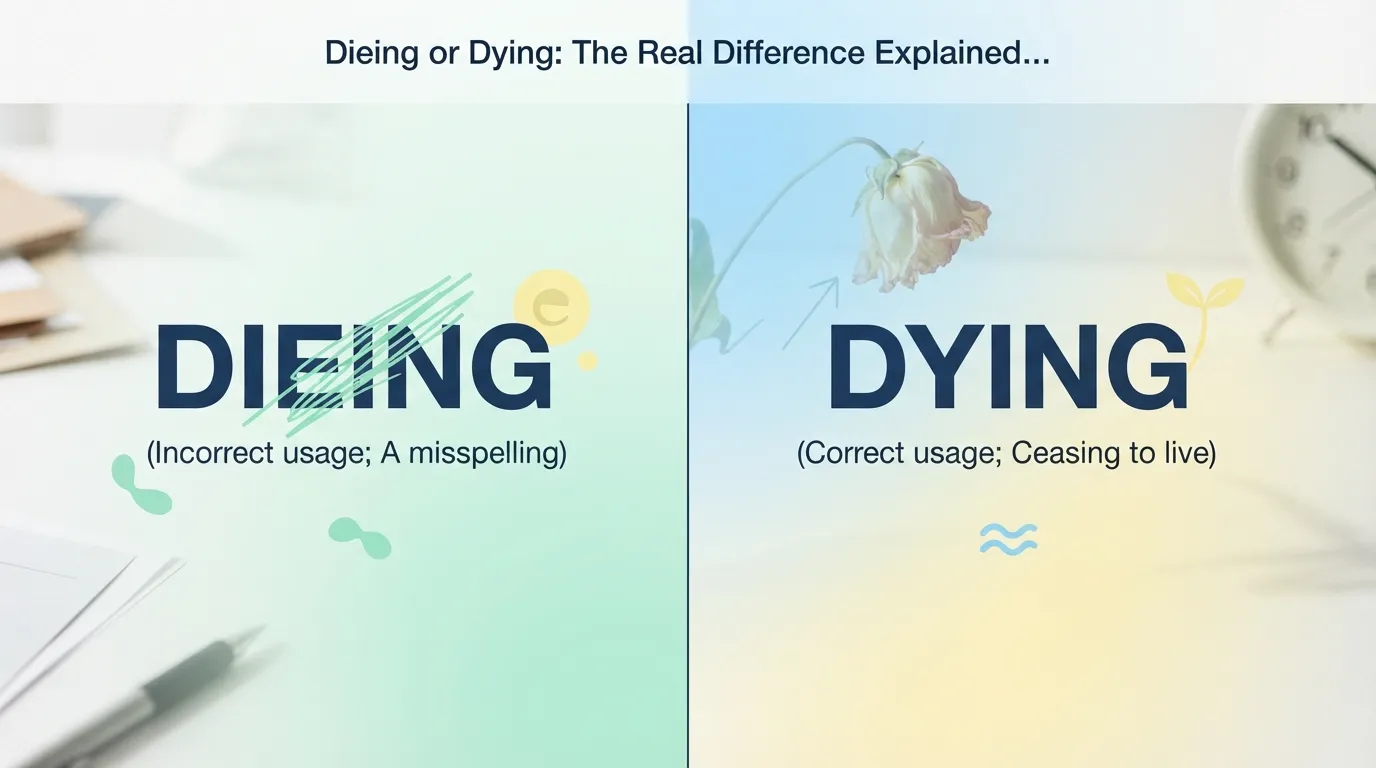
Dying is the correct spelling. Dieing is a common misspelling and is not accepted in standard English writing.
I once helped a coworker fix a company newsletter before it went out to hundreds of subscribers. Right in the second paragraph, she’d written, “Interest in the product is dieing down.” Nobody had caught it in three rounds of review, and it almost went out exactly like that.
This mistake shows up constantly, even among careful writers. You know the word ends in a soft sound, so adding “ing” feels like it should keep the “e” the way words like “seeing” and “agreeing” do.
Here’s the direct answer. This isn’t a regional spelling choice like gray and grey. Only one version is actually correct. This guide explains exactly why dying is right, why dieing keeps showing up anyway, and how to remember the rule permanently.
Dieing or Dying: Quick Answer
Dying is the correct present participle form of the verb “die,” meaning to stop living or to fade away.
Dieing is not a real word in standard English. It’s a spelling error that happens when writers keep the “e” from “die” before adding “ing,” following a pattern that doesn’t actually apply here.
Correct: “The old tradition is slowly dying out.” Incorrect: “The old tradition is slowly dieing out.”
The Origin of Dieing or Dying
The verb “die” comes from Old Norse “deyja,” and it entered English sometime around the twelfth century. Like many English verbs ending in a consonant plus “e,” it follows a specific spelling rule when you add “ing.”
That rule says you drop the final “e” before adding a vowel suffix. Write becomes writing. Like becomes liking. Die becomes dying.
Here’s where it gets tricky. Normally, dropping the “e” from a word ending in “ie” would leave an awkward double “i,” so English swaps the “ie” for a “y” instead. That’s exactly why “die” becomes “dying” and not “diing” or “dieing.”
The same swap happens with other “ie” verbs too. “Lie” becomes “lying,” and “tie” becomes “tying.” Once you notice this shared pattern, dying stops looking like an exception and starts looking like part of a consistent spelling rule.
Dieing or Dying Explained: Key Differences
The difference here isn’t regional. It’s simply correct versus incorrect.
| Term | Meaning | When to Use | Region/Context |
| Dying | Present participle of die, meaning fading or ceasing to live | Any formal or informal writing | Standard English worldwide |
| Dieing | Not a standard word, common misspelling of dying | Never in correct writing | Nonstandard, avoid entirely |
Some writers assume dieing might be an older or alternate spelling, similar to color and colour. It isn’t. Every major dictionary treats dying as the only correct form, with no regional exception anywhere.
Which Version Should You Use?
This one has a single confident answer, with no audience based exceptions required.
For every audience, in every context, use dying. Formal reports, casual messages, creative writing, and business communication all follow the exact same rule here.
If dieing ever shows up correctly, it’s almost always inside a brand name or a deliberate stylistic choice, never as standard spelling. Outside those rare cases, dieing simply isn’t accepted English anywhere.
Common Mistakes with Dieing or Dying
These mix ups come up again and again, even among strong writers.
Mistake 1: Writing dieing instead of dying. Wrong: “The battery was dieing fast, so I plugged it in.” Correct: “The battery was dying fast, so I plugged it in.” Why it happens: Writers assume the “e” stays before “ing,” the way it does in words like agreeing and seeing.
Mistake 2: Confusing dying with dyeing. Wrong: “She spent the afternoon dying her hair a new color.” Correct: “She spent the afternoon dyeing her hair a new color.” Why it happens: Dyeing, meaning to change color, keeps its “e” to distinguish it from dying, meaning to stop living, and the two get mixed up constantly.
Mistake 3: Dropping the “y” entirely. Wrong: “The plant is diing from lack of water.” Correct: “The plant is dying from lack of water.” Why it happens: Writers apply the standard rule of just dropping the final “e” without realizing the “ie” also needs to shift to “y.”
Mistake 4: Assuming dying only applies to literal death. Wrong belief: Dying can only describe a person or living thing ceasing to live. Correct belief: Dying also works figuratively, as in a tradition dying out or a fire dying down. Why it happens: Writers associate the word narrowly with its most literal meaning and forget its common figurative use.
Mistake 5: Overcorrecting nearby words that don’t follow the same rule. Wrong: Changing “tying” to “tieing” or “lying” to “lieing” out of habit. Correct: Trust the “ie to y” pattern consistently across die, tie, and lie. Why it happens: Uncertainty about one word spreads to related words that actually follow the identical spelling rule.
Dieing or Dying in Real World Examples
Professional email: “Customer interest in the older model is dying down as the new release approaches.”
News headline: “Local Industry Fights Against Dying Small Town Economies”
Social media post: “This houseplant is dying no matter what I do, send help.”
Formal report: “The committee noted that public awareness of the campaign was dying off by the final quarter.”
Each example uses dying naturally, whether describing something literal or a figurative decline.
Dieing or Dying: Data, Trends & Usage
Search interest in this spelling question stays steady year round, since the mistake appears constantly in everyday writing, emails, and social posts. People searching this term are usually double checking spelling right before publishing or sending something.
This is an informational search with a clear practical purpose. Writers aren’t debating grammar theory here, they’re confirming a word quickly, which makes a direct and confident answer far more valuable than a long explanation.
Standalone Comparison Table
| Term/Variant | Meaning | Region/Context | Best Used When |
| Dying | Present participle of die, meaning fading or ceasing to live | Standard English, worldwide | Describing something ending, literally or figuratively |
| Dieing | Not a standard English word | Nonstandard, avoid entirely | Never appropriate in correct writing |
| Dyeing | Present participle of dye, meaning to change color | Standard English, worldwide | Describing color being applied to fabric or hair |
| Lying | Present participle of lie | Standard English, worldwide | Describing reclining, or telling an untruth |
Related Words Worth Knowing
A few other verbs ending in “ie” follow this exact same spelling rule, so recognizing the pattern helps far beyond just dying.
Tying works the same way. The verb “tie” drops its final “e” and swaps “ie” for “y” before adding “ing,” giving you tying instead of the incorrect “tieing.”
Lying follows the identical pattern too. Whether you mean reclining or telling an untruth, “lie” becomes lying, never “lieing,” using the same consistent spelling shift.
Vying, from the verb “vie,” meaning to compete for something, also follows this rule. It becomes vying, not “vieing,” keeping the pattern completely consistent across every verb in this small family.
Once this pattern clicks for one word, it applies cleanly to all of them. Every English verb ending in “ie” drops the “e” and swaps to “y” before adding “ing,” with no real exceptions.
The Simple Memory Trick Nobody Else Explains
Most articles on dying versus dieing just tell you the rule and move on. Here’s a trick that actually makes it stick.
Think of the word “spy.” You already know it becomes “spying,” never “speying” or “spieing.” Your brain has zero hesitation there, because “spy” ends in “y” already, so you just add “ing” straight on top.
Now flip that logic around for “ie” words. Picture the “ie” at the end of die, tie, lie, and vie as a placeholder that’s secretly waiting to become a “y” the moment “ing” shows up. The “ie” and the “y” are basically the same sound wearing two different outfits, and “ing” only ever pairs with the “y” version.
So the next time you type dieing and it looks slightly off, picture that quiet costume change. Ie steps aside, y steps in, and dying comes out the other side. That single mental image clears up die, tie, lie, and vie all at once, which is far more useful than memorizing four separate spelling rules.
Quick Self Check: Test Yourself in Ten Seconds
Before you publish anything with this word, run it through this tiny checklist.
Does the sentence describe something ending, fading, or ceasing to live? If yes, you want dying, never dieing.
Does the sentence involve fabric, hair, or applying color? If yes, you want dyeing, with the “e” fully intact, not dying.
Read the word out loud in your head one more time. If it sounds like “die” plus “ing” jammed together with an extra “e,” that’s your signal you’ve written dieing by mistake, and it needs fixing before you hit send.
This ten second gut check works faster than looking up a grammar rule mid sentence, and it catches the mistake almost every single time.
Frequently Asked Questions
Q: What does dieing or dying mean?
A: Dying means fading, ending, or ceasing to live, and it’s the correct present participle of die. Dieing isn’t a real word and should never be used.
Q: How do you use dying correctly?
A: Use dying whenever you’re describing something in the process of ending or fading, such as “the signal is dying” or “the plant is dying.”
Q: Dying vs dyeing, what’s the actual difference?
A: Dying relates to the verb die, meaning to stop living or fade away. Dyeing relates to the verb dye, meaning to change color, and it keeps the “e” for that reason.
Q: Is dieing acceptable in formal writing?
A: No. Dieing is considered a spelling error in every formal or informal context and should always be corrected to dying.
Q: Which version is correct, dieing or dying?
A: Dying is correct. Dieing is a common misspelling that doesn’t appear in standard dictionaries as a valid form.
Q: Where does the confusion between dieing and dying come from?
A: It comes from the normal rule of dropping the final “e” before adding “ing,” combined with confusion over the extra step of swapping “ie” for “y.”
Q: Can dieing ever be used correctly?
A: No, not in standard English. The only correct present participle of die is dying, in every context and audience.
Final Thoughts
Dying is the only correct spelling here, and dieing simply isn’t a standard word, no matter the context. Remember that words ending in “ie” swap to “y” before adding “ing,” which is exactly why die becomes dying, tie becomes tying, and lie becomes lying.
Now you know exactly how to use dying correctly, so go try it in your next piece of writing. Bookmark this guide so you never second guess it again.
See More: Toward or Towards? The Real Difference Explained

I’m Zain. I got interested in commonly confused words while helping non-native English speakers prep for writing exams, where a single misused word could cost real marks. That experience shaped how I write now: I try to explain not just which spelling is correct, but why the confusion exists in the first place, since understanding the reason is what actually makes it stick.