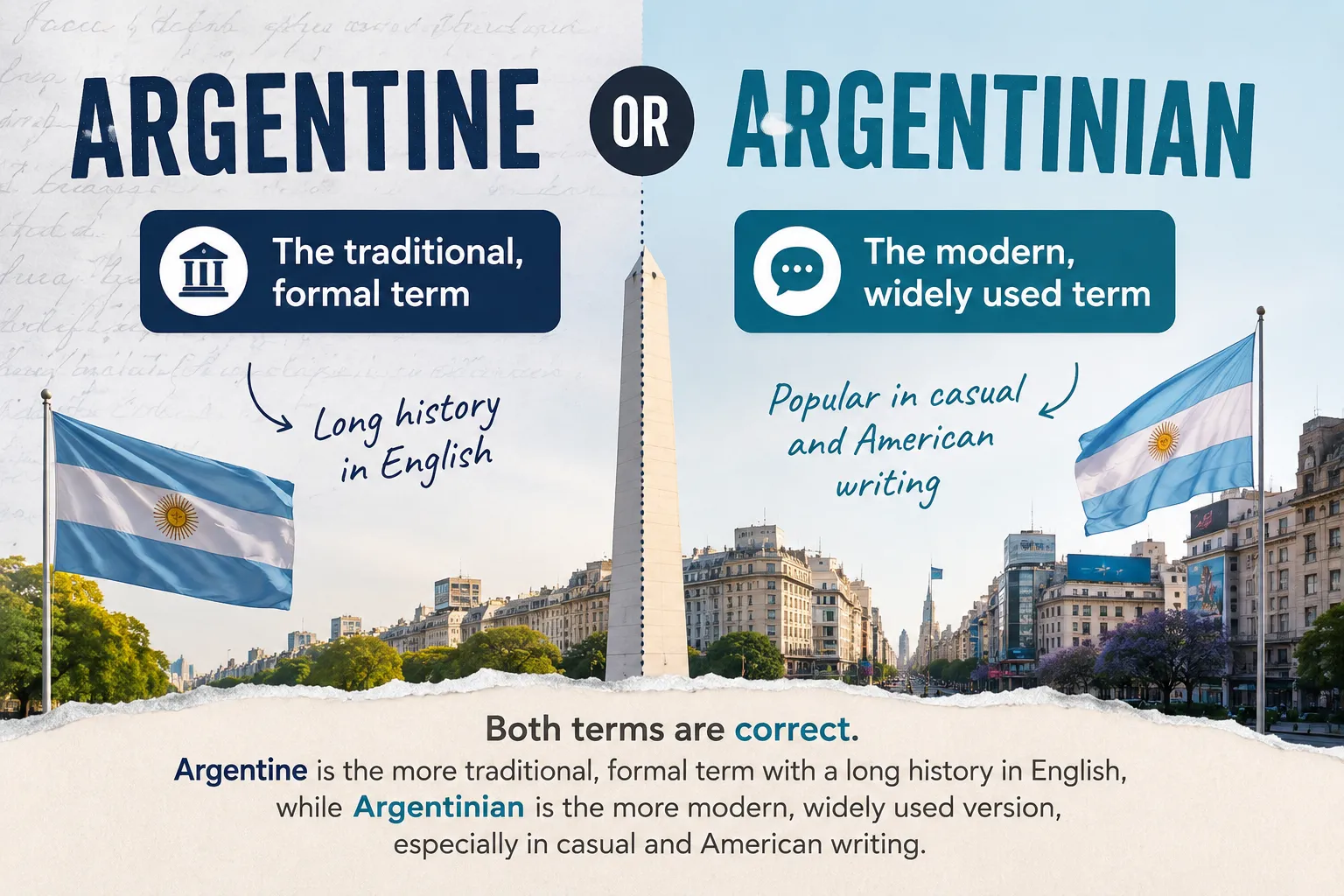
Both terms are correct. Argentine is the more traditional, formal term with a long history in English, while Argentinian is the more modern, widely used version, especially in casual and American writing.
I once wrote a magazine piece describing a chef as “an Argentinian culinary star.” My editor changed it to “an Argentine culinary star” and left a note saying it simply read better to her ear.
I pushed back a little, convinced Argentinian was the safer, more common choice. She sent me three published style guides to prove her point, and I realized this question was far less settled than I assumed.
That experience taught me something valuable. Unlike many spelling debates, this one does not have one single official winner. Both words are correct, and the right choice depends heavily on tone, audience, and publication style.
This guide breaks the confusion down clearly. You will learn where each term comes from, how major style guides treat them differently, and which one fits your specific writing situation.
Argentine or Argentinian: Quick Answer
Argentine describes a person, culture, or item connected to Argentina, and it carries a longer, more formal history in English, closely tied to the country’s official name.
Argentinian describes the exact same thing, but reads as slightly more modern and conversational, especially in American English and everyday speech.
Example: “The Argentine Republic celebrated its independence day” reflects the formal, historical usage. “She grew up eating traditional Argentinian food” reflects the more casual, contemporary style.
The Origin and Background of Argentine and Argentinian
Both words trace back to the same root, the Latin term argentum, meaning silver. Early European explorers believed the Rio de la Plata, meaning River of Silver, led toward a land rich in that precious metal, which eventually shaped the country’s name.
Argentine emerged first in English, closely following the country’s official title, the Argentine Republic. British English adopted this term early, and it became firmly established in formal writing, diplomatic language, and historical documents throughout the nineteenth and twentieth centuries.
Argentinian developed later, following a common English pattern of adding ian to a place name, similar to Canadian or Australian. As American English grew more influential globally, Argentinian gained popularity, particularly in everyday conversation, journalism, and modern digital content.
Neither term ever fully replaced the other, which explains why the debate continues today. Institutions like the BBC and older diplomatic style guides still favor Argentine, while many contemporary publications, including certain American outlets, lean toward Argentinian for people specifically.
Argentine vs Argentinian Explained: Key Differences and Variations
| Term | Meaning | When to Use | Region/Context |
|---|---|---|---|
| Argentine | Person or thing from Argentina, formal tone | Formal, historical, or British leaning writing | Common in UK and diplomatic contexts |
| Argentinian | Same meaning, modern and casual tone | Everyday writing, American English, casual media | Common in the United States and informal writing |
| Argentine Republic | The country’s official name in English | Official documents and government references | Used internationally in formal contexts |
Both terms describe identical nationality and cultural connections. The difference lies entirely in tone and formality, not in accuracy or correctness.
Which Term Should You Use?
Journalists Following British Style Guides
Use Argentine. Publications like the BBC continue to favor this term for both the noun and adjective forms.
American Writers and Casual Publications
Use Argentinian. It reads naturally to American audiences and has become increasingly common across United States media and everyday writing.
Diplomatic, Legal, or Historical Writing
Use Argentine. This aligns with the country’s official English name, the Argentine Republic, and matches how many governmental documents refer to the nation.
Sports and Entertainment Writing
Either term works well, though many modern sports outlets favor Argentinian when describing athletes, since it reads as more contemporary and conversational.
Global or Mixed Audience Writing
Choose whichever term matches your overall tone, formal or casual, and remain consistent throughout the entire piece for a polished result.
If you remember only one rule, remember this: Argentine leans formal and historical, while Argentinian leans modern and conversational.
Common Mistakes with Argentine and Argentinian
Mistake 1: Assuming One Term Is Officially Incorrect
Correction: Both terms are recognized and accepted. Neither dictionaries nor major style guides declare one version wrong.
Mistake 2: Mixing Both Terms Within the Same Document
Correction: Choose one term at the start of your writing and use it consistently throughout the entire piece for a more polished, professional result.
Mistake 3: Using Argentine as a Plural Noun Incorrectly
Correction: The correct plural form is Argentines, not Argentine, when referring to multiple people from the country.
Mistake 4: Forgetting Regional Style Preferences
Correction: British publications often favor Argentine, while American publications increasingly favor Argentinian, so consider your audience before choosing.
Mistake 5: Overlooking the Official Country Name
Correction: The country’s formal English name remains the Argentine Republic, which explains why Argentine still dominates in official and historical contexts.
Each of these mistakes happens because writers assume every word pair must follow a strict right versus wrong rule, when this particular case genuinely depends on tone and audience.
Argentine and Argentinian in Real World Examples
Professional Email
“Our sales team is preparing localized marketing materials specifically targeting Argentine consumers ahead of the product launch.”
News Headline
“Argentinian Athlete Breaks National Record at International Championship Event”
Social Media Post
“Tried authentic Argentinian empanadas for the first time tonight. Absolutely incredible flavor.”
Formal Document
“This treaty was signed between representatives of the Argentine Republic and neighboring member states.”
Notice how both terms appear naturally depending on tone, from a formal treaty to a casual food related social media post.
Argentine and Argentinian: Data, Trends, and Usage
Searches comparing Argentine and Argentinian happen consistently, driven largely by writers, students, and travelers preparing content related to Argentina’s culture, food, or people.
American audiences increasingly favor Argentinian in casual searches, while formal, historical, and diplomatic searches lean more heavily toward Argentine.
This search falls almost entirely into the informational category. Readers want clarity on acceptable usage, not a rigid grammar rule that does not actually exist here.
Growing global interest in Argentine cuisine, sports, and culture continues to keep both terms relevant, especially as more writers create content for international, cross regional audiences.
Standalone Comparison Table
| Term/Variant | Meaning | Region/Context | Best Used When |
|---|---|---|---|
| Argentine | Person or thing from Argentina, formal tone | UK, diplomatic, and historical writing | Formal or traditional contexts |
| Argentinian | Same meaning, modern tone | US and casual global writing | Everyday, conversational contexts |
Frequently Asked Questions
What does Argentine mean?
Argentine describes a person, culture, or item connected to Argentina, and it also appears in the country’s official English name, the Argentine Republic.
How do you use Argentinian correctly in a sentence?
Use Argentinian as an adjective or noun describing people or things from Argentina, such as “she is Argentinian” or “we tried Argentinian wine at dinner.”
Argentinian vs Argentine, what is the actual difference?
There is no difference in meaning. Argentine carries a more formal, traditional tone, while Argentinian feels more modern and conversational, especially in American English.
Is Argentinian acceptable in formal writing?
Yes, though many formal and historical style guides still favor Argentine, particularly in British English and official government references.
Which version is correct, Argentine or Argentinian?
Both are correct. Neither major dictionaries nor style guides declare one version incorrect, leaving the choice largely up to tone, audience, and personal or publication preference.
Where does the term Argentine come from?
Argentine comes from the Latin word argentum, meaning silver, connected to early explorers who believed the Rio de la Plata led toward a land rich in that metal.
Can Argentine and Argentinian be used interchangeably?
Yes, in most contexts they can be used interchangeably, though staying consistent with one term throughout a single piece of writing looks more polished and intentional.
Final Thoughts
Argentine and Argentinian both accurately describe people, culture, and items connected to Argentina. Neither term is wrong, and the real difference comes down to tone rather than correctness.
Keep the key takeaways in mind. Choose Argentine for formal, historical, or British leaning writing, and choose Argentinian for casual, modern, or American style content. Either way, consistency matters most.
Bookmark this guide so you never second guess this term again, and share it with any writer preparing content about Argentina’s culture, people, or history.
Read More: Endogamy or Exogamy: The Real Difference Explained

I’m Zain. I got interested in commonly confused words while helping non-native English speakers prep for writing exams, where a single misused word could cost real marks. That experience shaped how I write now: I try to explain not just which spelling is correct, but why the confusion exists in the first place, since understanding the reason is what actually makes it stick.