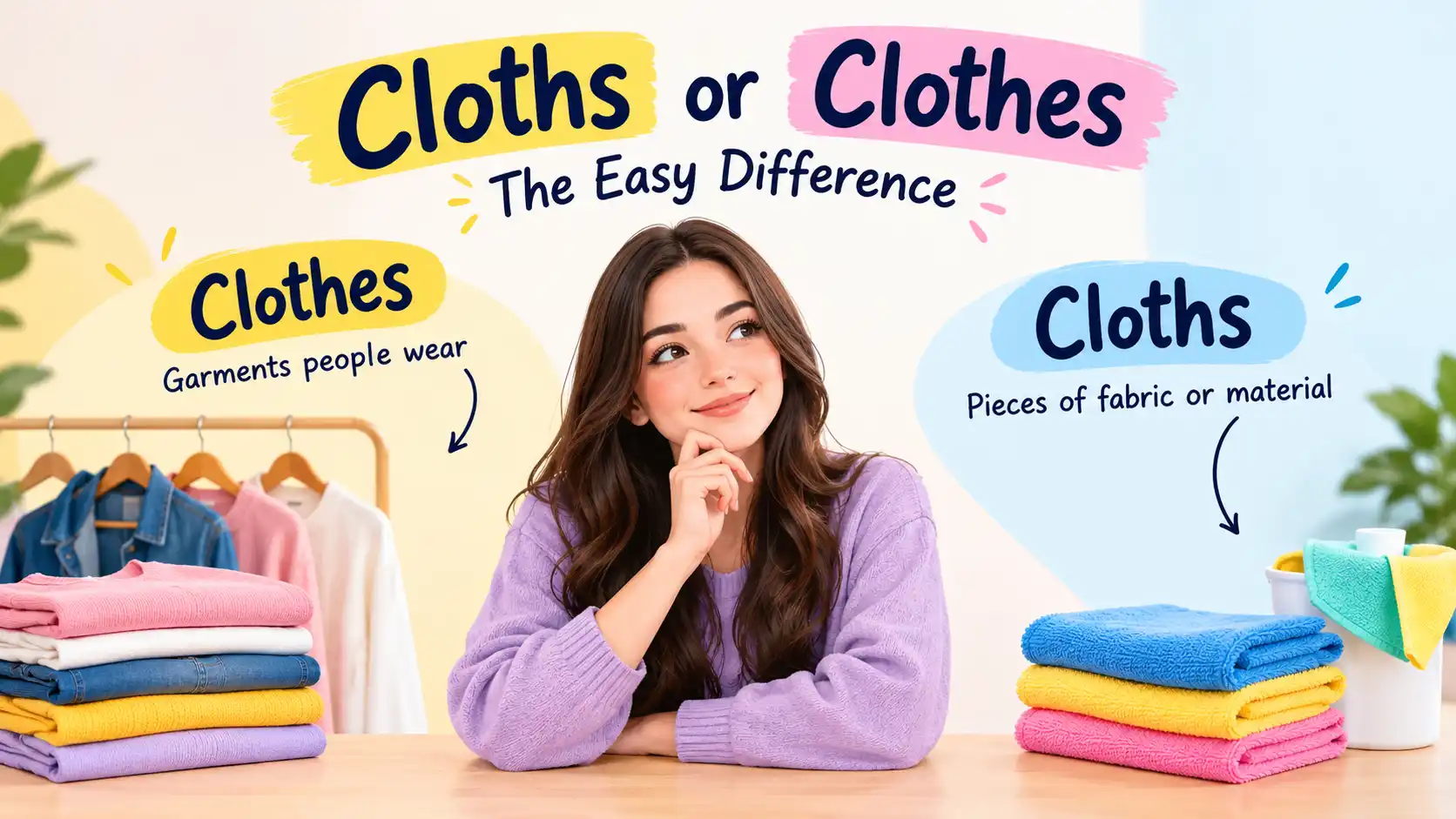
Clothes means items that people wear, such as shirts, trousers, dresses, and jackets. Cloths means pieces or types of fabric, often used for cleaning, covering, or making other things.
Have you ever typed cloths when you really meant clothes? You are not alone. These two words look almost the same, but they have different meanings and uses.
The confusion happens because both words come from the word cloth. They also sound similar in some forms of speech. However, clothes refers to things people wear, while cloths refers to pieces of fabric or different types of fabric.
For example, you might say, “I bought new clothes for the wedding.” Here, clothes means garments that you can wear. You might also say, “The cleaner used several cloths.” In this sentence, cloths means pieces of material used for cleaning.
Understanding this small difference can make your writing much clearer. It is especially useful when writing emails, school assignments, product descriptions, blog posts, and everyday messages.
Let us look at the difference in a simple way so you can choose the right word with confidence.
Cloths or Clothes: Quick Answer
Clothes means garments or things that people wear on their bodies.
Examples include:
- Shirts
- Trousers
- Dresses
- Jackets
- Skirts
- Socks
- Coats
Cloths is the plural of cloth when cloth means a piece or type of fabric.
Examples include:
- Cleaning cloths
- Polishing cloths
- Cotton cloths
- Soft cloths
- Microfiber cloths
The easiest way to remember the difference is this:
Clothes are worn. Cloths are pieces of material.
For example:
I need to buy new clothes.
I need two clean cloths for the kitchen.
That simple rule solves most cases.
What Does Clothes Mean?
Clothes is a plural noun. It refers to garments that people wear.
You can use it when talking about a person’s wardrobe or the things someone has on their body.
For example:
She bought new clothes for college.
His clothes are still wet.
Please put your clothes in the wardrobe.
These clothes are too small for me.
The word clothes can refer to many different types of garments. It does not usually refer to one specific item.
You can talk about clothes in general.
For example:
I need some new clothes.
You can also describe clothes by color, size, style, material, or purpose.
She likes comfortable clothes.
He wears formal clothes to work.
They packed warm clothes for the trip.
One important point is that clothes is normally treated as a plural word. We do not usually say a clothes or one clothes.
Instead, we say:
a piece of clothing
an item of clothing
a shirt
a dress
a pair of trousers
This distinction is useful because English has special ways of counting clothing items.
What Does Cloths Mean?
Cloths is the plural form of cloth when we mean separate pieces of fabric.
A cloth can be a piece of material used for cleaning, wiping, polishing, covering, or another purpose.
For example:
I bought three cleaning cloths.
Use soft cloths to clean the glass.
The mechanic wiped the machine with several cloths.
Keep a few cloths in the kitchen.
The word cloths is less common in everyday conversation than clothes. That is one reason learners sometimes become confused.
When people talk about garments, they normally use clothes.
When they talk about separate pieces of fabric, they can use cloths.
There is another useful point. Cloth can also refer to material in a general sense.
For example:
This dress is made from soft cloth.
However, when you mean separate pieces of material, cloths can be used.
Cloths and Clothes: The Main Difference
The easiest way to understand these words is to focus on what they describe.
| Word | Meaning | Example |
| Clothes | Things people wear | I bought new clothes. |
| Cloths | Pieces of fabric or material | I bought cleaning cloths. |
| Cloth | Fabric or material in general | This cloth is very soft. |
| Clothing | Garments in general | The store sells winter clothing. |
The key difference is simple.
Clothes are garments.
Cloths are pieces of material.
This difference is small in spelling but important in meaning.
Why Do People Confuse Cloths and Clothes?
The main reason is their similar spelling.
Look closely:
cloths
clothes
The difference is only a few letters, so it is easy to type the wrong word.
Pronunciation can also cause confusion. Clothes has an unusual pronunciation for many English learners. The letters do not sound exactly the way a learner might expect from the spelling.
Another reason is that both words are connected to cloth.
The word cloth can mean fabric or material. Over time, the word clothes became associated with garments made from fabric.
Because of this connection, learners may think that cloths and clothes are simply two spellings for the same thing. They are not.
Clothes in Everyday English
The word clothes is very common in everyday English.
You will see it in conversations about shopping, fashion, school, work, travel, weather, and personal style.
Here are some natural examples.
I need to wash my clothes.
Where did you buy those clothes?
Her clothes are beautiful.
Take some warm clothes with you.
My clothes are still in the dryer.
He donated his old clothes.
We need comfortable clothes for the trip.
In all these examples, the word refers to garments.
You can also use clothes with words such as:
- New clothes
- Old clothes
- Clean clothes
- Dirty clothes
- Casual clothes
- Formal clothes
- Warm clothes
- Summer clothes
- Winter clothes
- Baby clothes
- Children’s clothes
- Work clothes
These combinations are common and natural.
Cloths in Everyday English
The word cloths is more specific.
It usually appears when people talk about separate pieces of fabric.
Cleaning is one of the most common contexts.
For example:
I need clean cloths for the kitchen.
These cloths are good for cleaning windows.
The worker used several cloths to wipe the equipment.
Keep the cloths away from the dirty water.
You can also use cloths when talking about different pieces or kinds of fabric.
For example:
The shop displayed colorful cloths.
The artist worked with different cloths.
However, the exact meaning depends on the context.
Clothes vs Clothing
Another word that learners often confuse with clothes is clothing.
Both words can refer to things people wear, but their grammar is different.
Clothes is normally plural.
Clothing is an uncountable noun.
For example:
I bought new clothes.
I bought some new clothing.
We do not normally say:
I bought a clothing.
Instead, we can say:
I bought an item of clothing.
The word clothing often sounds slightly more formal than clothes.
For example:
The store sells children’s clothing.
Protective clothing is required in this area.
In everyday conversation, clothes is often the more natural choice.
Cloth vs Clothes
Do not confuse cloth with clothes.
Cloth can mean fabric or material.
Clothes means garments.
Consider these examples:
This cloth is soft.
Here, cloth means material.
These clothes are soft.
Here, clothes means garments.
The meaning changes completely.
Another example is:
She bought a piece of cloth.
This means she bought fabric.
She bought a piece of clothing.
This means she bought a garment.
That small change from cloth to clothing changes the meaning.
Cloths or Clothes: Comparison Table
| Term | Meaning | Common Context | Example |
| Cloth | Fabric or material | Textile and fabric | This cloth feels soft. |
| Cloths | Separate pieces of fabric | Cleaning and wiping | Use clean cloths. |
| Clothes | Garments people wear | Fashion and daily life | My clothes are clean. |
| Clothing | Garments in general | Formal and general writing | The store sells clothing. |
This table gives you a quick reference whenever you are unsure.
When Should You Use Clothes?
Use clothes when you are talking about things that people wear.
You can use it for:
- Shirts
- Dresses
- Trousers
- Jackets
- Coats
- Skirts
- Socks
- Sweaters
- Uniforms
- Other garments
Examples:
I packed my clothes last night.
She needs new clothes for work.
His clothes are covered in dust.
The children changed their clothes after school.
I left my clothes at home.
A useful test is to ask yourself:
Can a person wear it?
If the answer is yes and you are talking about garments in general, clothes is probably the word you need.
When Should You Use Cloths?
Use cloths when you mean separate pieces of fabric or material.
You might use it for:
- Cleaning cloths
- Kitchen cloths
- Polishing cloths
- Dusting cloths
- Soft cloths
- Cotton cloths
- Microfiber cloths
Examples:
I washed the cleaning cloths.
Use soft cloths on delicate surfaces.
The cleaner brought several cloths.
These cloths absorb water quickly.
A useful test is:
Is it a piece of material rather than something worn?
If yes, cloths may be correct.
Common Mistakes With Cloths and Clothes
Mistake 1: Using Cloths for Garments
Incorrect:
I bought new cloths for winter.
Correct:
I bought new clothes for winter.
The word clothes is correct because you are talking about garments.
Mistake 2: Using Clothes for Cleaning Material
Incorrect:
Use these clothes to clean the table.
Correct:
Use these cloths to clean the table.
Here, cloths means pieces of fabric used for cleaning.
However, there is a small point to remember. In some contexts, people may casually say a cloth when referring to a cleaning cloth. The plural form is cloths.
Mistake 3: Saying a Clothes
Incorrect:
I bought a clothes.
Correct:
I bought some clothes.
Or:
I bought an item of clothing.
Or simply:
I bought a shirt.
Mistake 4: Saying One Clothes
Incorrect:
I need one clothes.
Correct:
I need one item of clothing.
Or name the specific garment:
I need one shirt.
Mistake 5: Confusing Cloth With Clothes
Incorrect:
These clothes are used for cleaning.
Correct:
These cloths are used for cleaning.
The context tells you which word you need.
A Simple Memory Trick
Here is an easy way to remember the difference.
Think of clothes as the things inside your wardrobe.
Think of cloths as the things you might keep near a sink or cleaning area.
Wardrobe = clothes
Cleaning area = cloths
This is not the only use of these words, but it is a useful memory trick.
You can also remember:
Clothes are worn.
Cloths are wiped.
This short sentence can help you choose the correct word quickly.
Cloths or Clothes Cheat Sheet
| If you mean | Use |
| Shirts | Clothes |
| Dresses | Clothes |
| Trousers | Clothes |
| Jackets | Clothes |
| Garments | Clothes |
| Things worn on the body | Clothes |
| Cleaning fabric | Cloths |
| Polishing fabric | Cloths |
| Pieces of fabric | Cloths |
| Wiping material | Cloths |
| Fabric in general | Cloth |
| Garments in general | Clothing |
The One Second Test
Ask yourself:
Is someone wearing it?
Yes: clothes
Is it a piece of material being used separately?
Yes: cloths
Are you talking about fabric in general?
Use cloth.
Are you talking about garments in a general or formal way?
Use clothing.
Cloths or Clothes in Real World Examples
In a Shopping Conversation
I need some new clothes for the wedding.
The word clothes is correct because the speaker needs garments.
In a Kitchen
Please bring two clean cloths.
The word cloths is correct because the speaker needs pieces of fabric for cleaning.
In a Clothing Store
The store has a large selection of clothes.
Here, clothes refers to garments.
In a Cleaning Store
This package contains five microfiber cloths.
Here, cloths refers to separate pieces of cleaning material.
In a Textile Discussion
The cloth is made from cotton.
Here, cloth means fabric or material.
These examples show why context matters.
How to Use Clothes Correctly in Sentences
Here are more examples to help you become comfortable with the word.
My clothes are ready for tomorrow.
She donated her old clothes.
I need clean clothes after the workout.
His clothes were wet because of the rain.
They bought clothes for their children.
These clothes are too expensive.
Please fold the clothes carefully.
I left my clothes in the washing machine.
Notice that the word always refers to garments in these sentences.
How to Use Cloths Correctly in Sentences
Now look at examples with cloths.
The cleaner used several cloths.
Wash the cloths after cleaning the floor.
These cloths are soft and absorbent.
Keep separate cloths for different cleaning tasks.
The shop sells cotton cloths.
The worker wiped the surface with clean cloths.
In each sentence, cloths refers to separate pieces of material.
Is Clothes Singular or Plural?
Clothes is a plural noun.
It does not normally have a singular form with the same meaning.
You would not normally say:
one clothes
Instead, use a specific item.
one shirt
one dress
one jacket
Or use:
one item of clothing
one piece of clothing
For example:
I bought one item of clothing.
She bought two items of clothing.
This is especially useful in formal writing.
Is Cloths the Plural of Cloth?
Yes, cloths can be the plural of cloth when you mean separate pieces or types of fabric.
For example:
The store sells cleaning cloths.
Here, several separate pieces of cloth are being discussed.
But remember that cloth can also be used as an uncountable noun when talking about material in general.
For example:
This cloth is made of cotton.
You would not normally change this to cloths simply because you are talking about fabric.
The meaning and context determine the correct form.
Which Word Is More Common?
In everyday English, clothes is much more common when talking about garments.
You will hear it when people talk about:
- Shopping
- Fashion
- Dressing
- Travel
- School
- Work
- Weather
- Laundry
- Wardrobes
Cloths is more specific and usually appears when discussing separate pieces of fabric.
That is why learners are more likely to need clothes in ordinary conversations.
Clothes, Cloths, and Clothing at a Glance
| Word | Part of speech | Main meaning | Example |
| Cloth | Noun | Fabric or material | The cloth is soft. |
| Cloths | Noun | Separate pieces of fabric | The cloths are clean. |
| Clothes | Noun | Garments | Her clothes are new. |
| Clothing | Noun | Garments in general | The clothing is expensive. |
This is the easiest complete comparison to save for later.
Frequently Asked Questions
What is the difference between cloths and clothes?
Clothes means garments that people wear. Cloths means separate pieces of fabric or material. For example, shirts are clothes, while cleaning cloths are cloths.
Is clothes the plural of cloth?
No. Clothes and cloths have different meanings. Cloths is the plural of cloth when referring to separate pieces of fabric. Clothes refers to garments.
Can I say cloths when I mean clothes?
No, not when you are talking about garments. Say clothes when you mean things people wear.
For example:
I bought new clothes.
Can cloths mean pieces of fabric?
Yes. Cloths can refer to separate pieces of fabric or material.
For example:
The cleaner used three cloths.
Is clothing the same as clothes?
They have similar meanings, but their grammar is different. Clothes is normally plural, while clothing is an uncountable noun.
You can say:
I bought new clothes.
You can also say:
I bought some new clothing.
How can I remember cloths and clothes?
Remember this simple rule:
Clothes are worn. Cloths are used as pieces of material.
If you are talking about something in your wardrobe, use clothes. If you are talking about separate pieces of fabric, use cloths.
Is clothes correct in formal writing?
Yes. Clothes is a normal and correct English word. It can be used in both everyday and formal writing when you mean garments.
For very formal contexts, clothing may sometimes be more suitable, depending on the sentence.
Why are clothes and cloths spelled differently?
They developed with different meanings even though they are related to the word cloth. Clothes became the common word for garments, while cloths remained the plural form for separate pieces or types of cloth.
Final Cheat Sheet
Before you finish your sentence, use this quick guide.
Cloth
Use it for fabric or material in general.
Example:
This cloth is made from cotton.
Cloths
Use it for separate pieces of fabric.
Example:
I bought several cleaning cloths.
Clothes
Use it for garments that people wear.
Example:
I bought new clothes.
Clothing
Use it for garments in general.
Example:
The store sells children’s clothing.
The easiest rule to remember
Clothes are worn.
Cloths are pieces of material.
Once you remember that rule, the difference becomes much easier.
Conclusion
The difference between cloths and clothes is simple once you connect each word with its meaning.
Clothes refers to garments that people wear. Shirts, dresses, trousers, jackets, and coats are all examples of clothes.
Cloths refers to separate pieces of fabric or material. Cleaning cloths, polishing cloths, and other pieces of fabric can be called cloths.
The word cloth has a broader meaning because it can refer to fabric or material in general. The word clothing is another useful term for garments, especially when you want an uncountable noun.
If you are unsure which word to choose, ask yourself one question:
Is the thing being worn?
If yes, clothes is usually correct.
If it is a separate piece of fabric used for cleaning, wiping, polishing, or another purpose, cloths is usually correct.
For example:
I need new clothes.
I need clean cloths.
That small difference can prevent a common spelling and vocabulary mistake. Save this guide and return to the cheat sheet whenever you are unsure about cloths or clothes.
Now you know the difference. Use clothes for garments and cloths for separate pieces of fabric.
Read More: Colon or Semicolon: The Easy Guide to Using Both

Hi, I’m Zara. Words that look almost identical but mean different things have always fascinated me, and that is what pulled me into writing about spelling and usage. Every guide gives you the answer first, then explains it clearly enough that you won’t need to look it up again.