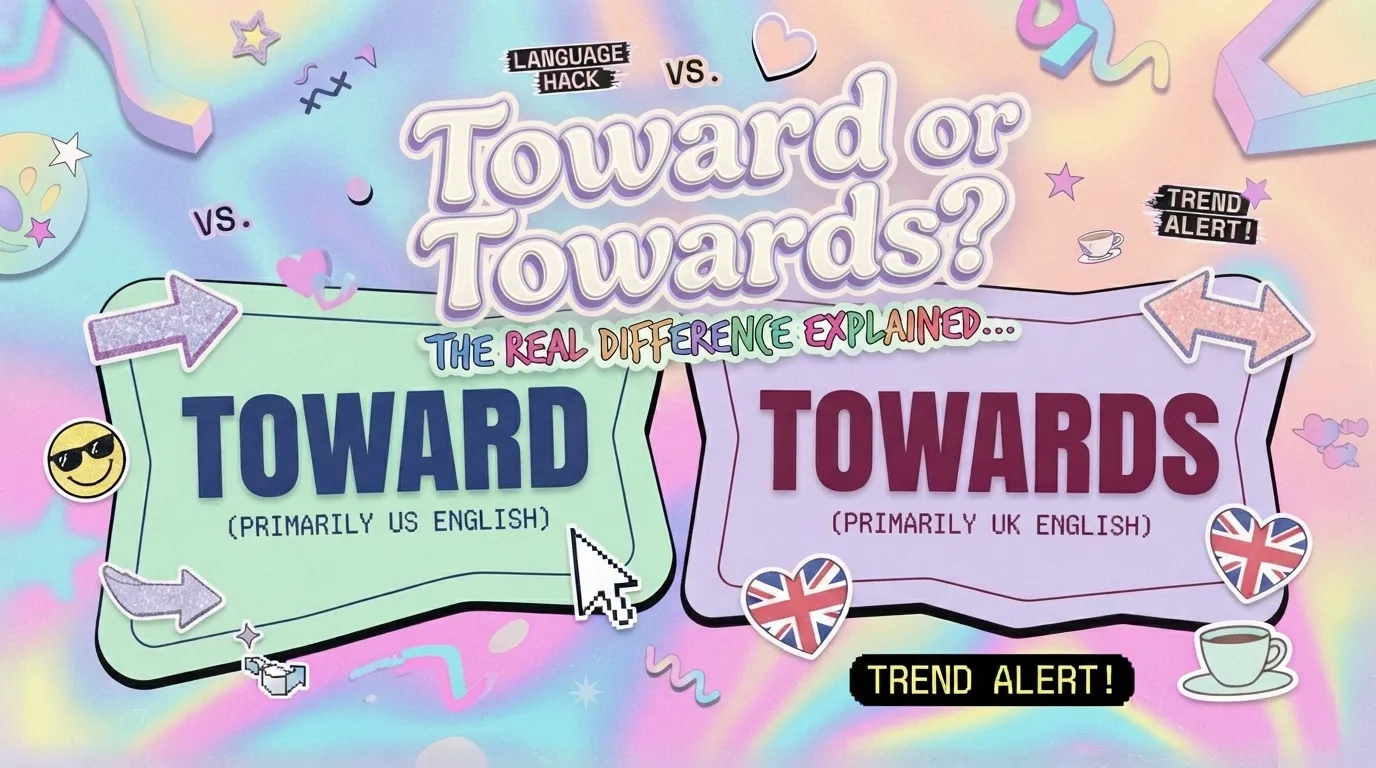
Toward and towards are the exact same word. The only difference is spelling. Toward is used in American English, and towards is used in British English.
I once proofread a college essay for a student applying to a UK university. Every single instance of “toward” in her draft got circled in red by her British tutor. She’d written a flawless essay, but she’d written it in American English by accident. That one missing “s” made her sound like she’d copied a template from an American blog.
This mix-up shows up everywhere. You write an email, a report, or an application, and suddenly you’re not sure. Toward or towards? Which one is correct?
Here’s the relief. You’re not picking between right and wrong. You’re picking between two versions of English. This guide breaks down exactly when to use each one, where the split started, and the small exceptions that catch out even strong writers.
Toward or Towards: Quick Answer
Both words mean the same thing: moving in the direction of something, or relating to a goal or attitude.
- Americans write it as toward. Example: “She walked toward the door.”
- The British, Australians, and New Zealanders write it as towards. Example: “She walked towards the door.”
That’s the entire rule. Everything else here is context.
The Origin of Toward or Towards
Both spellings come from Old English. The original word was toweard, and over time, English speakers added an “s” to some direction words as a natural grammatical habit, similar to how “always” and “besides” picked up their trailing “s” too.
For centuries, both forms floated around in British writing without much distinction. Then American English started trimming word endings during the 18th and 19th centuries, largely thanks to Noah Webster. Webster wanted American spelling to feel leaner and more efficient than British spelling. He dropped unnecessary letters wherever he could, and the “s” in “towards” was one of the casualties.
Britain never followed his lead here. Today, “towards” remains standard in the UK, while “toward” is the accepted form across the United States.
Toward or Towards Explained: Key Differences
The difference isn’t about meaning. It’s about regional preference.
| Term | Meaning | When to Use | Region/Context |
| Toward | In the direction of, or in relation to | Writing for American readers | United States |
| Towards | In the direction of, or in relation to | Writing for British-style readers | UK, Australia, New Zealand |
Both words work as prepositions in identical sentence structures. “He ran toward the finish line” and “He ran towards the finish line” mean exactly the same thing. Swap the spelling, and the sentence still reads naturally in the other dialect.
Which Version Should You Use?
Pick your spelling based on your reader, not personal habit.
- For American readers → use toward. This covers U.S. schools, businesses, and most American-based publications.
- For British, Australian, or New Zealand readers → use towards. This matches the expected spelling across most Commonwealth countries.
- For Canadian readers → lean toward towards. Canadian style guides generally follow British convention here, though American influence appears often in business and tech writing.
- For a global or mixed audience → choose one spelling and stay consistent. A single document switching between both looks careless, even if both spellings are technically correct.
Quick tip: check your spellchecker’s language setting before you start writing. Word and Grammarly will flag whichever version doesn’t match your chosen region, so you catch slip-ups early.
Common Mistakes with Toward or Towards
Even experienced writers stumble here. Watch for these five.
Mistake 1: Mixing both spellings in one document. Wrong: “We’re moving toward a solution, and heading towards success.” Correct: Pick one. “We’re moving toward a solution, and heading toward success.” Why it happens: Writers copy phrases from different sources without noticing the spelling shift.
Mistake 2: Assuming towards is informal or incorrect. Wrong belief: “Towards” is slang or a typo. Correct belief: “Towards” is completely standard, formal British English. Why it happens: American style guides and spellcheckers flag “towards” as nonstandard, which makes it look wrong even when it isn’t.
Mistake 3: Using toward in formal UK writing. Wrong: A UK academic paper reading, “The research points toward this conclusion.” Correct: “The research points towards this conclusion.” Why it happens: American software defaults and American media exposure quietly shift British writers toward the American spelling.
Mistake 4: Overcorrecting in casual American writing. Wrong: An American blog post using “towards” throughout, assuming it sounds more formal. Correct: Stick with “toward” for American audiences unless quoting British sources directly. Why it happens: Some writers assume the longer spelling automatically sounds more polished. It doesn’t. It just sounds British.
Mistake 5: Changing the spelling inside direct quotes. Wrong: Editing a quoted British source from “towards” to “toward” to match your document style. Correct: Leave direct quotes exactly as originally written, regardless of your document’s spelling convention. Why it happens: Writers apply their house style everywhere, forgetting that quotes preserve the original author’s wording.
Toward or Towards in Real-World Examples
Professional email (American): “We’re moving toward a final decision on the vendor contract by Friday.”
News headline (British): “UK Steps Towards New Climate Policy Ahead of Summit”
Social media post (American): “Feeling good about the progress toward my fitness goals this month 💪”
Formal report (British): “The committee’s recommendations point towards a full policy review next quarter.”
Notice how the spelling instantly signals which audience each example targets.
Toward or Towards: Data, Trends & Usage
Search interest for both spellings stays fairly steady, since the underlying question rarely changes: people just want to know which one is correct. Searches for toward cluster heavily in the U.S., while towards dominates search volume across the UK, Australia, and Canada.
This is almost entirely an informational search. People aren’t shopping. They’re double-checking their writing before hitting send on an email, submitting an essay, or publishing a blog post. That’s exactly why clear, direct answers rank well here. Readers want a quick decision, not a linguistics lecture.
Standalone Comparison Table
| Term/Variant | Meaning | Region/Context | Best Used When |
| Toward | In the direction of, or in relation to | United States | Writing for American audiences |
| Towards | In the direction of, or in relation to | UK, Australia, New Zealand, Canada | Writing for British-style audiences |
| Forward/Forwards | Moving in a forward direction | Both regions, “forwards” leans British | Casual or directional phrasing |
| Backward/Backwards | Moving in a backward direction | Both regions, “backwards” leans British | Casual or directional phrasing |
Related Words Worth Knowing
A few similar direction-words follow the same American/British pattern, so recognizing the pattern helps beyond just this one word.
- Forward / forwards: Americans typically drop the “s” (“move forward”), while British English often keeps it in casual speech (“move forwards”), though “forward” is common in both dialects.
- Backward / backwards: follows the same general split, with “backwards” more common in British and Australian English.
- Upward / upwards and downward / downwards: same pattern again, with the “s” version leaning British.
Once you notice this pattern, “toward or towards” stops feeling like an isolated exception and starts feeling like part of a broader, predictable rule.
Frequently Asked Questions
Q: What does toward or towards mean? A: Both words describe movement in a direction, or a relationship to a goal, attitude, or point in time. There’s no difference in meaning at all.
Q: How do you use toward or towards correctly? A: Match the spelling to your audience. Use toward for American readers and towards for British, Australian, or New Zealand readers.
Q: Toward vs towards, what’s the actual difference? A: Only spelling and region. Toward is American English. Towards is British English. Meaning and pronunciation stay identical.
Q: Is towards acceptable in formal American writing? A: It’s understood and grammatically correct, but most American style guides expect “toward” in formal writing meant for U.S. readers.
Q: Which version is correct, toward or towards? A: Neither is more correct. Both are standard, accepted spellings, just tied to different English-speaking regions.
Q: Where does the toward/towards spelling split come from? A: It traces back to Noah Webster’s 19th-century effort to simplify and Americanize British spelling conventions, including this one.
Q: Can toward and towards be used in the same document? A: Technically yes, but it looks inconsistent. Pick one spelling and use it throughout your entire piece of writing.
Final Thoughts
Toward and towards will always mean the same thing. The only real decision is who’s reading your writing. Use toward for American readers. Use towards for British, Australian, or New Zealand readers. Watch out for direct quotes and formal documents, where preserving the original spelling matters more than matching your house style.
Now you know exactly how to use toward or towards, so go try it in your next piece of writing. Bookmark this guide so you never second-guess it again.
Explore More: Dieing or Dying: The Real Difference Explained

Hey, I’m Ayeza. I started this site because I kept hitting the same wall over and over: typing a word, freezing, and not trusting my own instinct on the spelling. Now I research these mix-ups properly so you don’t have to, and I write every guide the way I wish these explanations had been written for me.