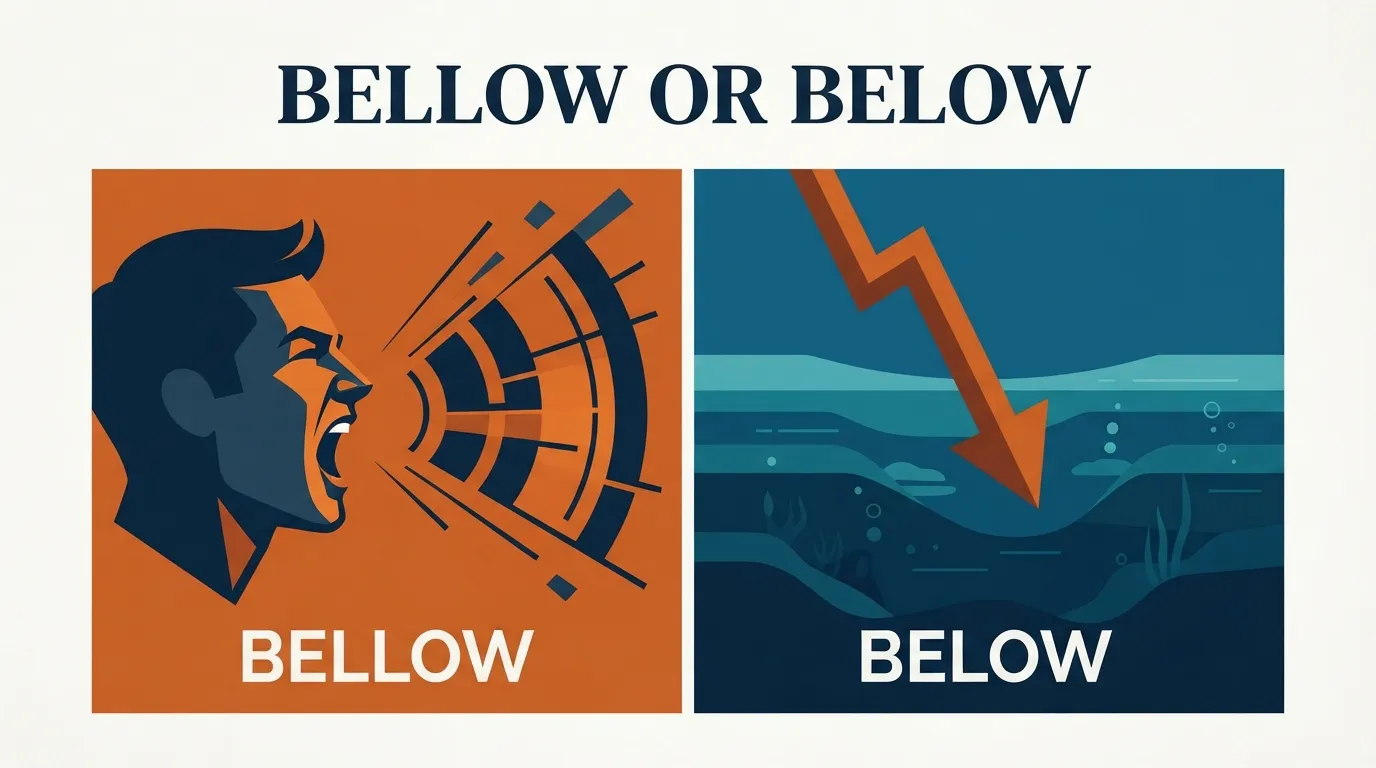
Bellow means to shout or roar loudly, while below means underneath or lower than something. They sound nothing alike once you say them out loud, but on the page they trip up writers constantly.
I once got an email from a manager who wanted his team to “bellow the deadline.” I read it three times before I realized he meant “below the deadline.” He was talking about a due date printed further down the page, not asking anyone to yell about it. That single letter swap changed the whole meaning of his sentence.
This mix up happens more often than people admit. Both words look similar at a glance. Both have five or six letters. Both start with B and end in a similar sound. Your brain sees the shape of the word before it reads every letter, and that is exactly where the confusion starts.
This guide clears up the difference for good. You will learn what each word actually means, where they came from, and how to use them correctly every time you write. By the end, you will never second guess this pair again.
Bellow or Below: Quick Answer
Bellow is a verb that means to shout loudly, often in anger or to be heard over noise. Think of a coach bellowing instructions from the sideline.
Below is a preposition or adverb that means in a lower position than something else. A footnote sits below the main text on a page.
One word describes a sound. The other describes a position. That is the entire difference in a nutshell.
The Origin of Bellow and Below
Bellow traces back to Old English bylgan, which meant to roar like a bull. The word has always carried that sense of raw, animal like volume. Over centuries it stretched to describe any loud human shout, especially one filled with emotion.
Below comes from Middle English, formed by combining be (meaning “by”) with low. Literally, it meant “by the low side” or “in a lower place.” The word settled into English as a simple, practical term for position and has barely changed since.
The confusion between them is purely visual. Neither word borrowed from the other, and neither shares a root. They simply look similar enough on paper to cause trouble, especially for fast typers and non native English speakers.
Bellow vs Below: Key Differences
| Term | Meaning | When to Use | Part of Speech |
|---|---|---|---|
| Bellow | To shout or roar loudly | Describing a loud sound or voice | Verb or noun |
| Below | In a lower position | Describing location or order | Preposition or adverb |
Example with bellow: The drill sergeant bellowed orders across the field.
Example with below: Please sign your name below the paragraph.
Notice how bellow always connects to sound and emotion, while below always connects to placement and structure. If you can replace the word with “shout,” you need bellow. If you can replace it with “underneath,” you need below.
Bellow vs Below: Pronunciation
Explain that bellow is pronounced roughly BEL-oh, while below is pronounced bih-LOH. Also mention that the stress falls on different syllables.
You can add a small table:
| Word | Pronunciation | Stress |
|---|---|---|
| Bellow | BEL-oh | First syllable |
| Below | bih-LOH | Second syllable |
Which Version Should You Use?
For writers describing noise, anger, or volume, use bellow. It fits scenes with shouting, roaring animals, or dramatic dialogue.
For anyone giving directions, instructions, or referencing document layout, use below. It fits sentences about location, rank, or order on a page.
For business and formal writing, below appears far more often. Most professional documents reference something positioned lower on the page, not a loud noise.
For creative and narrative writing, bellow shows up when you need a powerful verb to replace a weak phrase like “said loudly.” Strong verbs make fiction more vivid.
Common Mistakes with Bellow and Below
| Mistake | Correction | Why It Happens |
|---|---|---|
| “See the chart bellow.” | “See the chart below.” | Writers confuse the sound of the words while typing fast. |
| “He belowed at the referee.” | “He bellowed at the referee.” | People assume below can be a verb, but it cannot. |
| “The temperature dropped bellow zero.” | “The temperature dropped below zero.” | Autocorrect sometimes fails to catch this swap. |
| “Bellow average performance.” | “Below average performance.” | This phrase is common in speech, so the spelling gets overlooked. |
| Using bellow for anything related to position | Use below for position, always | Bellow never means underneath, no exceptions. |
A simple trick fixes this instantly. Below contains the word “low.” Since below always relates to a lower position, that shared spelling is your memory anchor. Bellow has nothing to do with “low” at all.
Bellow and Below in Real World Examples
Professional email: “Please find the attached invoice below for your review.”
News headline: “Protesters bellow demands outside city hall as talks stall.”
Social media post: “Drop your favorite recipe below and I’ll try one every week this month!”
Formal document: “All signatures must appear below the terms and conditions section.”
Creative writing: “The captain bellowed for the crew to brace as the storm hit.”
Each example shows the words doing completely different jobs. Below organizes information. Bellow adds drama and volume to a moment.
Common Phrases with Bellow and Below
Both bellow and below appear in common English expressions, but the words form very different phrases.
With bellow, common combinations include bellow with rage, bellow in anger, bellow an order, bellow for help, and bellow loudly. These expressions all involve a powerful or forceful sound.
With below, common phrases include below average, below zero, below the surface, below the line, see below, and listed below. These expressions usually describe position, level, measurement, comparison, or location.
Knowing these common word combinations can make the difference easier to recognize. If the phrase involves shouting or roaring, it likely needs bellow. If it involves a lower level, position, or measurement, it needs below.
Standalone Comparison Table
| Term | Meaning | Region/Context | Best Used When |
|---|---|---|---|
| Bellow | Loud shout or roar | Creative writing, dialogue, journalism | Describing volume, emotion, or animal sounds |
| Below | Lower position or rank | Business, legal, academic, everyday writing | Describing location, order, or reference points |
Frequently Asked Questions
Q: What does bellow mean?
A: Bellow means to shout loudly, often with force or anger. It can also describe the deep roaring sound made by an animal like a bull.
Q: What does below mean?
A: Below means in a lower position, place, or rank than something else. It often appears in phrases about location or document structure.
Q: Bellow vs below, what is the difference?
A: Bellow refers to a loud sound, while below refers to a lower position. They are unrelated words that simply look alike.
Q: Is below acceptable in formal writing?
A: Yes. Below is extremely common in formal, legal, and business writing whenever you need to reference something positioned lower on a page.
Q: Which version is correct, bellow or below, when referring to a chart?
A: Below is correct. Charts, tables, and images are positioned in a document, so you always use below to describe their placement.
Q: Where does the word bellow come from?
A: Bellow comes from Old English and originally described the loud roar of a bull. It later expanded to describe any powerful human shout.
Q: Can bellow be used as a noun?
A: Yes. A bellow can refer to the loud sound itself, as in “a bellow of laughter echoed through the hall.”
Q: How can I remember the difference quickly?
A: Below contains the word “low,” which matches its meaning of lower position. Bellow has no connection to “low” at all, since it relates to sound.
Final Thoughts
Bellow and below might look similar, but they serve completely different purposes. Bellow captures volume and emotion. Below marks position and order. Once you remember that below literally hides the word “low” inside it, the confusion disappears for good.
Next time you write a sentence with either word, pause for one second and ask yourself: am I describing a sound or a position? That single question will guide you to the right spelling every time.
Bookmark this guide so you never mix up bellow and below again, and share it with anyone who still second guesses this pair.
See More: Leaped or Leapt: The Complete Spelling Guide

My name is Ayesha Sadiqah, the writer behind this website. I write in-depth articles on English spelling, word comparisons, grammar, and vocabulary to help learners make better language choices. Every guide is carefully researched and designed to provide accurate, practical, and easy-to-understand information.