Loathe is a verb that means to hate something strongly. Loath is an adjective that means unwilling or reluctant. They sound almost the same, but they are not the same word.
I used to mix these two up all the time. I would type “I am loathe to admit it” and my editor would circle it in red every single week. It felt like a small thing, but it kept happening, and it started to bother me.
That mix up is more common than you think. Loath and loathe look almost identical. They sound almost identical too. But one is a feeling word and the other is an action word, and once you see the pattern, you will never confuse them again.
This guide breaks the whole thing down in plain language. You will learn what each word means, where they came from, how to pronounce them correctly, and how to use them in real writing without hesitation. By the end, you will spot the difference instantly, even in a fast email or a rushed text message.
Grammar mix ups like this one seem small, but they add up. Readers notice small errors, even when they cannot name exactly what feels off. Getting loath and loathe right is one of those quiet signals that tells a reader you care about precision.
Loath or Loathe: Quick Answer
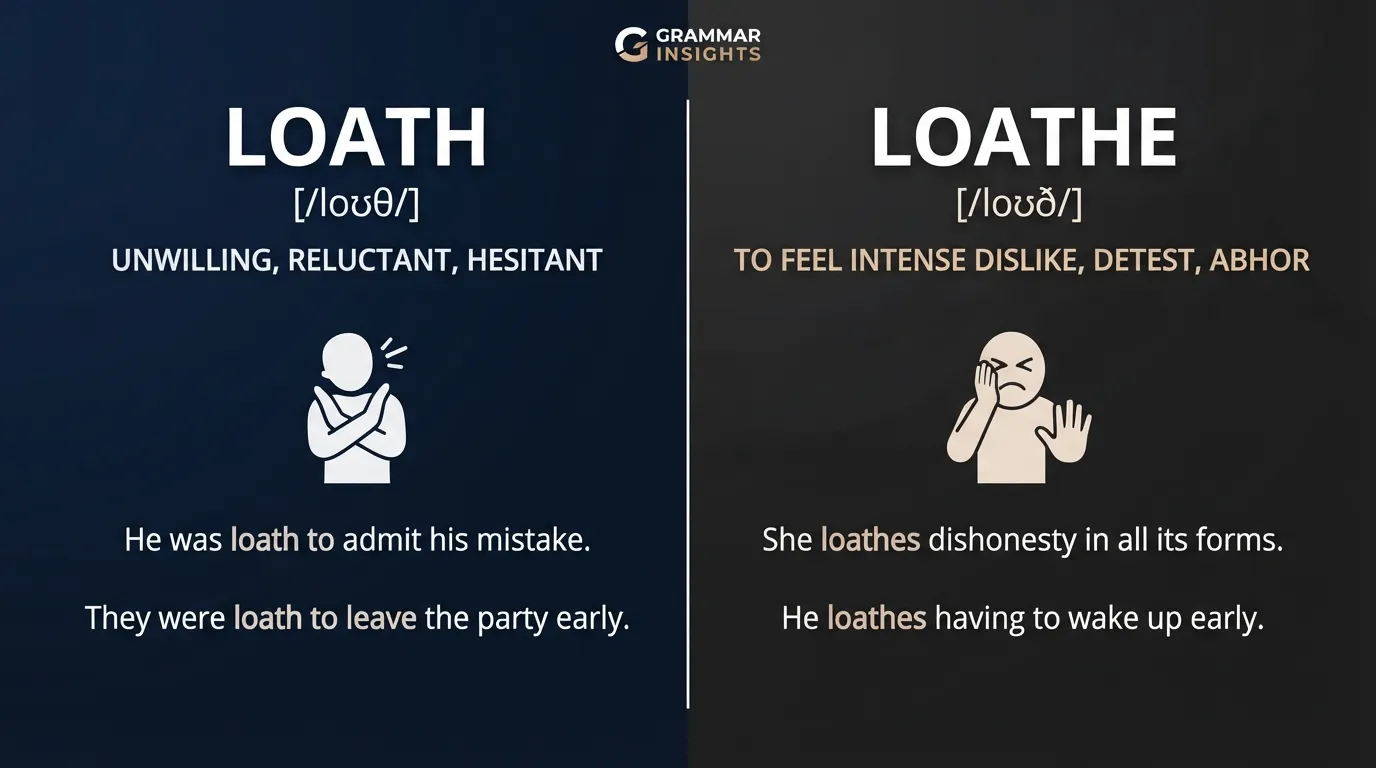
Loathe is a verb. It means to feel intense hatred or disgust toward something. Example: “She loathes waiting in long lines.”
Loath is an adjective. It means unwilling or reluctant to do something. Example: “He was loath to leave the party early.”
The easiest way to remember it: loathe has an action hiding inside it, because it is an action word. Loath describes a state of mind, not an action. Think of loath as a feeling of hesitation, and loathe as a feeling of hatred pointed directly at something.
Another simple trick is to look at the ending. Loathe ends in a silent e, just like other verbs such as breathe and bathe. Loath has no silent e, and it behaves more like a describing word, similar to words such as reluctant or unwilling.
The Origin of Loath and Loathe
Both words trace back to Old English, and they are actually related in meaning, which is part of why people confuse them even today.
Loath comes from the Old English word lath, meaning hostile or hateful. Over time, its meaning softened into simple reluctance or unwillingness. By the time Middle English developed, loath had already shifted away from strong hatred and settled into a gentler sense of not wanting to do something.
Loathe comes from the Old English verb lathian, meaning to hate. Unlike loath, it kept its stronger, more emotional meaning through the centuries. Writers from Shakespeare’s era used loathe in exactly the way we still use it today, to describe deep dislike or disgust.
So historically, these words grew from the same root, a shared ancestor word tied to hostility and hatred. English speakers slowly split them into two separate jobs: one describes a feeling of hesitation before acting, and the other describes active, ongoing hatred toward a person, place, or thing.
This shared history explains why the spelling looks so close. It is not a coincidence or a modern typo pattern. It is a genuine case of two words drifting apart from one shared root over hundreds of years.
Loath and Loathe Explained: Key Differences
| Term | Part of Speech | Meaning | Example |
| Loath | Adjective | Unwilling or reluctant | I am loath to cancel the trip. |
| Loathe | Verb | To hate strongly | I loathe rainy Mondays. |
Notice the pattern. Loath always follows a form of “to be,” such as am, is, was, or were, and it describes how someone feels about doing something. Loathe always acts directly on an object, the thing being hated, without needing a helping verb.
Here is a simple test you can run in your head before typing either word. If you can replace the word with “unwilling,” you need loath. If you can replace it with “hate,” you need loathe.
- I am loath to speak up. (unwilling to speak up)
- I loathe public speaking. (hate public speaking)
- She was loath to change her plans. (unwilling to change her plans)
- She loathes last minute changes. (hates last minute changes)
This test works almost every time, because the two words never overlap in function. One always needs a helping verb before it, and the other never does.
Which Version Should You Use?
For formal writing, use loath when describing hesitation and loathe when describing hatred. Both are acceptable in professional documents when used correctly, and neither is considered old fashioned or overly formal.
For casual writing, loathe shows up far more often, since people talk about hating things more than they talk about reluctance. You will see loathe in reviews, complaints, and casual conversation constantly.
For academic papers, loath is especially useful when discussing a subject’s unwillingness to act, such as in psychology, behavioral research, or political science, where hesitation is often the subject being studied.
For everyday speech, most people rarely use loath at all, since “reluctant” or “unwilling” often feels more natural in conversation. If you are unsure which one fits your sentence, ask yourself if you mean “unwilling” or “hate.” That single question solves almost every case you will ever run into.
It also helps to say the sentence out loud. If it sounds like you are describing a feeling of hatred toward something specific, loathe almost always fits. If it sounds like you are hesitating before doing something, loath is the better choice.
Common Mistakes with Loath and Loathe
Mistake 1: Writing “I am loathe to admit it” instead of “I am loath to admit it.” Why it happens: loathe looks more familiar to most readers, so writers default to it without thinking twice.
Mistake 2: Writing “I loath spiders” instead of “I loathe spiders.” Why it happens: dropping the silent e feels natural, since many English words shorten this way when people type quickly.
Mistake 3: Using loath as a verb, such as “I loath my job.” Why it happens: people assume both words can act as verbs, but loath only works as a descriptive adjective, never as an action word on its own.
Mistake 4: Confusing loathe with “loathsome,” thinking the two words share a root incorrectly. Why it happens: the adjective loathsome actually does come from loathe, which adds another layer of confusion for careful writers.
Mistake 5: Mixing up pronunciation, saying loath with a hard “th” sound like in the word “bath.” Why it happens: many English speakers assume similar spelling always means similar sound, but loathe rhymes with clothe, not with bath.
Mistake 6: Using loath in a sentence without a helping verb, such as “Loath to go, he stayed home,” which technically works but sounds overly formal for most modern writing. Why it happens: writers borrow older sentence patterns from classic literature without realizing modern readers expect a helping verb nearby.
Loath and Loathe in Real World Examples
In a professional email: “I am loath to interrupt your vacation, but this client issue needs your input before Friday.”
In a news headline: “Voters Loathe New Tax Proposal, Poll Shows”
In a social media post: “Not gonna lie, I absolutely loathe Monday morning traffic.”
In a formal report: “Management remained loath to approve the budget without further review from the finance team.”
In casual conversation: “Honestly, I loathe when people cancel plans last minute.”
Each example shows the same rule holding steady across very different writing styles. Loath sits beside a form of “to be” and shows reluctance or hesitation. Loathe stands alone as a strong action verb, pointing directly at whatever is being hated.
Loath and Loathe: Data, Trends and Usage
Search interest in “loath or loathe” spikes among writers, students, and editors trying to settle a grammar debate mid sentence, usually while drafting something important. It falls under informational search intent, meaning people want a fast, clear answer, not a long academic breakdown of Old English roots.
English learners search this pair frequently too, since many non native speakers learn loathe first through common phrases and never encounter loath at all until much later in their studies.
Interest also rises during school terms and exam seasons, when students write essays and need quick clarification on tricky word pairs like this one. Editors and content writers search it often as well, since a single wrong word can slow down an entire editing pass.
This confusion matters more now because so much writing happens quickly, through email, chat, and social posts, where there is no time to second guess word choice. Getting it right the first time saves editing time later and keeps writing looking polished under pressure.
Standalone Comparison Table
| Term | Meaning | Region or Context | Best Used When |
| Loath | Reluctant, unwilling | Formal and academic writing | Describing hesitation before an action |
| Loathe | To hate intensely | General and casual writing | Describing strong dislike toward something |
Frequently Asked Questions
Q: What does loath mean? A: Loath means unwilling or reluctant to do something. It is always an adjective, never a verb, and it usually follows a form of “to be,” such as am, is, or was.
Q: What does loathe mean? A: Loathe means to hate or despise something strongly. It is a verb, and it needs a direct object, such as “I loathe traffic” or “She loathes dishonesty.”
Q: Loath vs loathe, what is the actual difference? A: Loath describes reluctance or hesitation, while loathe describes active hatred. They come from related Old English roots but serve completely different grammatical roles in modern English.
Q: Is loath acceptable in formal writing? A: Yes, loath is completely acceptable in formal and academic writing, especially when describing hesitation or unwillingness to take a specific action.
Q: Which version is correct, loath or loathe, when describing hate? A: Loathe is correct when describing hate. If you mean hatred or disgust toward something, always choose loathe, never loath.
Q: Where does the confusion between loath and loathe come from? A: Both words share an Old English root related to hostility, and their similar spelling and sound cause frequent mix ups, even among careful and experienced writers.
Q: Can loath ever be used as a verb? A: No, loath functions only as an adjective. If you need a verb form to express hatred, loathe is always the correct choice.
Q: How do you pronounce loathe correctly? A: Loathe rhymes with clothe, using a soft “th” sound similar to the one in the word “this.” Loath uses a harder “th” sound, closer to the one in “bath” or “path.”
Conclusion
Loath and loathe look like twins, but they play very different roles in a sentence. Loath describes reluctance, always functioning as an adjective. Loathe describes hatred, always functioning as a strong verb. Once you remember that loathe hides an action inside it, the choice becomes automatic.
Keep the simple test in mind whenever you hesitate. Swap in “unwilling” for loath, and swap in “hate” for loathe. If the sentence still makes sense with the swap, you picked the right word.
Small grammar details like this build trust with your readers. They signal care and precision, even in a short email, a quick social post, or a rushed text message sent between meetings.
Now you know exactly how to use loath and loathe correctly, every single time. Bookmark this guide so you never second guess it again, and share it with a friend or coworker who mixes them up too.
Read More: Writen or Written: Which Spelling Is Actually Correct

I’m Zain. Through Wordiums.com, I write clear, accurate word comparison guides that show the difference between similar words, spellings, and phrases, so readers can choose the right word in seconds.