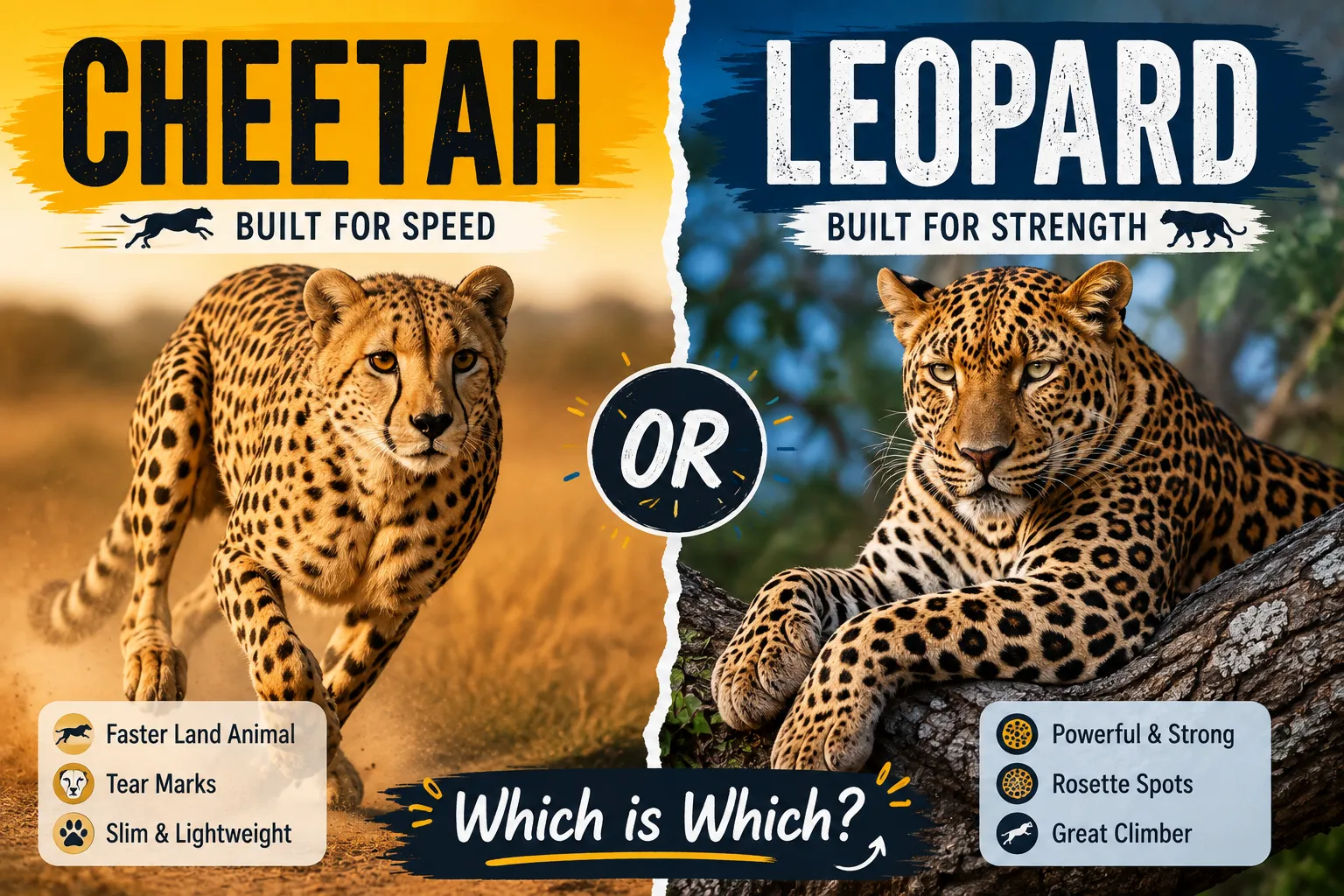
A cheetah and a leopard are two completely different big cats. A cheetah is built for speed with a slim body and solid black spots, while a leopard is built for strength with a muscular frame and cluster shaped rosette spots.
I once stood at a safari lookout in Kenya, pointed at a spotted cat resting under a tree, and confidently told my kids “that is a cheetah.” Our guide gently corrected me. It was a leopard. I had no idea how wrong I was until he explained the difference.
That moment stuck with me, because I am far from the only person who mixes these two animals up. Both are spotted, both are fast, and both live across parts of Africa and Asia. From a distance, they genuinely look similar.
But once you know what to look for, telling them apart becomes almost instant. Spot shape, body build, facial markings, and behavior all separate these two cats in ways most people never learn.
This guide breaks down every meaningful difference between a cheetah and a leopard, in plain language, so you never confuse them again, whether you are watching a documentary, visiting a zoo, or scrolling wildlife photos online.
Let us get into it.
Cheetah or Leopard: Quick Answer
A cheetah is the fastest land animal on earth, built with a lightweight frame, long legs, and a small head designed purely for explosive speed over short distances.
A leopard is a powerful, muscular climber built for strength and stealth, capable of dragging prey heavier than itself up into trees to keep it safe from other predators.
For example, a cheetah chasing a gazelle across open grassland relies entirely on raw speed, while a leopard stalking the same prey relies on patience and a sudden, powerful ambush.
The Origin of Cheetah and Leopard as Terms
This word cheetah comes from the Hindi word chita, which itself traces back to the Sanskrit word chitraka, meaning spotted one. The word entered English through colonial contact with India, where cheetahs were historically trained for hunting.
The word leopard has a much older path, tracing back to ancient Greek, where it combined leon, meaning lion, with pardos, an older word for a spotted panther like cat. Ancient naturalists mistakenly believed the leopard was a hybrid between a lion and another spotted cat, which is exactly how this compound name came to exist.
Both names reflect old attempts by humans to categorize animals based on appearance and assumed ancestry, long before modern genetics could confirm that cheetahs and leopards actually belong to entirely separate branches of the cat family tree.
Genetically, cheetahs are more closely related to cougars and jaguarundis than to leopards, despite looking somewhat similar at a glance. Leopards, on the other hand, belong to the Panthera genus alongside lions, tigers, and jaguars, making them true big cats capable of a deep roar that cheetahs simply cannot produce.
This genetic separation happened millions of years ago, long before either animal took on the form we recognize today. Fossil evidence suggests the cheetah lineage split off early and developed increasingly specialized adaptations for speed, including enlarged nasal passages for extra oxygen intake and semi retractable claws that function almost like sprinting cleats.
Leopards followed a very different evolutionary path, developing incredible upper body strength relative to their size, along with flexible joints that allow them to climb, balance, and even sleep securely on narrow tree branches many meters above the ground. These separate evolutionary pressures explain why two cats that occasionally share the same grassland ended up looking so different once you study them closely.
Cheetah Explained: Key Differences and Variations
Once you line up their features side by side, the differences become obvious and easy to remember.
| Feature | Cheetah | Leopard | Context or Habitat |
| Body build | Slim, lightweight, built for speed | Muscular, stocky, built for strength | Open savannas versus varied terrain |
| Spot pattern | Solid, small, round black spots | Cluster shaped rosettes with a hollow center | Visible up close or in clear photos |
| Facial marking | Black tear stripe running from eye to mouth | No tear stripe present | Easiest quick identifier |
| Top speed | Around one hundred kilometers per hour | Around fifty eight kilometers per hour | Cheetah is far faster over short bursts |
| Climbing ability | Rarely climbs trees | Excellent climber, often rests in trees | Leopards drag prey up trees regularly |
That black tear stripe running down a cheetah’s face is often the single fastest way to tell the two animals apart in any photo or video, even from a distance.
Which One Should You Look For?
Your identification approach depends entirely on what clue you can actually see clearly.
For a quick glance from far away, check the body shape first. A slim, greyhound like frame signals cheetah, while a thick, muscular frame signals leopard.
For a close up photo, check the spots directly. Solid round dots mean cheetah, while rosette shaped clusters with a lighter center mean leopard.
For video or live footage, watch the movement. A cheetah chasing prey in open flat terrain at incredible speed is almost certainly a cheetah, while a cat lounging in a tree branch is almost certainly a leopard.
For the most reliable identifier of all, look at the face. That black tear mark running from the eye down to the mouth belongs only to the cheetah, and no leopard has this feature.
Common Mistakes People Make With Cheetahs and Leopards
These two cats confuse even experienced wildlife enthusiasts. Here are the errors that come up again and again.
Mistake 1: Assuming spot pattern alone is enough Wrong: “It has spots, so it must be a leopard.” Correct: Check whether the spots are solid dots or hollow rosette clusters, since jaguars also have rosettes but with a distinct center dot, adding further confusion if you skip this step.
Mistake 2: Confusing cheetahs with jaguars Wrong: “That spotted cat sprinting must be a jaguar.” Correct: Jaguars are stocky, powerful swimmers found mainly in the Americas, and they never reach anywhere close to cheetah speed, so build and location both rule this out quickly.
Mistake 3: Believing leopards cannot run fast Wrong belief: “Leopards are slow since they rely on strength.” Correct understanding: Leopards can still reach impressive speeds over short distances, just nowhere near the extreme burst speed a cheetah reaches.
Mistake 4: Thinking cheetahs can roar like leopards Wrong: “I heard it roar, so it must be a cheetah.” Correct: Cheetahs cannot roar at all, they only purr, chirp, and make bird like sounds, while leopards can produce a deep, powerful roar typical of big cats.
Mistake 5: Assuming both animals live in identical habitats Wrong: “They are basically found in the same places doing the same thing.” Correct: Cheetahs prefer open grassland for hunting at speed, while leopards thrive in forests, mountains, and even urban edges thanks to their climbing ability and adaptability.
Cheetah and Leopard in Real World Examples
Seeing these terms used naturally helps cement the distinction even further.
Professional wildlife report: “Camera traps confirmed a healthy leopard population thriving within the forested reserve boundary.”
News headline: “Conservationists Celebrate Rare Cheetah Sighting in Newly Protected Grassland Corridor”
Social media post: “Watched a cheetah hit full sprint chasing an impala today, genuinely one of the wildest things I have ever seen.”
Formal document, conservation summary: “The study tracked leopard movement patterns across three distinct mountain regions over an eighteen month period.”
Each example shows how context, habitat, and behavior naturally reveal which animal the writer means, even before any physical description appears.
Cheetah and Leopard: Data, Trends and Usage
Search interest for both animals spikes heavily around wildlife documentaries, safari trip planning, and general animal fact curiosity, showing this is primarily an informational search intent.
Cheetah searches often peak around speed related content, since people frequently search terms like fastest land animal or cheetah top speed, driven by genuine fascination with the extremes of animal ability.
Leopard searches lean more toward habitat, behavior, and conservation status content, since leopards face significant habitat loss and appear frequently in wildlife protection news and documentaries.
This distinction matters for content creators, educators, and safari companies alike, since accurately describing these animals builds trust with readers and avoids the kind of embarrassing mix up that happened to me on that lookout point years ago.
Wildlife tourism operators report that guests frequently arrive already confused about basic identification, having absorbed inaccurate information from movies, cartoons, and casual internet browsing over the years. Tour guides often spend the first few minutes of any game drive simply clarifying these basics before guests can fully appreciate what they are actually seeing.
Educational content that clears up this confusion tends to perform well precisely because it solves a problem people did not realize they had until they needed it, whether planning a trip, helping a child with a school project, or simply settling a friendly argument during a nature documentary.
Comparison Table: Cheetah vs Leopard
| Term or Variant | Meaning | Region or Context | Best Used When |
| Cheetah | Fast, slim built cat with solid spots | Africa, small population in Iran | Describing speed and open grassland hunting |
| Leopard | Muscular, adaptable climbing cat with rosettes | Africa and Asia | Describing strength, stealth, and tree climbing |
| Jaguar | Stocky rosette patterned cat with a center dot | Central and South America | Never confuse with cheetah or leopard |
| Panthera genus | True big cats capable of roaring | Global, includes lions and tigers | Leopards belong here, cheetahs do not |
Frequently Asked Questions
Q: What is the real difference between a cheetah and a leopard? A: A cheetah is a slim, incredibly fast cat with solid black spots and a tear stripe on its face, while a leopard is a muscular, adaptable climber with rosette shaped spots and no tear stripe.
Q: How do you tell a cheetah and a leopard apart quickly? A: Look for the black tear stripe running from the eye to the mouth, since only cheetahs have this feature, making it the fastest reliable identifier.
Q: Cheetah vs leopard, which one is faster? A: The cheetah is dramatically faster, capable of reaching speeds near one hundred kilometers per hour, while a leopard tops out around fifty eight kilometers per hour.
Q: Is a cheetah considered a big cat like a leopard? A: No, cheetahs belong to a separate genus and cannot roar, while leopards belong to the Panthera genus alongside lions and tigers and can produce a true roar.
Q: Which animal climbs trees, cheetah or leopard? A: Leopards are excellent climbers and often rest or store prey in trees, while cheetahs rarely climb since their body build favors ground based speed instead.
Q: Where do cheetahs and leopards typically live? A: Cheetahs favor open grasslands ideal for high speed chases, while leopards thrive across forests, mountains, and varied terrain thanks to their strength and adaptability.
Q: Can cheetahs and leopards be found in the same region? A: Yes, their ranges overlap in parts of Africa, though they generally avoid direct competition by hunting differently and occupying slightly different habitat niches within the same area.
Final Thoughts
Cheetahs and leopards may share a spotted coat, but almost everything else about them tells a different story. One is built purely for speed, the other for strength and stealth.
Remember these key takeaways. Check the tear stripe first, since only cheetahs have it. Look at spot shape next, solid dots for cheetah, hollow rosettes for leopard. Consider habitat and behavior as a final confirmation, since these two cats rarely act alike even when spotted in similar terrain.
Next time you spot a big cat in a photo, documentary, or on safari, you will know exactly which one you are looking at within seconds.
Bookmark this guide so you never mix up a cheetah and a leopard again, and share it with anyone who has ever confidently pointed at the wrong spotted cat.
See More: Bias or Biased: The Simple Grammar Rule Everyone Gets Wrong

Hi, I’m Zara. Words that look almost identical but mean different things have always fascinated me, and that is what pulled me into writing about spelling and usage. Every guide gives you the answer first, then explains it clearly enough that you won’t need to look it up again.