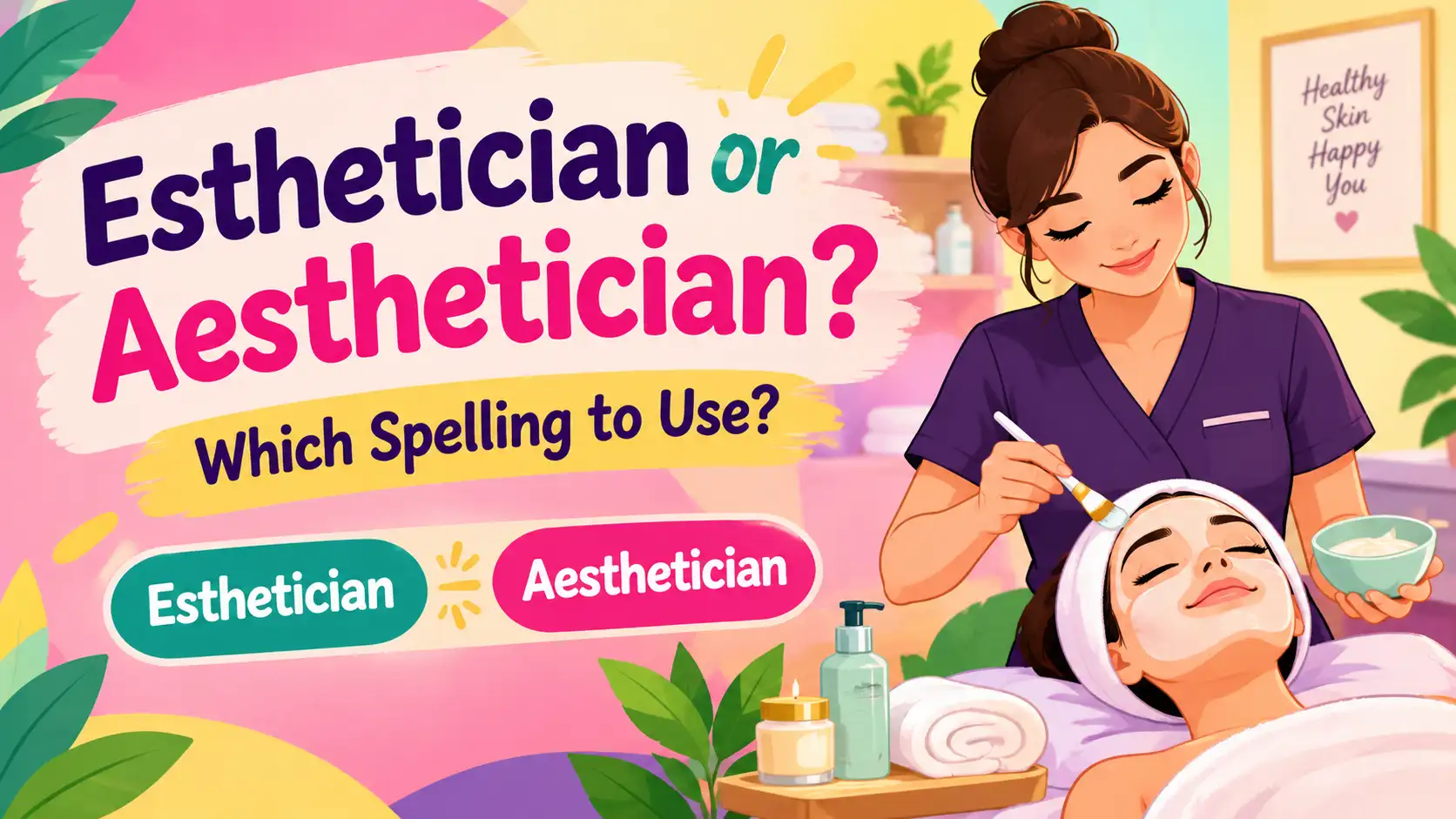
Both spellings are correct. Esthetician is the common American form, and aesthetician is widely used around the world.
Esthetician and aesthetician are both correct spellings of the same word. They name a trained professional who provides skin care treatments, such as facials. Esthetician is the standard American spelling and is used by many licensing boards in the United States. Aesthetician keeps the original ae and is common in British English and in many international settings. Choose the one your readers expect, and use it consistently.
At a Glance: Esthetician vs Aesthetician
| Feature | Esthetician | Aesthetician |
| Correct spelling | Yes | Yes |
| Style | American spelling | British and international spelling |
| Meaning | A trained skin care professional | A trained skin care professional |
| Common in | US licensing boards and salons | UK, Australia, and many other regions |
| Pronunciation | /ˌɛsθəˈtɪʃən/ | /ˌɛsθəˈtɪʃən/ (same sound) |
| Other meaning | None | Rare: a person who studies the philosophy of beauty |
| Example | She booked a facial with an esthetician. | The clinic hired a new aesthetician. |
What Does Esthetician Mean?
An esthetician is a person who is trained to care for the skin. Services often include facials, skin analysis, exfoliation, waxing, and makeup application. The word is pronounced /ˌɛsθəˈtɪʃən/ in American English, and the spelling does not change the sound.
Examples:
- She booked a facial with a licensed esthetician.
- The salon hired a new aesthetician last month.
- An esthetician can suggest a skin care routine for dry skin.
Remember that the exact services an esthetician may offer depend on local law and training. In many places, they work on the skin’s surface and do not diagnose or treat medical conditions.
Why Are There Two Spellings?
The difference comes from the ae and e pattern. Many English words come from Greek and Latin words with ae. American English often simplified that to e, while British English often kept ae.
- aesthetic and esthetic
- aesthetics and esthetics
- anaesthesia and anesthesia
- paediatrics and pediatrics
Esthetician and aesthetician follow the same rule. The base word is aesthetic, from the Greek aisthetikos, meaning relating to perception. The profession name was formed with the suffix ician, the ending used in words such as beautician, musician, and technician.
Which One Should You Use?
Use these quick guidelines.
- Writing for readers in the United States: esthetician.
- Writing for readers in the UK, Australia, or many other regions: aesthetician.
- Writing a job posting, a license page, or a school page: match the exact wording used by your local licensing office.
- Writing for a global audience: pick one and stay consistent.
If you work in a country where the title is not formal, many salons advertise the same service under beautician, beauty therapist, or skin therapist.
Esthetician vs Cosmetologist vs Dermatologist
People often mix up these professions, so here is a quick comparison.
- Esthetician: focuses on skin care, such as facials, waxing, and light exfoliation. Training and rules vary by place.
- Cosmetologist: usually has a broader license that can include hair, nails, and skin services.
- Dermatologist: a medical doctor who diagnoses and treats skin, hair, and nail conditions.
- Beautician or beauty therapist: a general term for a person who provides beauty services, used more in British English.
If you have a medical skin concern, a dermatologist is the right person to see. An esthetician can help with routine skin care and relaxation treatments.
Medical Esthetician
You may also see the titles medical esthetician or clinical esthetician. These usually describe an esthetician who works in a medical office or skin clinic, often alongside doctors. The services can include deeper skin treatments, but the rules depend on the location and the supervision. Always check the license and training of any provider.
Aesthetician in Another Sense
Aesthetician can also mean a person who studies aesthetics, the philosophy of beauty and art. This use is rare and mostly found in academic writing. In a skin care context, readers will understand aesthetician as a skin professional, so context solves any confusion.
Word History
The root word aesthetic comes from the Greek aisthetikos, meaning perceptive, which comes from aisthanesthai, meaning to perceive. The German philosopher Alexander Baumgarten used the term aesthetica in the 1700s for the study of sensory beauty, and English adopted aesthetic in the late 1700s. The job title esthetician was formed later from the same root, as skin care became a recognized profession.
Related Words
- Aesthetic or esthetic: relating to beauty.
- Aesthetics or esthetics: the study of beauty, or the visual style of something.
- Aesthete or esthete: a person who has a strong love of beauty.
- Aesthetically or esthetically: in a way that relates to beauty.
Each follows the same ae or e pattern, so once you choose your spelling, apply it to all of them.
Example Sentences
- The esthetician cleaned her skin and applied a light mask.
- An aesthetician offers treatments for dry and sensitive skin.
- He trained as an esthetician before opening his own studio.
- The clinic employs a medical aesthetician and two nurses.
- She wants to become a licensed esthetician next year.
Common Mistakes
- Mixing esthetician and aesthetician on the same page.
- Writing estetician without the h.
- Spelling it estheticien or aestheticien, which are French style endings.
- Calling an esthetician a doctor. They are not medical doctors.
- Writing aesthetician for the American license title when your local board uses esthetician.
Frequently Asked Questions
Is it esthetician or aesthetician? Both are correct. Esthetician is more common in the US.
What does an esthetician do? They provide skin care services such as facials, waxing, and skin analysis.
What is the difference between an esthetician and a cosmetologist? An esthetician focuses on skin, while a cosmetologist often has a broader license that includes hair and nails.
Is an esthetician a doctor? No. A dermatologist is the medical doctor for skin conditions.
Are esthetic and aesthetic the same? Yes. They are two spellings of the same word.
Conclusion
Esthetician and aesthetician are two accepted spellings of the same job title. Esthetician suits American readers, and aesthetician suits readers in Britain and many other places.
The key is to pick one spelling and keep it everywhere on the page. When you write about licensing or training, follow the exact term used by your local board.
Once you match the spelling to your audience, the choice becomes simple.
Read More: Macaron vs Macaroon: What Is the Difference?

My name is Ayesha Sadiqah, the writer behind this website. I write in-depth articles on English spelling, word comparisons, grammar, and vocabulary to help learners make better language choices. Every guide is designed to provide accurate, practical, and easy-to-understand information.