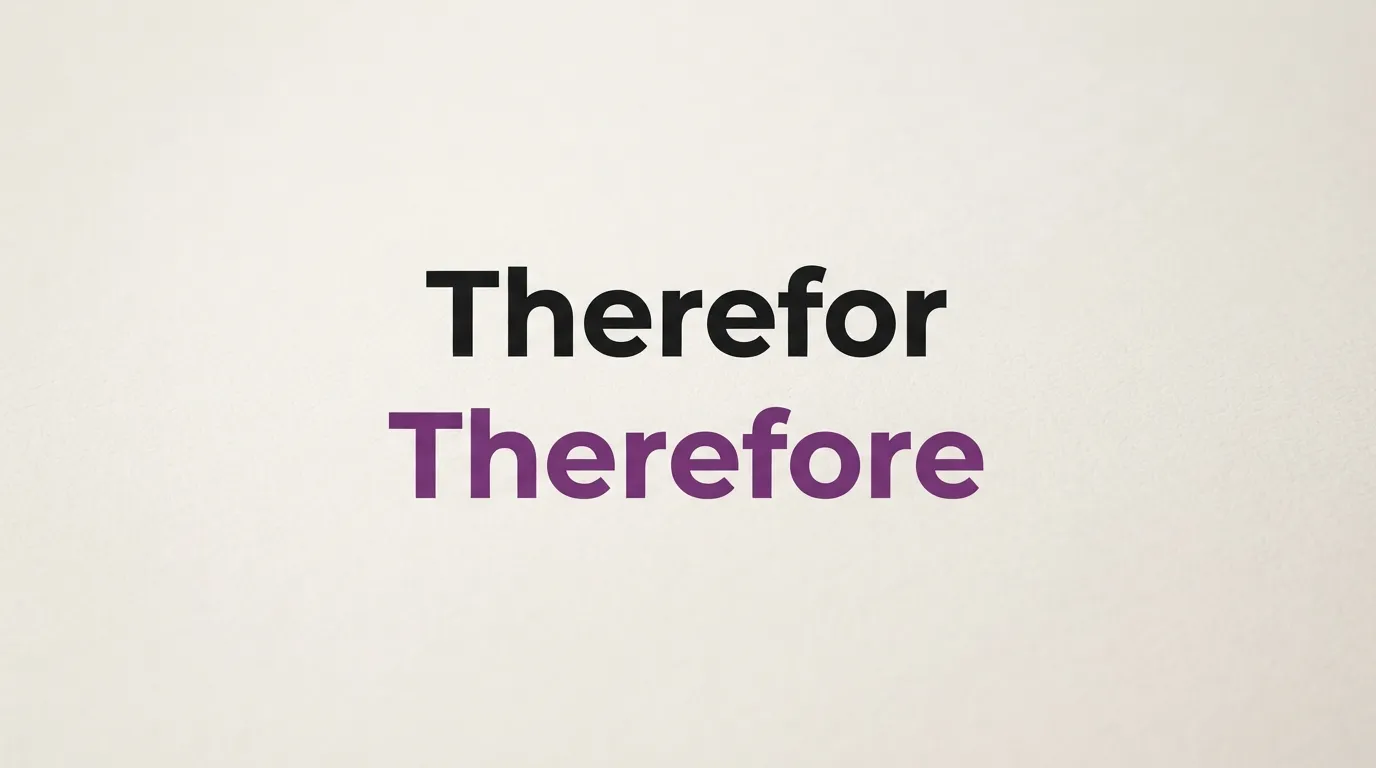
Therefore means “as a result” or “for that reason.” Therefor is a rare, formal word meaning “for that” or “for it,” mostly used in legal writing.
I Once Deleted a Word by Accident
I was proofreading a client’s contract years ago. I spotted what looked like a typo, “therefor,” and quietly fixed it to “therefore.” My client called an hour later, confused. That single letter had changed the legal meaning of the whole clause.
That mistake taught me something important. These two words look almost identical, but they are not interchangeable. Most people have never even heard of “therefor” on its own.
This confusion pops up constantly in essays, emails, and legal documents. Spell check often flags “therefor” as wrong, even though it is a real word.
This guide settles the confusion for good. You will learn exactly what each word means, when to use it, and how to avoid an expensive mistake like mine.
Let’s clear it up.
Therefore, Quick Answer
Therefore is the word you already know. It means “as a result” or “consequently.”
You use it to connect a cause with its effect. For example, “It rained all day, therefore the game was cancelled.”
Therefor is different. It means “for that” or “for it,” and it almost always appears in formal or legal contexts, such as “The buyer shall pay the amount due therefor.”
The Origin of Therefore and Therefor
Both words come from Old English. They were built by joining “there” with a preposition, either “for” or “fore.”
Therefore developed from “there” plus “fore,” carrying the sense of moving forward toward a result. Over time, English speakers used it to signal cause and effect in everyday speech.
Therefor kept the plain preposition “for,” staying closer to its original, literal meaning of “for that thing.” Legal English tends to preserve older word forms, which is why “therefor” survived mainly in contracts, court documents, and statutes.
Most modern readers never encounter “therefor” outside formal writing. That rarity is exactly why it feels like a typo, even when it is correct.
Therefore and Therefor Explained, Key Differences
The two words serve completely different grammatical roles, even though they look nearly identical on the page.
Therefore works as a conjunctive adverb. It links two ideas and shows a logical result.
Therefor works as an adverb too, but it replaces a specific noun phrase already mentioned, similar to how “for it” or “for that” would function.
| Term | Meaning | When to Use | Region/Context |
| Therefore | As a result, consequently | Everyday writing, essays, speech | Used worldwide in English |
| Therefor | For that, for it | Legal contracts, formal statutes | Mostly legal and formal writing |
For example, “She studied hard, therefore she passed the exam” uses the common word correctly. “The property and all rights appurtenant therefor” uses the rare legal form correctly.
Which Version Should You Use?
For students and everyday writers, always use therefore. It fits nearly every situation where you want to show cause and effect.
For lawyers and legal drafters, use therefor only when replacing a specific noun already named earlier in the sentence.
For business professionals, stick with therefore unless you are drafting or reviewing formal legal text.
For anyone unsure, default to therefore. It is correct almost everywhere outside of legal writing.
Common Mistakes with Therefor and Therefore
Mistake 1: Using “therefor” when you mean “as a result.” Correction: Use “therefore” instead. “He was late, therefore he missed the meeting.”
Mistake 2: Assuming “therefor” is always a typo. Correction: It is a real word. Spell check flags it because it is rare, not because it is wrong.
Mistake 3: Confusing “therefor” with “therefore” in legal editing. Correction: Read the sentence carefully. If it means “for that specific thing,” keep “therefor.”
Mistake 4: Adding an extra “e” out of habit. Correction: Double check formal or legal documents before autocorrecting anything.
Mistake 5: Using “therefor” in casual writing to sound formal. Correction: This usually confuses readers. Stick with “therefore” in everyday content.
Therefore and Therefor in Real World Examples
Professional email: “The report is complete, therefore we can move forward with the next phase.”
News headline: “City Council Approves Budget, Therefore Delays New Tax Plan”
Social media post: “Missed the bus again this morning, therefore late to work. Again.”
Formal document: “The applicant shall submit payment and all documentation required therefor.”
Each example shows exactly how the correct spelling changes based on context, from casual daily writing to strict legal language.
Therefore and Therefor, Data, Trends, and Usage
Searches comparing these two words spike among law students, paralegals, and contract writers far more than general audiences.
Most search intent here is informational. People want confirmation before submitting a legal document or academic paper.
This distinction matters more now, since AI writing tools and spell checkers frequently autocorrect “therefor” into “therefore” without asking. That quiet change can alter the legal meaning of a sentence entirely, just like it did with my client’s contract.
Therefore vs Therefor, Standalone Comparison
| Term/Variant | Meaning | Region/Context | Best Used When |
| Therefore | As a result, consequently | General English, worldwide | Showing cause and effect |
| Therefor | For that, for it | Legal and formal documents | Replacing a specific noun already named |
| Thereof | Of that, of it | Legal and formal documents | Referring back to something previously mentioned |
| Thereto | To that, to it | Legal and formal documents | Attaching something to a prior reference |
A Simple Way to Remember It
Picture a courtroom. Lawyers speak in old fashioned, precise phrases, and “therefor” belongs right there among them, tucked into contracts like a small, formal cousin of “therefore.”
Outside that courtroom, in everyday conversation, “therefore” does all the heavy lifting. It carries the idiom of logic itself, the simple phrase that says one thing led to another.
The connotation of therefore feels confident and clear. It signals a conclusion, almost like closing an argument. Therefor, on the other hand, feels stiff and technical, carrying the formal weight of legal English.
Frequently Asked Questions
Q: What does therefore mean?
A: Therefore means “as a result” or “consequently.” It connects a cause with its effect in a sentence.
Q: How do you use therefor correctly?
A: Use it to replace a specific noun phrase already mentioned, mostly in legal or formal writing, such as “payment due therefor.”
Q: Therefor vs therefore, what’s the difference?
A: Therefore shows cause and effect in everyday writing. Therefor means “for that” and appears almost only in legal documents.
Q: Is therefor acceptable in formal writing?
A: Yes, it is standard in legal and contractual writing, though rare outside those contexts.
Q: Which version is correct, therefor or therefore?
A: Therefore is correct for almost all everyday and academic writing. Therefor is correct only in specific legal contexts.
Q: Where does the word therefore come from?
A: It comes from Old English, combining “there” with “fore,” originally meaning “before that” and later shifting toward showing a result.
Q: Can therefor be used in casual conversation?
A: No, it sounds out of place outside formal or legal writing and can confuse everyday readers.
Final Thoughts
Therefore is the word you need almost every time. Therefor stays reserved for legal and formal writing, replacing a specific noun already named.
Remember the courtroom picture, and you will always know which one to reach for.
Now you know exactly how to use therefor or therefore, go try it in your next piece of writing.
Bookmark this guide so you never second guess therefor or therefore again.
Explore More: Yea or Yeah: The Simple Rule You Need to Know

I’m Zain. I got interested in commonly confused words while helping non-native English speakers prep for writing exams, where a single misused word could cost real marks. That experience shaped how I write now: I try to explain not just which spelling is correct, but why the confusion exists in the first place, since understanding the reason is what actually makes it stick.