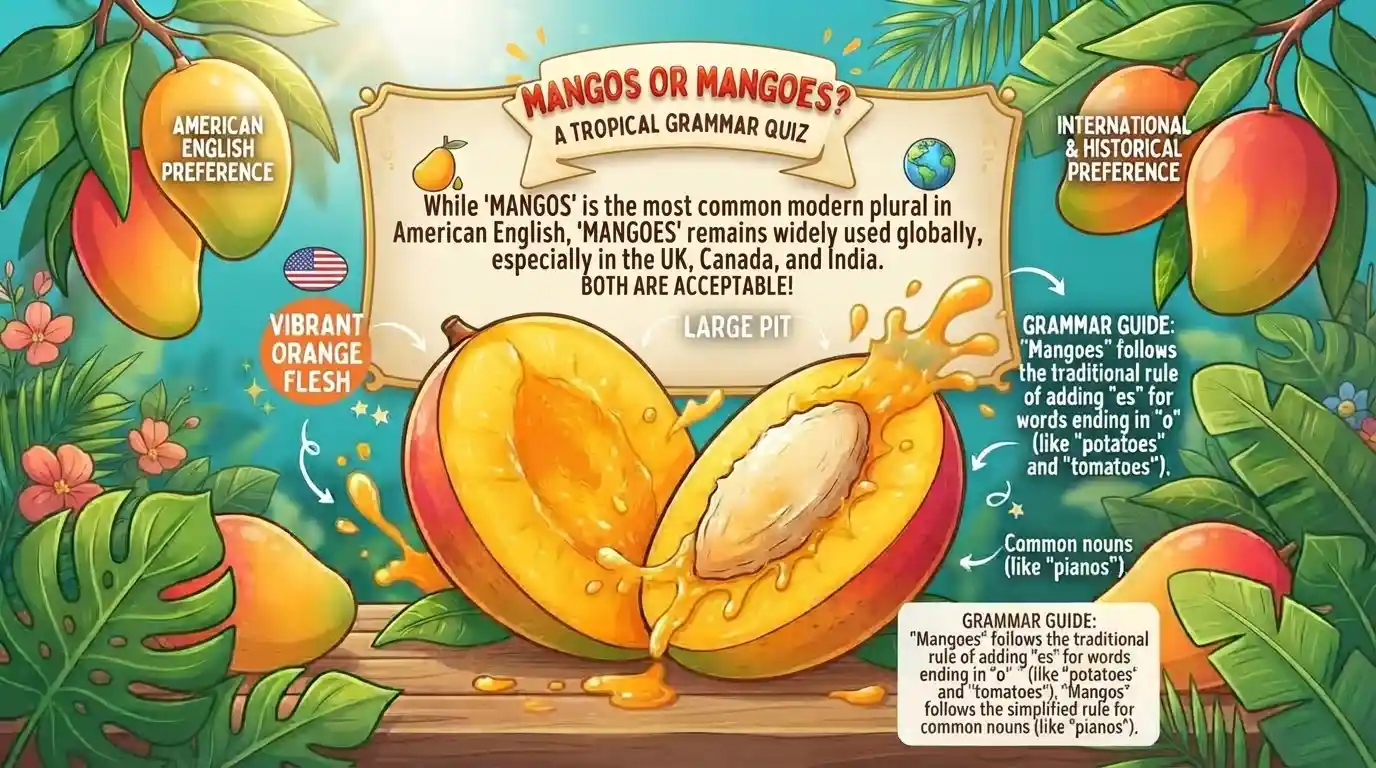
Both “mangos” and “mangoes” are correct plural forms of “mango.” “Mangoes” is the more traditional and widely preferred spelling, while “mangos” is a common variant, especially in casual writing, packaging, and American usage.
I stood in a grocery store once, staring at a produce sign that read “Mangos, 3 for $5,” and felt oddly bothered by it. I was almost certain the plural should have an “e” in it, like “tomatoes” or “potatoes.” I went home and looked it up, fully expecting to find a store employee’s typo. Instead, I found out the sign was completely correct.
That small grocery store moment captures exactly why this question gets searched so often. English pluralization rules for words ending in “o” are famously inconsistent. Some words add “es,” some simply add “s,” and a small handful, including mango, genuinely accept both endings without any of them being wrong.
This guide breaks down where each spelling comes from, which one shows up more often in formal writing, and how to stop second guessing yourself the next time you write a grocery list, a recipe, or a menu.
Once you understand why both spellings exist, the choice stops feeling like a coin flip. It becomes a simple style decision, similar to choosing between “email” and “e mail,” rather than a rule you might be getting wrong.
Mangos or Mangoes Quick Answer
Both “mangos” and “mangoes” are grammatically correct plurals of “mango.” Major dictionaries list both spellings as valid, though “mangoes” tends to appear more often in formal, edited writing, while “mangos” shows up frequently in casual writing and commercial branding.
Example: “The recipe calls for two ripe mangoes, peeled and diced.” (traditional spelling)
Example: “This smoothie mix contains real mangos and a touch of lime.” (common variant spelling)
The Origin of Mangos and Mangoes
The word “mango” entered English through Portuguese, which borrowed it from a Dravidian language spoken in southern India, where the fruit originated. As the word settled into English, its plural form followed the same uncertain pattern that affects many other nouns ending in “o.”
English generally handles nouns ending in “o” in one of two ways. Some take “es” in the plural, such as “potatoes” and “heroes,” while others take a simple “s,” such as “pianos” and “photos.” A smaller group of words, including “mango,” “volcano,” “tornado,” and “buffalo,” ended up accepting both plural forms as the language never fully settled on one standard.
This kind of dual acceptance is more common than most people realize. It usually happens when a word enters English from another language and different regional communities adopt slightly different pluralization habits before any single form wins out completely.
Dictionaries have tracked this pattern for well over a century without forcing a single winner. Rather than picking a side, most major dictionaries simply list both spellings as acceptable, which is part of why style guides, not grammar rules, end up deciding which form a particular publication prefers.
Mangos vs Mangoes Explained: Key Differences and Variations
Both spellings mean exactly the same thing. The difference is entirely about frequency, tone, and regional habit rather than correctness.
| Term | Meaning | When to Use | Region/Context |
| Mangoes | Plural of mango | The more traditional, dictionary preferred spelling | Standard everywhere, common in formal and published writing |
| Mangos | Plural of mango | A widely accepted variant spelling | Common in casual writing, packaging, and American usage |
| Mango (singular) | The tropical fruit itself | Refers to one single fruit | Standard everywhere |
| Mangoe | Incorrect singular spelling | Never correct | Not accepted anywhere |
Notice that unlike true spelling errors, neither “mangos” nor “mangoes” is ever flagged as wrong by a dictionary. This puts the pair in a different category from mistakes like confusing “truely” for “truly.”
It helps to think of this less as a right versus wrong question and more as a style choice, similar to deciding between “toward” and “towards.” Both are correct. One simply appears more often depending on the region, publication, or personal habit of the writer.
Which Version Should You Use?
For formal or published writing, choose “mangoes,” since it remains the more traditional and slightly more common choice in edited books, newspapers, and academic writing.
For casual writing, recipes, and social media, either spelling works comfortably, and “mangos” often feels a touch more modern or streamlined to some writers, especially in shorter captions where every character counts.
For food branding and packaging, “mangos” appears frequently, likely because it looks cleaner and slightly shorter on a label or a grocery sign.
For global or neutral use, “mangoes” is the safer default if you want to match the spelling most readers were taught in school, while “mangos” remains completely understandable and correct everywhere. Neither choice will confuse a reader or slow them down.
Common Mistakes With Mangos or Mangoes
Mistake: Mangoe Correction: Mango (singular) Why it happens: Writers sometimes assume the plural form’s extra “e” should also appear in the singular, which is never correct.
Mistake: Mixing both plural spellings within the same document. Correction: Pick one spelling and use it consistently throughout a single piece of writing. Why it happens: Since both forms are accepted, writers often switch between them without noticing, especially across longer documents or multiple drafts.
Mistake: Assuming “mangos” is a modern misspelling rather than a genuine accepted form. Correction: “Mangos” is a legitimate, dictionary recognized plural, not a recent error. Why it happens: Writers familiar mainly with “mangoes” sometimes assume any variation must be incorrect, even when dictionaries list both.
Mistake: Applying the “mangoes” rule automatically to every word ending in “o.” Correction: Check each word individually, since English handles “o” ending plurals inconsistently. “Photos” and “pianos” never take “es,” for example. Why it happens: After learning that “mangoes” is common, writers sometimes overgeneralize the rule to unrelated words that follow a different pattern entirely.
Mistake: Assuming a spellchecker’s suggestion is automatically the only correct option. Correction: Some spellcheck tools default to one spelling and flag the other, even though both are genuinely accepted. Why it happens: Spellcheck dictionaries are not always comprehensive, and many default to whichever spelling their internal word list was built around first.
Mistake: Writing “mango’s” to indicate more than one mango. Correction: Use “mangoes” or “mangos,” never an apostrophe, to form the plural. Why it happens: Apostrophes are sometimes mistakenly used to pluralize nouns, especially ones ending in a vowel, though this is never correct in standard English.
Mangos or Mangoes in Real World Examples
In a professional email: “Please confirm the shipment includes two crates of ripe mangoes for Saturday’s event.”
In a news headline: “Local Farmers Report Record Mango Harvest This Season”
In a social media post: “Obsessed with these frozen mangos in my smoothie lately. Total game changer.”
In a formal document or report: “The import data shows a fifteen percent increase in mango shipments compared to last year, driven mostly by demand for ripe mangoes in grocery and restaurant supply chains.”
Notice how the casual social media post leans toward “mangos,” while the more formal email and report favor “mangoes,” reflecting the general tendency described earlier in this guide.
This pattern is not a strict rule, though. Plenty of formal writing uses “mangos” without any issue, and plenty of casual writing sticks with “mangoes” out of habit. The tendency simply reflects a common pattern, not a requirement you need to follow rigidly.
Mangos or Mangoes: Data, Trends, and Usage
People search “mangos or mangoes” constantly because the word shows up everywhere, from grocery store signs to recipe blogs to nutrition labels, and writers want confidence they are choosing the version their audience expects. This search falls into the informational category, since readers want a clear spelling explanation rather than a product or service.
Interest tends to spike around cooking and recipe content, particularly during mango season and in tropical smoothie or dessert recipes, where the word appears repeatedly throughout a single piece of writing. Food bloggers, recipe developers, and grocery copywriters search this pairing especially often, since consistency matters for professional looking content.
This matters now because so much food content circulates globally within seconds, crossing regional writing habits instantly. A recipe written in one country can reach readers everywhere, making a confident, consistent spelling choice more noticeable than it might have been in the past.
Grocery and produce industry writing offers a useful real world signal here too. Many large fruit exporters and packaging companies specifically favor “mangos” on labels, likely because it is one character shorter and reads cleanly on small packaging, even though their formal marketing copy elsewhere often reverts to “mangoes.”
Mangos vs Mangoes Comparison Table
| Term/Variant | Meaning | Region/Context | Best Used When |
| Mangoes | Plural of mango | All English speaking regions | Formal writing, published content, traditional style guides |
| Mangos | Plural of mango | All English speaking regions, especially American casual use | Casual writing, branding, packaging, informal recipes |
| Mango | Singular form | All English speaking regions | Referring to a single fruit |
| Mango’s | Incorrect plural using an apostrophe | Not accepted anywhere | Never, this is always a mistake |
Frequently Asked Questions
Q: What does mangos or mangoes mean? A: Both words are plural forms of “mango,” referring to more than one of the tropical fruit. They mean exactly the same thing.
Q: How do you use mangos or mangoes correctly in a sentence? A: Either spelling works as a plural noun, as in “I bought three mangoes” or “I bought three mangos.” Choose one spelling and stay consistent within a single piece of writing.
Q: Mangos vs mangoes, what is the real difference? A: There is no difference in meaning. “Mangoes” is the more traditional, slightly more common spelling, while “mangos” is an equally correct, more casual variant.
Q: Is mangos acceptable in formal writing? A: Yes, though “mangoes” remains the more common choice in formal, edited, or published writing.
Q: Which version is correct, mangos or mangoes? A: Both are correct. Major dictionaries accept either spelling as a standard plural of mango.
Q: Where does the word mango come from? A: Mango entered English through Portuguese, which borrowed the word from a Dravidian language of southern India, where the fruit originally grew. The plural spelling question emerged later, once the word had fully settled into everyday English use.
Q: Can mangos or mangoes be used interchangeably in the same document? A: They can technically be used interchangeably, but choosing one spelling and using it consistently throughout a single document looks more polished and professional. A quick search of your own document before publishing can catch any accidental mixing.
Final Thoughts
Both “mangos” and “mangoes” are correct, and neither one is a spelling mistake. “Mangoes” remains the more traditional, slightly more common choice, especially in formal or published writing, while “mangos” works just as well in casual writing, recipes, and product packaging.
Remember these key points: pick one spelling and stay consistent within a document, lean toward “mangoes” for formal writing if you want the safer default, and never add an apostrophe to form the plural. Both spellings will be understood instantly by any English speaking reader, whether they grew up seeing one version or the other.
Now you know exactly how to choose between them. Bookmark this guide so you never second guess “mangos or mangoes” again, and share it with anyone who has ever paused over a grocery store sign wondering which spelling was actually correct, whether they are writing a recipe, a menu, or a quick grocery list of their own.
Read more: Burned or Burnt: Easy Guide to Correct Usage

I’m Zain. Through Wordiums.com, I write clear, accurate word comparison guides that show the difference between similar words, spellings, and phrases, so readers can choose the right word in seconds.