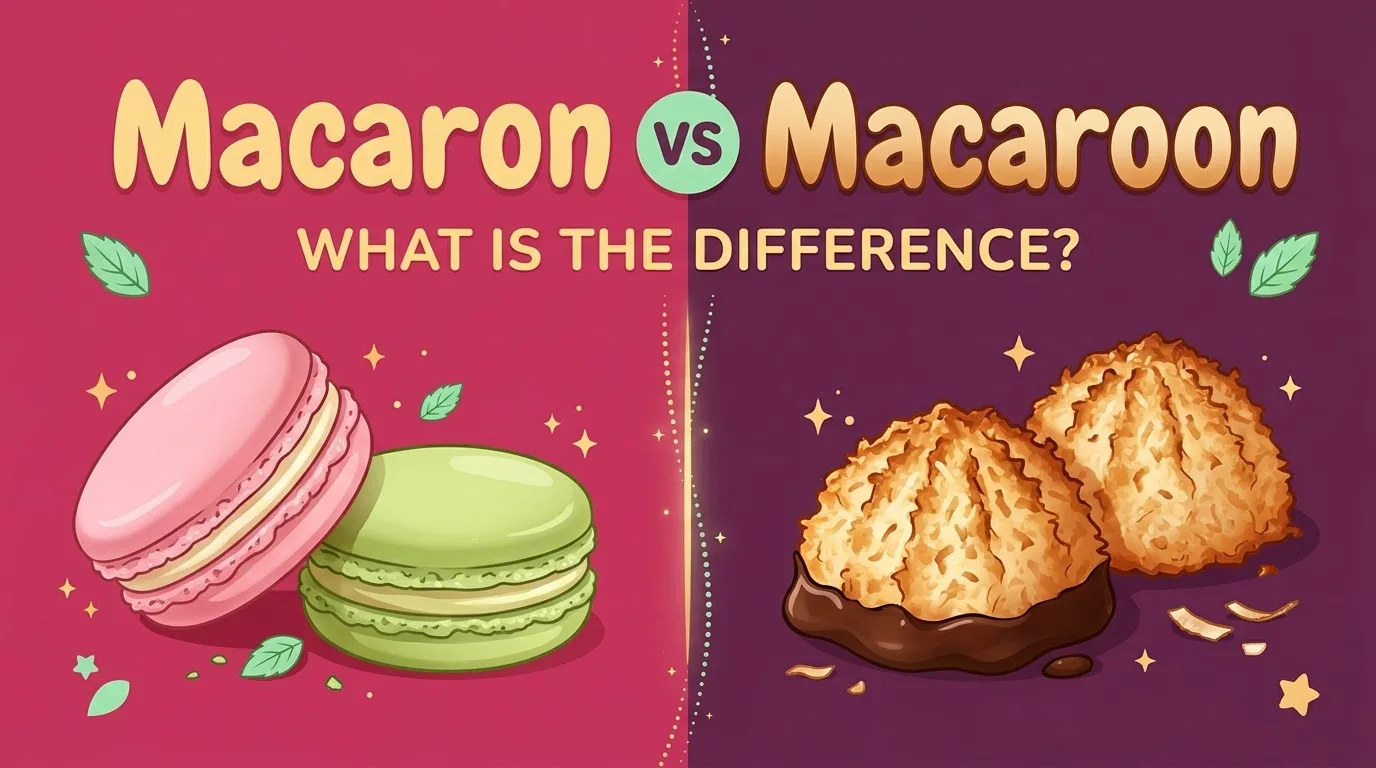
A macaron is a colorful French sandwich cookie. A macaroon is a chewy coconut mound.
A macaron is a delicate French cookie made from almond flour, egg whites, and sugar, usually sandwiched around a creamy filling. A macaroon is a dense, chewy cookie, most often made with shredded coconut. The two names look almost the same, and they share a common root, but they are different treats with different textures, ingredients, and looks.
At a Glance: Macaron vs Macaroon
| Feature | Macaron | Macaroon |
| Origin | France | Several European roots |
| Main ingredient | Almond flour | Shredded coconut, or almond paste |
| Texture | Crisp shell, soft center | Dense and chewy |
| Shape | Smooth round sandwich | Rough, small mound |
| Filling | Ganache, buttercream, or jam | None |
| Look | Colorful and neat | Golden and rustic |
| Pronunciation | US /ˌmækəˈrɑːn/ | /ˌmækəˈruːn/ |
| Popular flavors | Pistachio, raspberry, vanilla, salted caramel | Coconut, chocolate dipped coconut |
What Is a Macaron?
A macaron is a small round cookie with two thin, crisp shells and a soft filling in the middle. It is pronounced US /ˌmækəˈrɑːn/ and UK /ˈmækərɒn/. The shells are made from almond flour, powdered sugar, and whipped egg whites. The center is usually ganache, buttercream, or jam.
Key features of a macaron:
- A smooth, shiny top.
- A ruffled edge at the base, known as the foot.
- A crisp shell and a soft, slightly chewy inside.
- Bright colors, such as pink, green, and yellow.
- Flavors such as vanilla, chocolate, pistachio, raspberry, and salted caramel.
Macarons are strongly linked with Paris, and the filled version popular today is tied to French bakeries in the 1900s. Stories also connect early almond cookies to Italy and the French court, but the early history is debated.
What Is a Macaroon?
A macaroon is a dense, soft cookie shaped into a small mound. It is pronounced /ˌmækəˈruːn/ in both American and British English. The most common version in the United States and Canada is made with shredded coconut, sugar, and egg whites, and sometimes sweetened condensed milk. Many are baked until golden on the outside and chewy inside. Some are dipped in chocolate.
Key features of a macaroon:
- A rough, rustic shape.
- A chewy, moist center with a golden outside.
- A strong coconut flavor in the common version.
- A simple recipe with only a few ingredients.
An older style of macaroon is made from almond paste, sugar, and egg whites, and it has no coconut. In Scotland, a macaroon bar is a different sweet made from a potato fondant center covered with chocolate and toasted coconut.
The Main Differences
- Base ingredient: macarons use almond flour. Macaroons use coconut, or sometimes almond paste.
- Texture: macarons have a crisp shell and a soft inside. Macaroons are chewy and moist.
- Shape: macarons are smooth, round, and sandwiched. Macaroons are small, uneven mounds.
- Filling: macarons have a creamy filling. Macaroons have no filling.
- Look: macarons are colorful and neat. Macaroons are golden and rustic.
- Origin: macarons are strongly linked to France. Macaroons have several European roots.
Why Are the Names So Similar?
The two words grew from the same Italian root. Both come from the Italian word maccarone, which was related to paste or dough. That word also gave English macaroni. French turned it into macaron, and English borrowed it as macaroon in the 1600s. Over time, the English word came to mean the coconut cookie, while macaron came into English later to name the French sandwich cookie.
Because of this shared history, some older English texts use macaroon for the almond cookie. Today, however, writers keep the two words separate, and food menus do too.
Are They Gluten Free?
Both cookies are often made without wheat flour, so they are commonly gluten free. Macarons use almond flour, and many coconut macaroons use only coconut, sugar, and egg whites. However, some recipes or bakeries may add flour, and kitchens may handle wheat products nearby. If you need to avoid gluten for health reasons, always check the label or ask the baker.
Macaroons and Passover
Coconut macaroons are popular during the Jewish holiday of Passover. Because they use no flour or leavening, many recipes fit the holiday’s food rules. Passover packages are usually marked for that purpose.
How to Remember the Difference
A simple memory trick is to look at the endings.
- Macaron has a short ending, like a small, delicate cookie.
- Macaroon has a double o in the middle, like two round coconut mounds side by side.
Another trick is to think of the French word. Macaron is the French spelling, so link it with the elegant French cookie.
Example Sentences
- She ordered a box of pistachio macarons from a Paris style bakery.
- The coconut macaroons were chewy and dipped in dark chocolate.
- A macaron needs a perfectly smooth shell and a ruffled foot.
- My grandmother bakes macaroons every spring.
- The cafe serves raspberry macarons with tea.
Common Mistakes
- Calling a French sandwich cookie a macaroon. It is a macaron.
- Calling a coconut cookie a macaron. It is a macaroon.
- Mixing up macaron and macaroni. Macaroni is pasta.
- Pronouncing macaron and macaroon the same way. The endings differ.
- Assuming all macaroons contain coconut. Some use almond paste.
Frequently Asked Questions
What is the difference between a macaron and a macaroon? A macaron is a French almond cookie sandwich. A macaroon is a chewy coconut cookie.
Is a macaroon the same as a macaron? No. They are different cookies, though they share a name root.
Why are macarons so expensive? They need careful baking and special ingredients, and they are hard to make perfectly.
Are macarons gluten free? Many are, because they use almond flour, but always check the ingredients.
How do you say macaron? In American English it is often said as mack uh RAHN.
Conclusion
A macaron is a colorful French sandwich cookie made with almond flour and a creamy filling. A macaroon is a chewy cookie, usually made with coconut.
Both names come from the same Italian root, which explains the confusion. Their taste, texture, and look are very different, so they are easy to tell apart once you know what to look for.
Remember crisp and colorful for macaron, and chewy and coconut for macaroon.
Read More: Time Flies or Time Flys: Which Is Correct?

Hey, I’m Ayeza. I started wordiums.com because I kept freezing over words that look almost the same, unsure which one was right. Now I explain every word comparison in plain language, so you can pick the right word with confidence and move on.