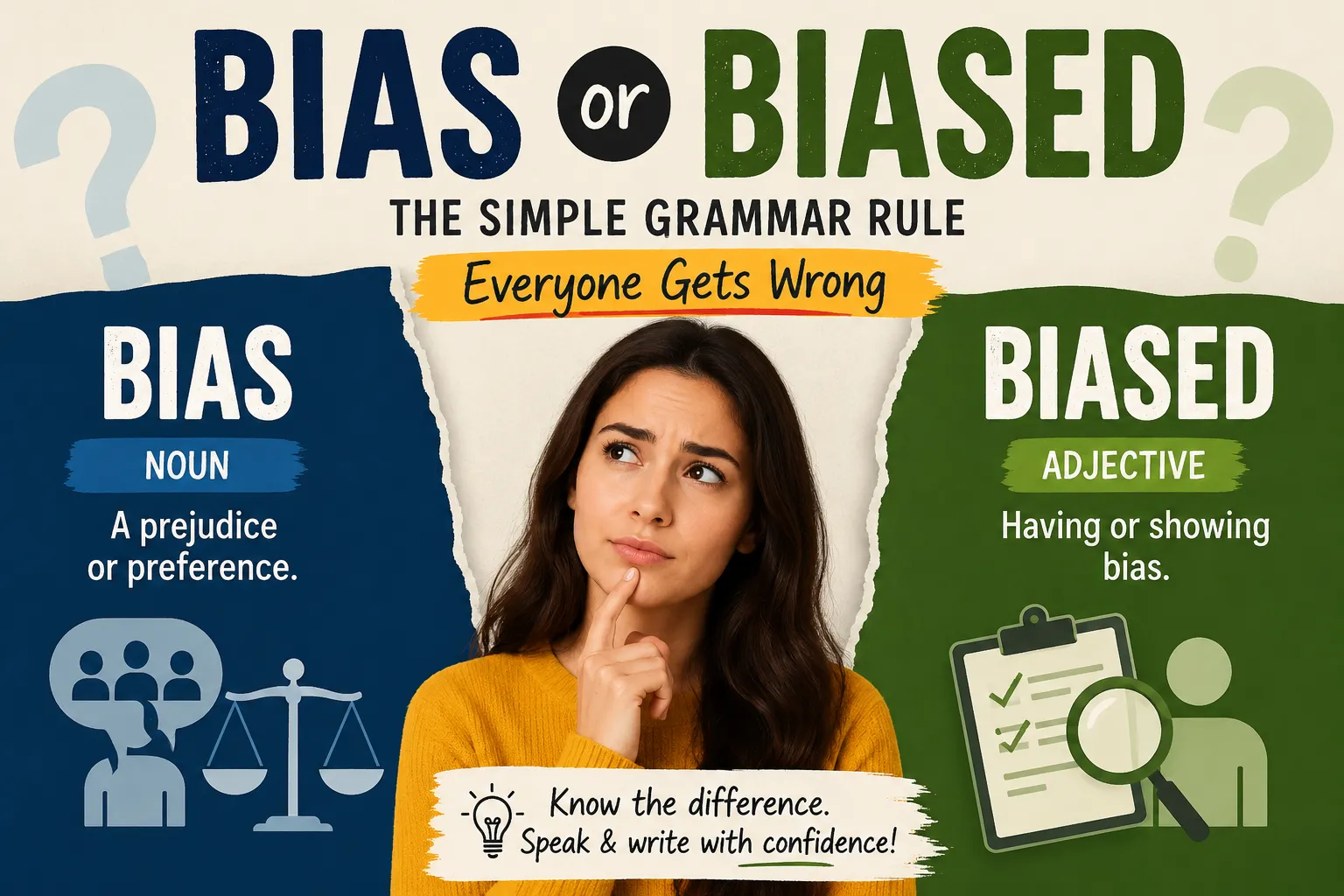
Bias is a noun describing an unfair preference or leaning toward one side. Biased is an adjective describing a person, source, or opinion that shows that unfair preference. You have a bias, but you are biased.
I once wrote in a college essay “the article was very bias toward one political party,” and my professor circled the word in red ink with a single note, wrong word form. I stared at that circle for a solid minute, completely confused, convinced I had simply misspelled something rather than chosen the wrong part of speech entirely.
That mistake taught me something a lot of writers never quite learn, bias and biased are not interchangeable, even though they look and sound almost identical in a sentence.
This mix up happens constantly in essays, news commentary, workplace reports, and everyday conversation. People reach for whichever word feels natural in the moment, without realizing one is a noun and the other is an adjective, each with a very specific grammatical job to do.
This guide breaks the rule down so clearly that you will never second guess it again. You will learn exactly when to use bias, when to use biased, and how to catch the mistake before it slips into your writing.
Let us clear it up for good.
Bias or Biased: Quick Answer
Bias is a noun. It names the thing itself, an unfair leaning or preference toward one side of an issue, group, or idea.
Biased is an adjective. It describes something or someone that displays that unfair leaning, whether that is a person, a document, a report, or even an entire organization.
For example, “the report showed clear bias” uses bias correctly as a noun, while “the report was clearly biased” uses biased correctly as an adjective describing the report.
The Origin of Bias and Biased
The word bias entered English in the sixteenth century from the French word biais, meaning a slant or oblique line. It originally described a diagonal cut across fabric, a term still used today in sewing when someone cuts fabric on the bias for extra stretch and drape.
Over time, the word shifted from describing a physical slant to describing a mental or emotional slant, an inclination that leans away from neutral or fair judgment. This metaphorical leap, from a slanted piece of cloth to a slanted opinion, is a common pattern in how English absorbs and reshapes borrowed words.
Biased simply formed as the past participle of the verb to bias, following the standard English pattern of adding ed to turn a verb into a descriptive adjective, much like how excite becomes excited or interest becomes interested.
This grammatical pattern is exactly why so many people get confused. English speakers instinctively know that most ed words function as adjectives, yet bias breaks the pattern slightly by also functioning fully as its own standalone noun, creating a small trap for writers moving quickly.
Linguists point out that bias is somewhat unusual because it retained its noun form so strongly even after the adjective biased became widely used. Many similar word pairs in English eventually let the noun form fade from common use, but bias never lost its footing, remaining just as common in everyday speech and writing as biased itself.
This dual survival means both forms compete constantly for the same mental slot when people write quickly, especially under time pressure like exams, live commentary, or fast paced newsroom writing, which helps explain why this particular mix up appears so often even among skilled and experienced writers.
Bias Explained: Key Differences and Variations
Seeing the full word family together makes the grammar rule click much faster.
| Term | Part of Speech | When to Use | Example |
| Bias | Noun | Naming the unfair preference itself | “The study revealed a clear bias in the results.” |
| Biased | Adjective | Describing something that shows bias | “The results were clearly biased toward one outcome.” |
| To bias | Verb | Describing the act of influencing unfairly | “Personal experience can bias how we interpret data.” |
| Unbiased | Adjective | Describing something free of unfair preference | “We aimed for a fully unbiased review process.” |
| Biases | Plural noun | Describing multiple unfair preferences | “Everyone carries certain biases, whether they realize it or not.” |
Notice how the entire word family stays consistent once you recognize bias as the core noun and biased as its adjective form, with bias also doubling as a verb in certain sentences.
Which Version Should You Use?
The choice comes down to a simple grammar test, ask whether your sentence needs a naming word or a describing word.
For naming the concept itself, use bias. This fits sentences like “unconscious bias affects hiring decisions” or “the survey tried to reduce bias in its questions.”
For describing a person, source, or piece of writing, use biased. This fits sentences like “the news anchor seemed biased” or “avoid biased sources when researching.”
For describing the action of influencing something unfairly, use the verb form to bias, as in “personal relationships can bias your judgment without you realizing it.”
A quick trick many writers use, if you can replace the word with unfair or slanted and the sentence still makes sense as a description, you need biased. If the sentence needs a thing or concept instead, you need bias.
Common Mistakes With Bias and Biased
This pair trips up writers at every level. Here are the errors that show up most often.
Mistake 1: Using bias where biased belongs Wrong: “The judge seemed very bias during the trial.” Correct: “The judge seemed very biased during the trial.” Why it happens: Writers grab the shorter, more familiar word without checking whether the sentence needs a noun or an adjective.
Mistake 2: Using biased where bias belongs Wrong: “The report contained a lot of biased.” Correct: “The report contained a lot of bias.” Why it happens: Writers overcorrect after learning the previous rule, swinging too far in the other direction.
Mistake 3: Forgetting the plural noun form Wrong: “Everyone has their own bias about different topics.” Correct: “Everyone has their own biases about different topics,” since multiple distinct leanings require the plural noun form.
Mistake 4: Misusing the verb form Wrong: “Do not let your emotions biased your decision.” Correct: “Do not let your emotions bias your decision,” since the verb form never takes an ed ending in this present tense construction.
Mistake 5: Confusing biased with prejudiced incorrectly Wrong belief: “Biased and prejudiced always mean exactly the same thing.” Correct understanding: Biased often describes a leaning that can be unconscious or unintentional, while prejudiced usually implies a stronger, often deliberate negative judgment, so context still matters even though the words overlap.
Bias and Biased in Real World Examples
Context helps lock in the correct usage of each word.
Professional email: “We reviewed the hiring process carefully to reduce unconscious bias at every stage of candidate selection.”
News headline: “Study Finds Widespread Bias in Algorithm Used for Loan Approval Decisions”
Social media post: “This article is so biased, it barely mentions the other side of the argument at all.”
Formal document, workplace policy: “Employees must complete annual training designed to identify and reduce personal bias in performance evaluations.”
Each example shows the grammar rule in action, bias fills the noun role naming the concept, while biased fills the adjective role describing something that displays it.
Bias and Biased: Data, Trends and Usage
Search interest for both words spikes heavily around workplace training, media literacy, and psychology content, showing this is strongly informational search intent driven by people trying to understand fairness and objectivity.
Bias sees particularly high search volume tied to terms like unconscious bias, cognitive bias, and bias in the workplace, reflecting growing interest in diversity training and decision making psychology across many industries.
Biased sees frequent search volume tied to evaluating sources, especially around phrases like biased news or how to spot a biased article, reflecting rising public interest in media literacy and misinformation awareness.
This distinction matters enormously for journalists, researchers, and content creators, since correctly distinguishing bias from biased signals careful, credible writing, while mixing them up can quietly undermine a reader’s trust in the rest of the content.
Editors at major publications often treat this specific mistake as a quick credibility check during review, since a writer who consistently confuses bias and biased may also overlook other important grammatical distinctions elsewhere in a piece. Getting this pair right, even in casual writing, signals attention to detail that readers subconsciously pick up on.
Academic writing centers report that this exact confusion appears constantly in student essays, particularly in social science and media studies courses where discussions of fairness, objectivity, and perspective come up regularly, making it one of the most commonly flagged grammar notes across those disciplines.
Comparison Table: Bias vs Biased
| Term or Variant | Part of Speech | Meaning | Best Used When |
| Bias | Noun | Unfair leaning or preference | Naming the concept itself |
| Biased | Adjective | Showing an unfair leaning | Describing a person, source, or opinion |
| To bias | Verb | To influence unfairly | Describing the act of skewing judgment |
| Unbiased | Adjective | Free from unfair leaning | Describing neutral, fair judgment |
Frequently Asked Questions
Q: What does bias or biased mean? A: Bias is a noun naming an unfair preference or leaning, while biased is an adjective describing something or someone that shows that unfair preference.
Q: How do you use bias or biased correctly in a sentence? A: Use bias when naming the concept itself, and use biased when describing a person, source, or piece of writing that displays that unfair leaning.
Q: Bias vs biased, what is the real grammar difference? A: Bias functions as a noun and sometimes a verb, while biased functions strictly as an adjective, describing something that shows bias.
Q: Is biased acceptable in formal writing? A: Yes, biased is fully appropriate in formal writing whenever describing a source, opinion, or decision that shows unfair leaning toward one side.
Q: Which word is correct, bias or biased, when describing a news article? A: Biased is correct here, since you are describing the article itself, as in “the article seemed biased,” not naming the concept directly.
Q: Where does the word bias come from? A: Bias comes from the French word biais, originally meaning a diagonal slant, later evolving to describe a mental or emotional leaning toward one side.
Q: Can bias ever function as a verb in a sentence? A: Yes, bias can function as a verb, as in “past experiences can bias how we judge new information,” describing the act of influencing unfairly.
Final Thoughts
Bias and biased look similar but play very different grammatical roles in a sentence. One names the concept, the other describes something shaped by it.
Remember these key takeaways. Use bias as a noun to name the unfair leaning itself. Use biased as an adjective to describe something that shows that leaning. Watch for the plural biases when discussing multiple distinct preferences. Check your sentence structure before choosing between the two, and read the sentence back once more before moving on.
Next time you write about fairness, opinion, or judgment, you will know exactly which word form your sentence actually needs, without pausing or guessing halfway through a paragraph.
Bookmark this guide so you never mix up bias and biased again, and share it with anyone who has ever gotten a confused red circle on an essay just like I did. A tiny grammar fix like this one pays off every single time you write.
Read More: Sceptical or Skeptical: Clearing Up the Confusion for Good

I’m Zain. Through Wordiums.com, I write clear, accurate word comparison guides that show the difference between similar words, spellings, and phrases, so readers can choose the right word in seconds.