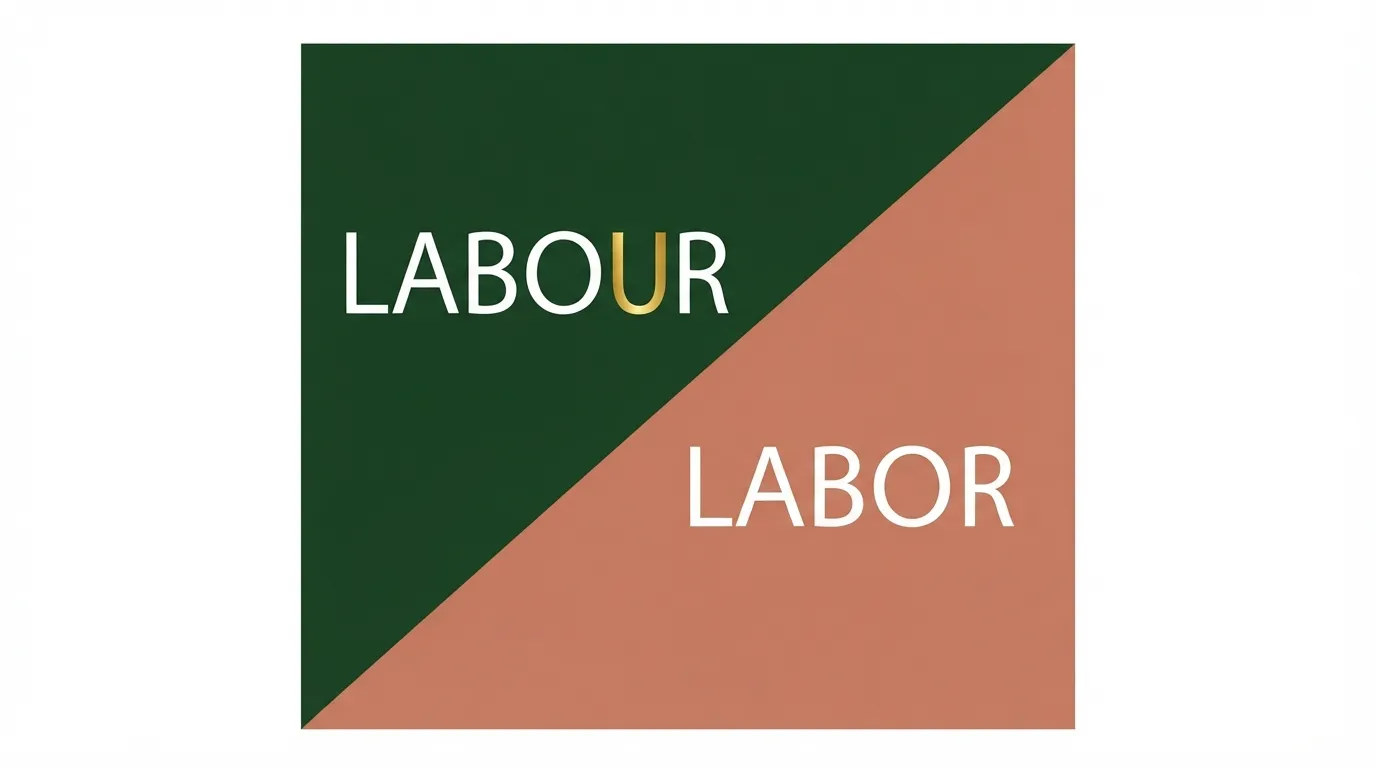
Labour and labor mean exactly the same thing, referring to physical or mental work, or the workforce itself. Labor is the American spelling, while labour is the British spelling used across the UK and most Commonwealth countries.
I once submitted a business proposal to a client in London using American spelling throughout, including labor instead of labour, and received polite but firm feedback asking me to adjust the document for a British audience before resubmitting, along with a gentle reminder that these small details often shape a first impression more than people realize.
That small correction taught me something many writers never fully learn, this spelling choice signals far more than grammar preference. It signals attention to audience, professionalism, and cultural awareness.
Labour and labor show up constantly in business documents, news articles, political discussions, and everyday writing, yet the spelling split between American and British English still trips up plenty of confident writers.
This guide explains exactly where this split comes from, when to use each spelling, and how to avoid the small inconsistencies that make professional writing look careless. By the end, you will handle this word with complete confidence no matter your audience.
Let us dive into it.
Labour or Labor: Quick Answer
Labor is the standard spelling in American English, referring to physical or mental effort, work performed, or the broader workforce within an economy.
Labour is the standard spelling in British English, Canadian English, and Australian English, carrying the exact same meaning across all these contexts.
For example, an American economic report discusses labor market trends, while a British economic report discusses labour market trends, both referring to identical economic concepts.
The Origin of Labour and Labor
The word traces back to the Latin term labor, meaning toil, work, or hardship, which entered English through Old French during the medieval period. Old French had already added the u, following patterns common across many French derived words during that era.
English adopted this French influenced spelling early on, and labour became the standard form used throughout Britain for centuries, appearing consistently in early legal documents, literature, and everyday correspondence well before the eighteenth century.
The split emerged, as with many similar word pairs, through American lexicographer Noah Webster’s spelling reform efforts in the early nineteenth century. Webster believed American English should simplify its spelling, removing what he considered unnecessary letters inherited from French influence.
Webster specifically targeted the ou combination found in words like colour, favour, honour, and labour, proposing the simpler or ending instead. His reforms gained traction gradually through American schools and dictionaries, eventually becoming the firmly established standard across the United States by the later part of the nineteenth century.
Webster framed his proposed changes as both practical and patriotic, arguing that a young nation deserved its own distinct written language, separate from the spelling conventions tied to British aristocracy and colonial rule. This nationalistic framing helped his reforms gain public support beyond pure linguistic argument alone.
Not every proposed Webster reform survived, however. Several of his more radical suggestions, like spelling tongue as tung or women as wimmen, never caught on and were eventually abandoned entirely. The ou to or change proved far more durable, likely because it affected a smaller, more consistent set of words and required less dramatic adjustment from everyday readers and writers at the time.
Labour Explained: Key Differences and Variations
Beyond the base word, several related forms and phrases follow this same consistent regional spelling pattern.
| Term | Meaning | When to Use | Region or Context |
| Labor | Physical or mental work, workforce | American writing and speech | United States |
| Labour | Physical or mental work, workforce | British writing and speech | UK, Canada, Australia, most Commonwealth nations |
| Labor Day | American workforce holiday | Referring to the US federal holiday | United States, first Monday of September |
| Labour Party | British political party name | Referring to UK politics specifically | United Kingdom |
| Laborer | Person performing manual work | American writing | United States |
| Labourer | Person performing manual work | British writing | UK and Commonwealth nations |
Notice that Labour Party always keeps the British spelling regardless of which English variant surrounds it in a sentence, since it functions as a proper noun tied to a specific political organization.
Which Version Should You Use?
Audience determines the correct choice, just as with most American versus British spelling pairs.
For American readers, always choose labor, laborer, and related forms. This applies to US publications, American business writing, and content targeting Google searches from within the United States specifically.
For British, Canadian, Australian, or other Commonwealth readers, choose labour and labourer instead, since these spellings feel natural and professionally appropriate to that audience.
For discussions specifically about the British political party, always use Labour Party regardless of your own regional spelling elsewhere, since this refers to an official proper noun rather than the general concept of work.
And For international business writing targeting a mixed global audience, pick one spelling system and apply it consistently across the entire document, rather than switching between labor in one section and labour in another.
Common Mistakes With Labour and Labor
Even experienced professionals slip up on this particular pair. Here are the errors that appear most frequently.
Mistake 1: Mixing spelling systems within one document Wrong: “The labor market report showed steady growth across the labour force.” Correct: “The labor market report showed steady growth across the labor force,” matching American spelling consistently throughout.
Mistake 2: Misspelling the British political party name Wrong: “The Labor Party won the general election with a strong majority.” Correct: “The Labour Party won the general election with a strong majority,” since this proper noun always keeps the British spelling regardless of context.
Mistake 3: Forgetting related word forms need updating too Wrong: “The British report described rising labor costs across several sectors.” Correct: “The British report described rising labour costs across several sectors,” matching the rest of the British spelling used throughout that document.
Mistake 4: Assuming Labor Day and Labour Day are identical holidays Wrong belief: “Labor Day and Labour Day happen on the same date everywhere.” Correct understanding: The American Labor Day falls on the first Monday of September, while Canada also celebrates Labour Day on that same date, though other Commonwealth countries may recognize different labor related holidays entirely.
Mistake 5: Autocorrect silently changing regional spelling Many word processors default to American English, quietly converting labour to labor without the writer noticing, especially in quick emails or documents prepared under time pressure.
Labour and Labor in Real World Examples
Context makes the regional spelling pattern easy to spot once you know what to look for.
Professional email, American English: “Our latest labor cost analysis shows a noticeable increase across the manufacturing division this quarter.”
News headline, British English: “Labour Costs Rise Sharply Across UK Construction Sector, New Report Finds”
Social media post, American English: “Spent all weekend doing manual labor around the house, my whole body is sore today.”
Formal document, British English: “The tribunal reviewed evidence regarding fair labour practices within the manufacturing facility in question.”
Each example shows how the surrounding writing style stays neutral, while the single spelling choice instantly signals the intended regional audience and context.
Labour and Labor: Data, Trends and Usage
Search data consistently shows labor earning significantly higher global search volume, primarily due to the size of the American English speaking population searching online. Labour still maintains strong, steady search volume specifically within the UK, Canada, Australia, and Ireland.
This word appears heavily in economic news, workplace policy content, and political discussions, often carrying informational search intent, since people frequently search terms like labor market trends or labour force statistics to understand broader economic conditions.
Political content adds another layer of complexity, since Labour Party searches carry strong informational and sometimes navigational intent from people specifically seeking news, policy positions, or election coverage related to that particular UK political party.
Businesses operating across both American and British markets increasingly localize this spelling choice deliberately in official documents, recognizing that small details like this can meaningfully affect how professional and regionally appropriate their communication feels to different audiences.
International law firms and consulting agencies often maintain internal style guides specifically addressing this spelling pair, ensuring contracts, reports, and correspondence match the expected regional standard for each client relationship. A single overlooked spelling can occasionally raise unnecessary questions during formal negotiations, even when the substance of the document remains entirely accurate and professional.
Global companies publishing employee handbooks or workplace policies across multiple countries frequently produce separate regional versions specifically to account for this kind of spelling difference, alongside other important variations in employment law and terminology between American and Commonwealth jurisdictions.
Comparison Table: Labour vs Labor
| Term or Variant | Meaning | Region or Context | Best Used When |
| Labor | Work, effort, workforce | United States | Writing for American audiences |
| Labour | Work, effort, workforce | UK, Canada, Australia | Writing for Commonwealth audiences |
| Labor Day | American workforce holiday | United States | Referring to the US federal holiday |
| Labour Party | British political organization | United Kingdom | Always regardless of surrounding spelling |
Frequently Asked Questions
Q: What does labour or labor mean? A: Both words describe physical or mental work, effort, or the broader workforce within an economy, carrying identical meaning across both spellings.
Q: How do you use labour or labor correctly? A: Match the spelling to your audience, using labor for American readers and labour for British or Commonwealth readers, staying consistent throughout your writing.
Q: Labour vs labor, what is the real difference? A: There is no difference in meaning whatsoever. The only distinction is regional spelling convention, with labor used in America and labour used across most other English speaking countries.
Q: Is labour acceptable in formal business writing? A: Yes, labour is completely standard and expected in formal British, Canadian, and Australian business writing, including legal documents and official reports.
Q: Which spelling is correct, labour or labor, for the UK political party? A: Labour Party is always correct here, since this proper noun name never changes regardless of which regional spelling appears elsewhere in your writing.
Q: Where does the word labour come from? A: It comes from the Latin word labor, meaning toil or hardship, which entered English through Old French during the medieval period.
Q: Can labour and labor be used interchangeably online? A: Yes for meaning, but consistency still matters. Search engines and readers respond best when a single spelling system is used throughout an entire piece of content.
Final Thoughts
Labour and labor share identical meaning and identical Latin roots, split apart only by a spelling reform movement that reshaped American English over a century ago. Neither version outranks the other in correctness.
Remember these key takeaways. Labor belongs to American English. Labour belongs to British and Commonwealth English. The Labour Party always keeps its British spelling regardless of context. Consistency throughout your writing matters more than which specific spelling you personally prefer, so pick one system and stay with it from the first sentence to the last.
Next time you write about work, employment, or economics, you will know exactly which spelling fits your audience without a moment of hesitation, letting you focus entirely on the substance of what you are writing.
Bookmark this guide so you never second guess labour or labor again, and share it with a colleague preparing an international business document who might appreciate a quick, reliable reference the next time this question comes up.
See More: Leary or Leery: The Correct Spelling Explained

Hey, I’m Ayeza. I started wordiums.com because I kept freezing over words that look almost the same, unsure which one was right. Now I explain every word comparison in plain language, so you can pick the right word with confidence and move on.