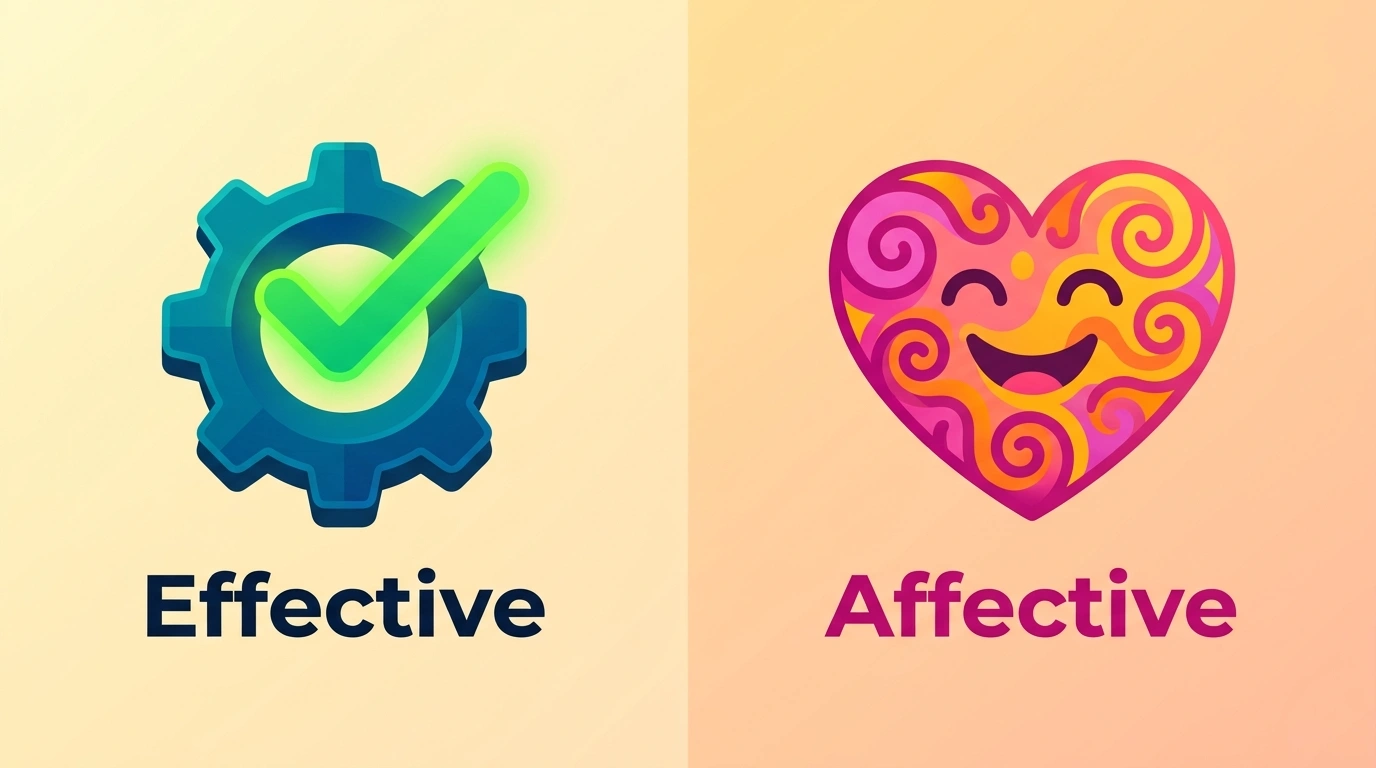
Effective means something works well and gets the result you want. Affective means something is about feelings or emotions.
I still remember the line that stopped my red pen. A student had written, “The speech was very affective.” The speech was good. It really did move the room. But the word was wrong.
That one letter cost the student a mark. It also made me curious. Why do so many smart people mix up these two words?
Here is the short answer. They look almost the same. Even their sounds are close. And they sit next to two other tricky words, affect and effect. That is a lot of A and E for one brain to hold.
Maybe you are writing an email. You could be finishing an essay. Or you just typed “affective” and now you doubt yourself.
This guide will fix that. You will learn what each word means. Then you will see where they come from. Cheat sheets you can copy and keep come next. After that, you will never second guess the pair again.
Ready? Let us start with the basics.
Effective or Affective Quick Answer
Effective is an adjective. It describes something that works. The job gets done.
Affective is also an adjective. It describes something tied to emotions. You will see it most in psychology and education.
Here are two simple examples:
- This cough syrup is effective. (It works.)
- The doctor studied affective disorders. (Disorders of mood and feelings.)
Need a fast rule? Ask one question: is this about a result or about a feeling? A result calls for effective. For a feeling, pick affective.
In daily life, you will want effective almost every time. Affective is rare.
Where Effective and Affective Come From
Both words grew from Latin. That is why they look like cousins.
Effective comes from the Latin word effectivus, which means productive. It is built from efficere, which means to work out or to accomplish. English picked it up through Old French in the late 1300s. From the start, it meant “doing what it is meant to do.”
Affective is part of a different family. It belongs with the word affect. The noun affect means feeling or emotion. It comes from the Latin word affectus, which means a mental or emotional state. That word grew from afficere, which means to act on or to influence.
Both words trace back to facere, the Latin verb for “to make” or “to do.” But they went in two directions. One went toward results. The other went toward feelings.
Why does the mix up happen? Three reasons:
- The words look alike on the page.
- They can sound alike in fast speech, because the first sound is soft.
- Their cousins, affect and effect, are famous for causing trouble.
Many people mix up the two words because they have already struggled with the second pair. That doubt then spreads.
Effective or Affective Explained: Key Differences
Let us put the words side by side. Read this table slowly once. Then use the cheat sheets later.
<table> <thead> <tr><th>Term</th><th>Meaning</th><th>When to Use</th><th>Region or Context</th></tr> </thead> <tbody> <tr><td><strong>Effective</strong></td><td>Producing the result you want. Also: in operation, as in “effective Monday.”</td><td>Plans, medicines, tools, methods, rules, dates</td><td>Everyday English in the US, UK, and everywhere else</td></tr> <tr><td><strong>Affective</strong></td><td>Relating to feelings, moods, or emotions</td><td>Psychology, education, mental health, research</td><td>Mostly technical and academic writing</td></tr> </tbody> </table>
Effective in action
You can use effective in two main ways.
The first way is about results:
- An effective study plan helped her pass the exam.
- Garlic is an effective way to flavor this soup.
The second way is about timing. It tells you when a rule starts.
- The new price is effective from March 1.
- This policy is effective immediately.
You can also use effective to mean impressive. A speech or a design can be called effective when it makes a strong point.
Affective in action
Affective has a narrow job. It talks about feelings.
- The class studied affective disorders, such as mood problems.
- Teachers describe an affective domain of learning. It covers attitudes, values, and feelings.
- Seasonal affective disorder is a mood problem linked to the seasons.
There is also a field called affective computing. It studies how machines can notice and respond to human emotion.
Notice something? You will rarely say “affective” at the dinner table. Textbooks and reports are where it lives.
Which Word Should You Use?
Let us make this simple. Here is direct advice for different readers.
- For students writing essays: Use effective for almost everything. Use affective only when you write about emotions in a psychology or education paper.
- For business writers: Use effective for plans, results, and dates. Write “effective immediately” in policy notes.
- For English learners: Learn effective first. It is common and useful. Learn affective later, when you study psychology words.
- For teachers and parents: Say “effective” when you mean “it works.” Say “emotional” in place of affective when you talk to kids.
- For global or neutral use: Pick effective. It is safe in every country and every style of writing.
A quick rule of thumb: if you are not sure, choose effective. You will be right far more often.
Common Mistakes with Effective or Affective
Here are five mistakes I see again and again. Each one has a fix.
Mistake 1
- Wrong: The teacher’s new method was very affective.
- Right: The teacher’s new method was very effective.
- Why it happens: The writer meant “it worked.” The word sounded close enough.
Mistake 2
- Wrong: She has seasonal effective disorder.
- Right: She has seasonal affective disorder.
- Why it happens: The name is a medical term. It is about mood, so it needs affective.
Mistake 3
- Wrong: The new rule is affective from Monday.
- Right: The new rule is effective from Monday.
- Why it happens: The writer was thinking of “affect.” But a start date needs effective.
Mistake 4
- Wrong: The song was so affective that I cried.
- Right: The song was so moving that I cried. (Or: so emotional.)
- Why it happens: Affective does mean “about emotion.” But in daily talk it sounds stiff. Plain words work better.
Mistake 5
- Wrong: That ad was affective at selling shoes.
- Right: That ad was effective at selling shoes.
- Why it happens: Selling shoes is a result. Results call for effective.
Notice the pattern. The wrong word often comes from sound, not from meaning.
Effective or Affective in Real World Examples
Seeing a word in use helps it stick. Here are four places you might need it.
A professional email
Subject: New work schedule
Hi team,
The new schedule is effective from Monday. We think it is an effective way to cut wait times. Please let me know if you have questions.
A news headline
Study Finds Short Walks Are Effective for Easing Stress
A social media post
Tried the five minute tidy rule today. So effective! My desk has never looked this good.
A formal report
The researchers measured affective responses, such as mood and anxiety, after each session. They also tested whether the program was effective in lowering stress.
See how both words can live in the same report? One talks about feelings. The other talks about results. That is exactly the split to remember.
Cheat Sheets for Effective or Affective
Copy these. Print them. Stick them on your monitor.
Cheat Sheet 1: The Quick Choice
- Does it work? Use effective.
- Does it start on a date? Use effective.
- Is it about feelings or moods? Use affective.
- Are you not sure? Use effective.
Cheat Sheet 2: Memory Tricks
- Effective shares the sound “ef” with the word efficient. Both are about getting things done.
- Affective has the word affection hiding inside it. Affection is a feeling.
- Think of the end of the job. The “e” at the start of effective points to the end result.
- Think of the letter A for Attitude, Anger, Anxiety, and Affection. All of them are feelings.
Cheat Sheet 3: The Swap Test
Try swapping in another word. If it fits, you have the right one.
- If you can say “successful” or “works well,” use effective.
- If you can say “emotional,” use affective.
Example: “The plan was ___.” Swap in “successful.” It fits. So the answer is effective.
Example: “The study looked at ___ disorders.” Swap in “emotional.” It fits. So the answer is affective.
Cheat Sheet 4: The Word Family Map
Both words have cousins. Keep them apart.
- Effective (adjective): it works.
- Effect (usually a noun): a result.
- Affective (adjective): about feelings.
- Affect (usually a verb): to influence.
A famous helper is the trick RAVEN: Remember, Affect is a Verb, Effect is a Noun. It is not perfect. But it solves most cases.
Effective or Affective: Who Searches and Why
This part is about trends. Here is the honest part. I am not going to quote search numbers. They change often and differ by country. If you need exact figures, check a free tool such as Google Trends for your region.
Here is what we can say safely:
- Search intent: Informational. People want to know which word is correct.
- Who asks: Students, English learners, writers, and office workers.
- When they ask: Often in the middle of writing, when doubt strikes.
- Who needs affective: People in psychology, nursing, teaching, and research.
Why does this matter now? More people write online every day. Emails, reports, and social posts all need clean language. One wrong word can make a good message look careless. A small fix like this builds trust.
Effective or Affective Comparison Table
Here is one more table. It adds the cousins, so you can see the whole family.
<table> <thead> <tr><th>Term or Variant</th><th>Meaning</th><th>Region or Context</th><th>Best Used When</th></tr> </thead> <tbody> <tr><td><strong>Effective</strong></td><td>Works well. Also: in force.</td><td>All varieties of English</td><td>You talk about results, methods, or start dates</td></tr> <tr><td><strong>Affective</strong></td><td>Relating to feelings or emotions</td><td>Psychology, education, research</td><td>You write about mood, emotion, or attitude in a technical way</td></tr> <tr><td><strong>Effect</strong></td><td>A result or outcome (noun). Also: to bring about (verb).</td><td>All varieties of English</td><td>You name a result, such as “the effect of sleep”</td></tr> <tr><td><strong>Affect</strong></td><td>To influence (verb). Also: a felt emotion, stressed on the first syllable (noun, in psychology).</td><td>All varieties of English; the noun is mostly technical</td><td>You say that one thing changes another</td></tr> </tbody> </table>
Frequently Asked Questions
Q: What does effective mean?
A: Effective means producing the result you want. It can also mean “in operation,” as in “effective immediately.” It is a common word in everyday English.
Q: What does affective mean?
A: Affective means relating to feelings or emotions. You will mostly see it in psychology, education, and medical writing.
Q: Effective vs affective: what is the difference?
A: Effective is about results. Affective is about feelings. One asks, “Did it work?” The other asks, “How did it feel?”
Q: Is affective acceptable in formal writing?
A: Yes, when you mean something related to emotion. Academic papers use it often. But in plain writing, a word like emotional is usually clearer.
Q: Which is correct: effective or affective?
A: It depends on your meaning. If you want to say something works, effective is correct. To say something is about emotion, affective is correct. For most daily writing, the answer is effective.
Q: Where does effective come from?
A: Effective comes from the Latin word effectivus through Old French. It is tied to the verb efficere, which means to accomplish. English took it in the late 1300s.
Q: Can I use affective in a business email?
A: You can, but only if you truly mean “about emotion,” as in “the affective side of customer service.” For nearly every other business case, you want effective.
Conclusion
Let us pull it together.
Effective means it works. It also means a rule is in force. Affective means it relates to feelings. That is the whole difference.
Remember three takeaways. First, ask whether you mean a result or a feeling. Second, try the swap test with “successful” or “emotional.” Third, when you are unsure, pick effective, because it is far more common.
My final advice is simple. Do not stress over this pair. You now have the rules, the examples, and four cheat sheets. That is more than most writers ever get.
Now you know exactly how to use effective or affective. Go try it in your next email or essay. And bookmark this guide so you never second guess the pair again.
Read More: Afterward or Afterwards: Which Is Correct?

My name is Ayesha Sadiqah, the writer behind this website. I write in-depth articles on English spelling, word comparisons, grammar, and vocabulary to help learners make better language choices. Every guide is designed to provide accurate, practical, and easy-to-understand information.