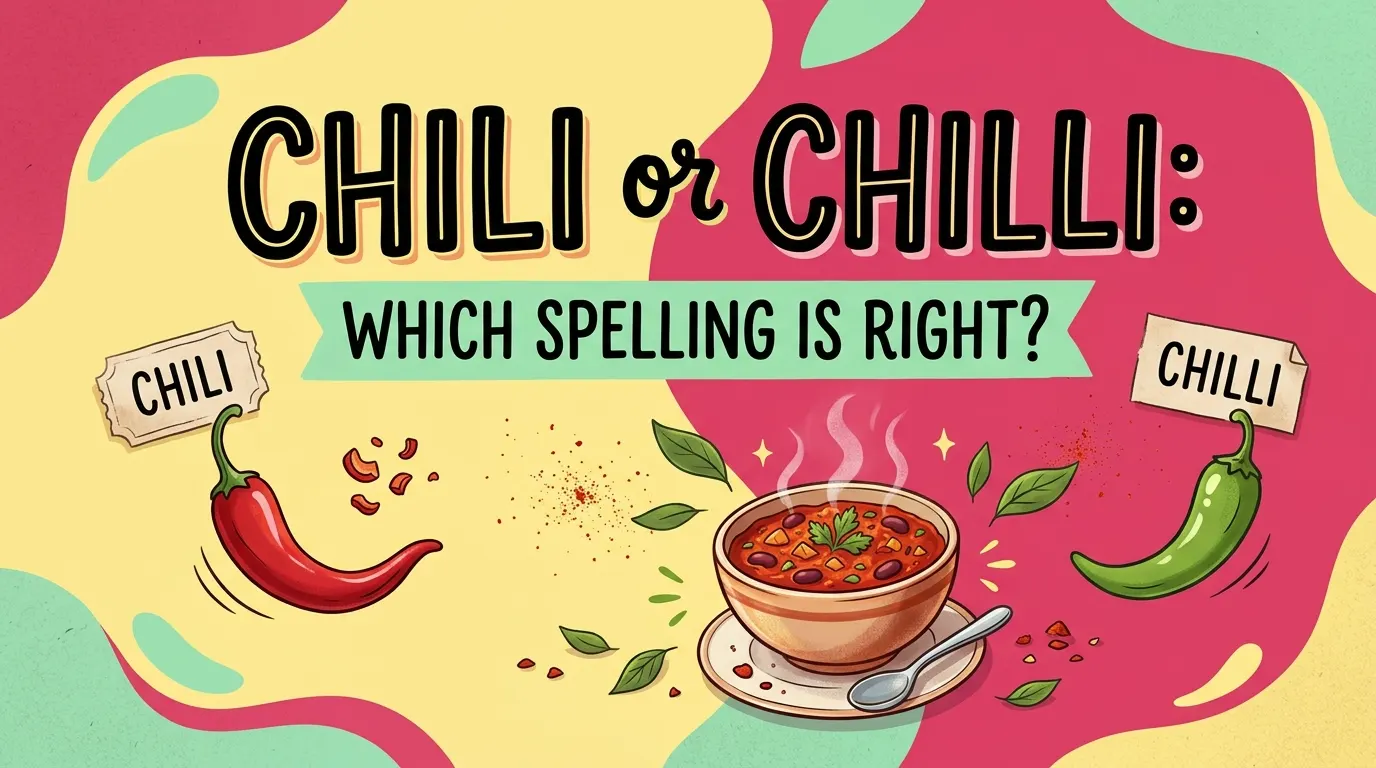
Both are correct. Chili is the American spelling, and chilli is the British one.
Chili and chilli are both correct spellings of the hot pepper and of the dish made with it. Chili is standard in American English. Chilli is standard in British, Australian, Indian, and Pakistani English. A third spelling, chile, is used in Spanish and in the American Southwest. The country is always spelled Chile, and the word chilly, with two l’s and a y, means cold.
At a Glance: Chili, Chilli, Chile, and Chilly
| Spelling | Used In | Plural | Note |
| Chili | United States, Canada | Chilies or chilis | The American standard for the pepper and the dish |
| Chilli | UK, Australia, India, Pakistan | Chillies | The British and South Asian standard |
| Chile | Spanish, New Mexico and the Southwest | Chiles | The Spanish spelling of the pepper |
| Chile (capital C) | South America | None | The country, never the pepper |
| Chilly | Everywhere | None | An adjective that means cold |
What Does Chili Mean?
Chili is a noun, pronounced /ˈtʃɪli/ in both American and British English. It has several related meanings.
- A small, hot pepper used to flavor food, such as a red chili or green chili.
- A dish of meat, beans, tomatoes, and spices, called chili or chili con carne.
- A shortened form of chili powder, the ground spice.
Examples:
- She added a sliced chili to the soup.
- We ate a big bowl of chili on a cold night.
- The curry had a strong chilli flavor.
Chili vs Chilli by Region
Here is how the spellings are usually used around the world.
- United States: chili, with plural chilies or chilis.
- United Kingdom: chilli, with plural chillies.
- Australia and New Zealand: chilli, with plural chillies.
- India and Pakistan: chilli, as in red chilli powder.
- Canada: both appear, though chili is common.
- New Mexico and the Southwest of the United States: chile, a spelling close to Spanish.
If you write for readers in one region, follow the local habit. If you write for readers around the world, choose one spelling and keep it consistent throughout the piece.
Chili, Chilli, and Chile
These three spellings are linked, but they are not always interchangeable.
- Chili: the American spelling of the pepper and the dish.
- Chilli: the British and South Asian spelling.
- Chile: the Spanish spelling, still used for the pepper in the American Southwest. In New Mexico, people even ask Red or green? when they order a meal with chile.
- Chile (capital C): the country in South America. Never write chili for the country.
- Chilly: an adjective meaning cold. It is not related to the pepper.
Chili Powder vs Chilli Powder
The spelling of powder also hides a difference in meaning.
- In the United States, chili powder is usually a blend of ground chilies with spices such as cumin, garlic, and oregano. It is used in dishes like chili.
- Chile powder, or pure chile powder, is just ground chilies.
- In the UK and South Asia, chilli powder usually means ground chilli on its own, and it can be very hot.
So if a recipe says chili powder, check where it comes from, because the two may not be the same.
Plural Forms
The plural also changes with the spelling.
- American: chilies or chilis.
- British: chillies.
- Spanish style: chiles.
Both chilies and chilis are accepted in the US, but chilies is more traditional in dictionaries.
Word History
The word comes from the Nahuatl word chīlli, used by the Aztec people of Mexico for the pepper. Spanish speakers turned it into chile, and English borrowed it in the 1600s. Over time, spelling split into chile, chili, and chilli, depending on the region. The heat of a chili is measured on the Scoville scale, a method developed by the American pharmacist Wilbur Scoville in the early 1900s. The heat comes from a natural compound called capsaicin.
The Chili Dish
Chili, also called chili con carne, which means chili with meat in Spanish, is closely linked with Texas and the American Southwest. Recipes vary widely. Some use beans, and some do not. Some use beef, others use turkey, beans only, or vegetables. It is a popular dish at cookouts, football games, and cook off contests.
Which Spelling Should You Use?
Use these quick guidelines.
- Writing for American readers: chili.
- Writing for readers in the UK, Australia, India, or Pakistan: chilli.
- Writing about the New Mexico pepper: chile.
- Writing about the country: Chile.
- Writing a food blog for a global audience: pick one, such as chili, and use it everywhere.
Example Sentences
- The recipe calls for two green chilies.
- My mother makes the best vegetable chili in town.
- Add a pinch of chilli powder to the rice.
- He tried a hot chile pepper and reached for water.
- We traveled to Chile and tasted fresh fish.
Common Mistakes
- Mixing chili and chilli on the same page.
- Writing chilly when you mean the pepper. Chilly means cold.
- Writing chili for the country. The country is Chile.
- Treating chili powder and chilli powder as always identical.
- Writing chille or chilie. These spellings are incorrect.
Frequently Asked Questions
Is it chili or chilli? Both are correct. Chili is American, and chilli is British.
What is the difference between chili and chile? Chile is the Spanish spelling, still used for the pepper in the American Southwest. Chili is the common American English spelling.
Is chilly the same as chilli? No. Chilly means cold, while chilli is the pepper.
What is the plural of chili? Chilies or chilis in American English, and chillies in British English.
Where does the word chili come from? It comes from the Nahuatl word chīlli, through Spanish.
Conclusion
Chili and chilli are both correct, and the choice depends on your readers. Use chili for American audiences, and use chilli for British, Australian, and South Asian audiences.
Chile is the Spanish spelling and the country, and chilly means cold. Each of these has a different meaning, so they should not be swapped.
Pick the spelling that fits your audience, and keep it the same on every page.
Read More: Afterward or Afterwards: Which Is Correct?

My name is Ayesha Sadiqah, the writer behind this website. I write in-depth articles on English spelling, word comparisons, grammar, and vocabulary to help learners make better language choices. Every guide is designed to provide accurate, practical, and easy-to-understand information.