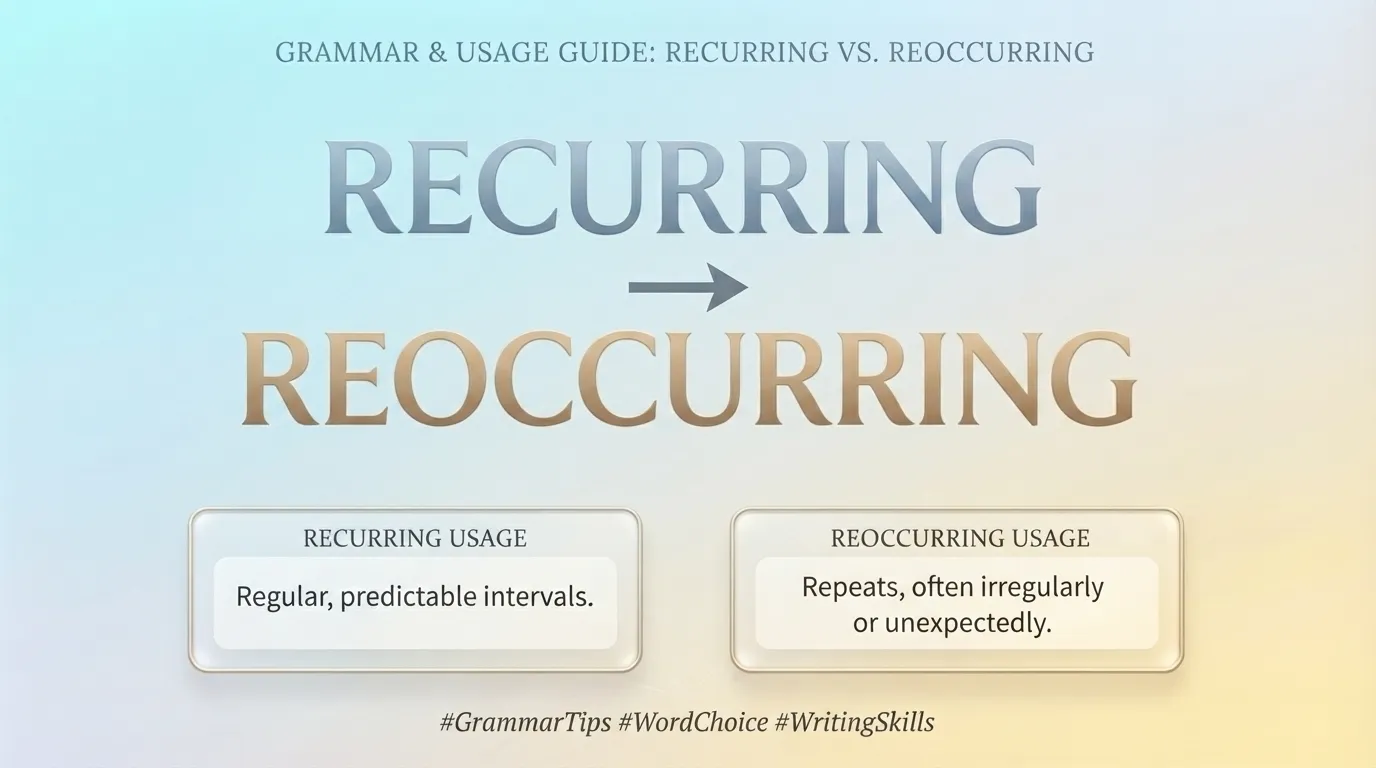
Both recurring and reoccurring are real words, but they are not identical. Recurring describes something that happens repeatedly on a regular, predictable pattern. Reoccurring describes something that simply happens again, without implying any pattern at all.
I once spent ten minutes staring at a billing email, trying to decide whether my subscription was a “recurring charge” or a “reoccurring charge.” Both looked fine. Both sounded fine. My brain simply refused to commit to one.
That moment sums up why this question gets searched so often. The words look almost like typos of each other, yet spellcheckers accept both. Nobody teaches this distinction in school, so most people guess and hope for the best.
Here is the good news. There actually is a real, useful difference between these two words, and once you see it, you will never guess again. This guide breaks down where each word comes from, when to use which one, and the small nuance that most articles online completely skip.
Let’s clear this up for good.
Reoccurring or Recurring: Quick Answer
Recurring means something happens again and again in a regular, expected pattern. Think subscriptions, scheduled meetings, or a recurring dream that shows up every few nights.
Example: “The team holds a recurring meeting every Monday at nine.”
Reoccurring means something happens again, but without any built in sense of pattern or schedule. It could happen once more, or many times, with no predictable rhythm.
Example: “The printer jam kept reoccurring, though never on any particular day.”
The Origin of Recurring and Reoccurring
Recurring comes from the Latin word “recurrere,” meaning “to run back” or “to return.” English absorbed this root centuries ago, and it settled into a word describing things that return in a cycle, like the seasons, a heartbeat, or a monthly bill.
Reoccurring, meanwhile, formed differently. It combines the prefix “re,” meaning “again,” with the verb “occur.” Rather than borrowing from an ancient root, English speakers simply built it from existing English pieces. This makes it a much younger, more casual construction compared to the long standing “recurring.”
The confusion exists because both words technically describe repetition. The subtle difference, pattern versus simple repetition, rarely gets explained clearly, so most people treat the two as interchangeable synonyms rather than words with distinct shades of meaning.
Recurring vs Reoccurring: Key Differences
| Term | Meaning | When to Use | Region/Context |
| Recurring | Happens repeatedly in a regular, predictable pattern | Subscriptions, scheduled events, medical symptoms, financial terms | Standard in both American and British English |
| Reoccurring | Happens again, without any implied pattern or schedule | One time repeats, random glitches, unexpected repeat events | Accepted but less formal, used more in casual speech |
A helpful way to picture this: recurring events follow a calendar. Reoccurring events simply show up again, whenever they feel like it.
Which Word Should You Use?
The right choice depends on whether a pattern exists.
For billing, subscriptions, and scheduled tasks: always use recurring. Financial and business writing almost universally prefers this word, since it implies structure and predictability, exactly what a monthly charge or scheduled meeting represents.
For random glitches, symptoms, or one off repeats: reoccurring fits better, since it avoids implying any fixed schedule. A headache that reoccurs on random days is not following a pattern, so this word captures that nuance accurately.
For formal writing, academic papers, or professional documents: lean toward recurring whenever possible. It is the more established, widely accepted term, and many style guides and editors still flag “reoccurring” as informal or redundant.
Common Mistakes with Recurring and Reoccurring
Mistake: “I have a reoccurring subscription charge every month.” Correction: “I have a recurring subscription charge every month.” Why it happens: Since a subscription follows a strict schedule, recurring is the accurate term, but many people default to reoccurring simply because it sounds more natural to say.
Mistake: “My dream keeps recurring, though it shows up completely at random.” Correction: “My dream keeps reoccurring, though it shows up completely at random.” Why it happens: Writers often use recurring as a catch all term for repetition, even when no real pattern exists.
Mistake: Treating reoccurring as a misspelling of recurring. Correction: Both words are valid. They are simply not interchangeable in meaning. Why it happens: Many spellcheckers and casual writers assume only one version is correct, leading people to “correct” reoccurring unnecessarily.
Mistake: “This is a reoccurring theme throughout the book.” Correction: “This is a recurring theme throughout the book.” Why it happens: Themes typically follow a structured, intentional pattern, so recurring fits far more naturally in literary or academic contexts.
Mistake: Using both words in the same piece of writing inconsistently. Correction: Pick one based on meaning, and stay consistent unless the context genuinely shifts between pattern based and random repetition. Why it happens: Writers sometimes alternate between the two purely for variety, without realizing the words carry different implications.
Recurring and Reoccurring in Real World Examples
In a professional email: “Please note that this is a recurring invoice, charged automatically on the first of each month.”
In a news headline: “Recurring Storms Expected Across the Region This Week”
In a social media post: “This weird reoccurring dream about losing my keys needs to stop, lol.”
In a formal document or report: “The audit identified a reoccurring error in the data entry process, though it did not follow any consistent monthly pattern.”
Notice how the formal financial and scheduled examples use recurring, while the more random, unpredictable examples use reoccurring.
Reoccurring or Recurring: Data and Search Trends
Search demand around this comparison stays high, particularly among students, business writers, and anyone dealing with billing or subscription language. Financial platforms, software companies, and customer service teams search this topic constantly, since accurate wording affects how customers understand their charges.
Search intent here is almost entirely informational, though it carries commercial undertones for businesses writing billing policies or terms of service. Getting this word choice right actually matters for legal clarity, since “recurring charge” carries specific implications in consumer protection law that “reoccurring charge” does not clearly convey.
This distinction matters more now than ever, given how many subscription based services exist today. Clear, accurate language around recurring payments helps avoid confusion, disputes, and even legal complaints.
Standalone Comparison Table
| Term/Variant | Meaning | Region/Context | Best Used When |
| Recurring | Repeats in a regular, predictable pattern | Universal, standard in formal and business writing | Subscriptions, schedules, medical symptoms, structured themes |
| Reoccurring | Repeats without any implied pattern | Universal, more casual and conversational | Random repeats, one off glitches, unpredictable events |
| Reccurring | Common misspelling of recurring | None | Never use this spelling |
| Re occurring | Incorrect spacing | None | Never use this form, always write reoccurring as one word |
Frequently Asked Questions
Q: What does recurring actually mean? A: Recurring describes something that happens repeatedly in a regular, predictable pattern, such as a monthly bill, a weekly meeting, or a seasonal event.
Q: How do you use reoccurring correctly in a sentence? A: Use it to describe something that happens again without implying any fixed schedule, such as “The technical glitch kept reoccurring throughout the week.”
Q: Recurring vs reoccurring, what is the real difference? A: Recurring implies a predictable pattern or cycle, while reoccurring simply means something happened again, with no guaranteed rhythm or schedule involved.
Q: Is reoccurring acceptable in formal writing? A: It is grammatically correct, but many editors and style guides prefer recurring in formal writing, since it is the more established and widely recognized term.
Q: Which version is correct, recurring or reoccurring, for a subscription charge? A: Recurring is correct for subscriptions, since these charges follow a fixed, scheduled pattern rather than happening randomly.
Q: Where does the word recurring come from? A: It comes from the Latin word recurrere, meaning to run back or return, which entered English centuries ago to describe cyclical repetition.
Q: Can reoccurring be used to describe a recurring illness or symptom? A: Yes, if the symptom shows up unpredictably. If the symptom follows a clear pattern, such as monthly flare ups, recurring is the more accurate choice.
Final Thoughts
Here is what to remember. Recurring describes repetition that follows a pattern, like subscriptions, schedules, and seasonal cycles. Reoccurring describes repetition without any guaranteed rhythm, like random glitches or unpredictable events.
Both words are correct, so this is not about right versus wrong spelling. It is about picking the word that actually matches the situation you are describing.
Next time you write about something happening again, pause and ask yourself one question: does this follow a pattern, or does it just keep popping up randomly? That answer will point you straight to the right word.
Bookmark this guide so you never second guess recurring or reoccurring again. Share it with anyone who has ever paused over a billing email wondering which word applies.
Read More: Whether or Weather: The Real Answer

Hey, I’m Ayeza. I started this site because I kept hitting the same wall over and over: typing a word, freezing, and not trusting my own instinct on the spelling. Now I research these mix-ups properly so you don’t have to, and I write every guide the way I wish these explanations had been written for me.