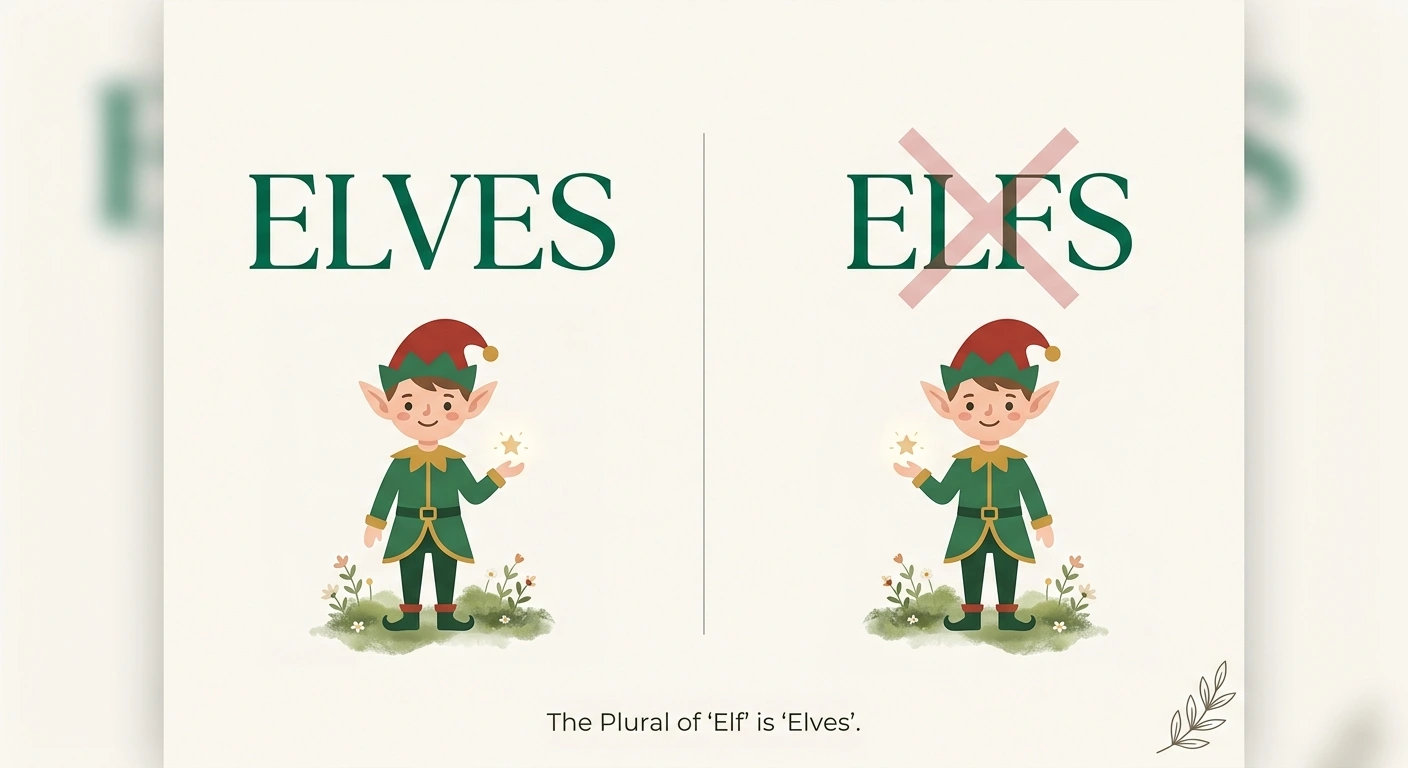
The correct plural of elf is elves. The spelling “elfs” is not the standard plural. It appears only in rare cases, such as the old verb “to elf” or the computer file format ELF.
Picture a quiet walk in the forest. Something rustles in the leaves. You catch a flash of a pointed hat and a mischievous giggle. You have just spotted an elf!
Then you hear a second giggle. And a third. Before long, a dozen small faces peek out from the branches. Now you face a very serious problem. How do you write about this when you get home?
I have taught English for over ten years, and this exact question lands on my desk every December. Last winter, a student showed me a holiday card she had made. She asked, “Teacher, is it elves or elfs?” I realized then that most guides skip the real reason behind the answer.
This guide fills that gap. You will get the answer, the history, two memory tools, a practice quiz, and real examples. Let us begin.
Elves or Elfs: Quick Answer
The plural of elf is elves. Every major dictionary lists it first. Books, films, newspapers, and school papers all use it.
Think of it like this. One elf bakes the cookies. Two elves bake the cookies. A whole crowd of elves bakes them all night.
Here are three simple examples:
- The elf hid behind the oak tree.
- The elves sang while they worked.
- Santa thanked every one of his elves.
Notice the pattern. The f in the singular turns into a v in the plural. Then es is added.
If you only want the rule, you can stop here. If you want to understand it, keep reading.
The Origin and Background of Elves
The word elf is very old. It comes from Old English, where it appeared as ælf. The plural form was ylfe. Over many centuries, the sounds shifted. By Middle English, writers were using forms close to our modern elves.
Some sources point to German, Danish, or Gaelic roots. The safer story is simpler. The word belongs to the old Germanic family of languages, and Old English carried it into modern English.
Why does the f turn into a v?
The answer lives in your mouth. The sounds f and v are twins. You make both by touching your lower lip to your upper teeth. The only difference is your voice. A v hums. An f does not.
Here is the clever part. In Old English, an f placed between voiced sounds was spoken as a v. Think of the middle of the word “elves.” The f sits right after an l and before a vowel, so speakers naturally hummed it. The spelling later caught up with the sound.
That is why we write the v we hear. It is a living fossil, not a random quirk.
Why the confusion exists
Three things keep the question alive:
- Not every f word follows the rule. Roof becomes roofs. Chief becomes chiefs. People guess the wrong pattern.
- Pop culture mixes things up. You see “elfs” in jokes, memes, and product names. It looks familiar, so it feels right.
- Spell checkers vary. Some flag one form, some flag the other, and some flag neither.
Elves and Elfs Explained: Key Differences and Variations
Let us look at every form you might meet. This table shows what each one means and where it belongs.
| Term | Meaning | When to Use | Region or Context |
| elf | One small magical being | Talking about a single creature | All English speaking regions |
| elves | More than one elf | Standard plural in every kind of writing | All English speaking regions |
| elfs | Verb form, or a rare informal plural | Only for the verb “to elf” or a playful tone | Rare, mostly informal |
| ELFs | More than one ELF file | Computer talk about the ELF file format | Technology and programming |
| elven | Relating to elves | As an adjective, like “elven ears” | Fantasy writing |
| elvish | Having the nature of elves | Describing a language or style | Fantasy writing |
| elfin | Small and delicate | Describing a person or a face | Literary, descriptive writing |
A few quick examples help each one stick.
- Elves: “The elves finished the toys before sunrise.”
- Elfs (verb): In old folk language, to “elf” hair meant to tangle it into knots. A tangled lock was called an “elf lock.”
- ELFs (tech): “The engineer checked three ELFs for errors.”
- Elven: “She wore an elven cloak.”
- Elfin: “He had an elfin grin.”
Which Version Should You Use?
You do not need to agonize. Here is a direct guide based on who you are and what you are writing.
- For students and teachers: Use elves. It is correct, and no teacher will mark it wrong.
- For fiction and fantasy writers: Use elves. Readers of the genre expect it. Pair it with elven or elvish for the adjective.
- For marketers and bloggers: Use elves. Search engines and readers both treat it as the standard form.
- For business and formal writing: Use elves. It protects your credibility.
- For programmers writing about ELF files: Write ELFs or “ELF files.” Keep the capital letters.
- For global and neutral use: Use elves every single time.
If you remember only one line, remember this: when in doubt, write elves.
Cheat Sheet One: The F to V Rule
Many English nouns that end in f or fe change to ves in the plural. Keep this list handy.
| Singular | Plural |
| elf | elves |
| shelf | shelves |
| self | selves |
| wolf | wolves |
| leaf | leaves |
| calf | calves |
| half | halves |
| loaf | loaves |
| thief | thieves |
| knife | knives |
| wife | wives |
| life | lives |
Now look at the words that break the rule. They simply add s.
| Singular | Plural |
| roof | roofs |
| chief | chiefs |
| belief | beliefs |
| cliff | cliffs |
| proof | proofs |
| reef | reefs |
| safe | safes |
| giraffe | giraffes |
Here is a gentle guide. Words that end in a double f, like cliff, nearly always just add s. Words with a long vowel before the f, like leaf and loaf, often change to ves. It is not perfect, but it helps.
Cheat Sheet Two: Words With Two Correct Plurals
Some words are flexible. Both forms are accepted, and either one is safe.
| Singular | First Plural | Second Plural |
| dwarf | dwarfs | dwarves |
| scarf | scarfs | scarves |
| hoof | hoofs | hooves |
| wharf | wharfs | wharves |
Elf is not on this list. It has one standard plural, and that plural is elves.
The word dwarf deserves a quick story. J.R.R. Tolkien chose dwarves and elves for his fantasy worlds. He knew dwarfs was the standard form, and he used dwarves on purpose to give his dwarf characters a special feel. Fantasy readers have loved the spelling ever since. Elves, however, needed no special choice, because elves is already standard.
Common Mistakes with Elves and Elfs
Let us look at the errors I see most often. Each one comes with the fix and the reason it happens.
Mistake one: Using elfs as the normal plural.
- Wrong: The elfs packed the presents.
- Right: The elves packed the presents.
- Why it happens: Writers add s out of habit, because most nouns work that way.
Mistake two: Writing elfes.
- Wrong: Three elfes sat by the fire.
- Right: Three elves sat by the fire.
- Why it happens: Writers mix the old and new rules and end up with a spelling that does not exist.
Mistake three: Using elves for one creature.
- Wrong: The elves waved at me. (when only one is waving)
- Right: The elf waved at me.
- Why it happens: Writers lose track of the number in long sentences.
Mistake four: Mixing up the possessive.
- Wrong: The elves toy box was full.
- Right: The elves’ toy box was full. (many elves)
- Right: The elf’s toy box was full. (one elf)
- Why it happens: The apostrophe is easy to forget, and its place changes with the number.
Mistake five: Treating every f word the same.
- Wrong: The roves were leaking. (for roofs)
- Right: The roofs were leaking.
- Why it happens: Writers overuse the f to v rule after learning it.
How to Say Elves Out Loud
Spelling is only half the job. Let us fix the sound too.
- Elf rhymes with shelf. You say it with a short e and a crisp f.
- Elves rhymes with shelves and selves. You hum the last sound, like a bee.
- Place your fingers on your throat. Say “elf.” Then say “elves.” You will feel a buzz on the second word.
That buzz is the whole story. When you hear it, you know to write a v.
Elves in Real World Examples
Seeing a word in action locks it into memory. Here are four settings where you might use it.
A professional email
Hi Maria, We have hired three seasonal helpers for the holiday booth. They will dress as elves during weekend events. Please send me the costume sizes by Friday. Thanks, Daniel
A news headline
Local Library Welcomes Volunteers Dressed as Elves for Winter Story Hour
A social media post
The elves in our workshop are working overnight. Only five days left to order your gifts! #HolidayMagic
A formal report
The festival survey showed that families rated the performance by the costumed elves as the most popular event of the evening.
In every example, the plural is elves. No exceptions, no matter how formal or casual the setting.
Elves: Data, Trends, and Usage
Let us talk about when and why people search for this question.
- Seasonal peaks. Interest in this topic tends to rise every year in November and December, when holiday cards, school plays, and festive posts fill the calendar.
- Fantasy fans. Readers and writers of fantasy fiction look for the form often, especially when drafting stories, role play characters, and game guides.
- English learners and students. Learners around the world ask about plural spelling rules. Elf is a favorite example because the change is so clear.
- Search intent. This is an informational search. The reader wants a fast, correct answer and a short reason.
Why does this matter now? More people write online than ever before. Social posts, blog articles, and product pages go public in seconds. A small spelling slip can look careless. Knowing the right plural helps you build trust with every reader.
Cheat Sheet Three: Memory Tricks You Can Use Today
Rules are easier to hold when you attach a picture to them. Try these.
- The Voice Trick. Say the word out loud. You hear “elvz,” not “elfs.” Write what you hear.
- The Shelf Trick. You would never write “shelfs” for books on a wall. You write shelves. Elf follows the same path.
- The Wolf Trick. One wolf howls. Many wolves howl. One elf giggles. Many elves giggle.
- The Rhyme Trick. Elves rhymes with shelves and selves. All three use the v.
- The Emergency Trick. If you feel stuck, rewrite the sentence with “a group of elves.” Using it a few times makes it automatic.
Practice Quiz: Test Yourself
Fill in the blank with the correct form. Answers sit at the end of the list.
- One ______ is hiding behind the door.
- Five ______ are hiding behind the door.
- The ______ hats were all red. (many elves)
- The ______ hat was green. (one elf)
- Two ______ held the ladder. (shelf)
- A pack of ______ howled at the moon. (wolf)
- The brothers wore warm ______ in winter. (scarf)
- The engineer reviewed three ______ for errors. (ELF files)
Answers: 1. elf. 2. elves. 3. elves’. 4. elf’s. 5. shelves. 6. wolves. 7. scarves or scarfs. 8. ELFs.
If you scored seven or more, you have mastered this topic. If you scored lower, read Cheat Sheet Three once more and try again tomorrow.
Standalone Comparison Table
| Term or Variant | Meaning | Region or Context | Best Used When |
| elf | One magical being | Worldwide | You are naming a single creature |
| elves | Many magical beings | Worldwide | You need the standard plural |
| elfs | Verb, or rare informal plural | Rare, informal | You mean the verb “to elf” or want a playful tone |
| ELFs | Many ELF files | Technology | You are discussing the file format |
| elf’s | Belonging to one elf | Worldwide | Showing ownership by one elf |
| elves’ | Belonging to many elves | Worldwide | Showing ownership by several elves |
Frequently Asked Questions
Q: What does elf mean? A: An elf is a small, magical being from folklore. Elves often appear in northern European stories and in fantasy books. Today the word also brings to mind Santa’s helpers.
Q: How do you use elves correctly in a sentence? A: Use elves when you mean more than one elf. For example, “The elves decorated the hall.” Use elf for one, and elves for two or more.
Q: Elves vs elfs: what is the difference? A: Elves is the standard plural form. Elfs is not the usual plural and appears only in special cases, such as the verb “to elf” or informal play. In nearly all writing, choose elves.
Q: Is elfs acceptable in formal writing? A: No. Formal writing, school papers, and professional documents all call for elves. Using elfs as a plural can make your work look careless.
Q: Which version is correct, elves or elfs? A: Elves is correct. Major dictionaries list it as the plural of elf. If you want to be safe, write elves every time.
Q: Where does the word elf come from? A: It comes from Old English ælf, with a plural ylfe. Over time, the sounds changed. The modern plural keeps the humming v sound that speakers used for centuries.
Q: Can elfs be used in technology writing? A: Yes, in one case. Programmers talk about the ELF file format, and several such files are called ELFs. Write it in capital letters so readers know you mean the format, not the creature.
Q: Is it elves or dwarves, and does it follow the same rule? A: Dwarves is an accepted plural, and so is dwarfs. Both exist, which makes dwarf more flexible than elf. For elf, there is only one standard choice, and that is elves.
Conclusion
Let us pull it together. Here are the key takeaways:
- The plural of elf is elves.
- The f turns into a v because speakers hummed that sound for centuries, just like shelf and shelves, wolf and wolves.
- Elfs is rare. It belongs to the verb “to elf” or to ELF files in tech talk.
- The possessives are elf’s for one and elves’ for many.
My final recommendation is simple. Write elves in every email, essay, story, and post. You will be right every time, and your readers will trust your words.
So the next time a dozen giggling faces peek out of the trees, you will know exactly what to write. Your friends may still doubt your story, but they will never doubt your spelling.
Share this guide with someone who has been confused about elves or elfs, and bookmark it so you never second guess the plural again.
Read More: Makeup or Cosmetics: The Easy Guide to Choose Right

Hey, I’m Ayeza. I started wordiums.com because I kept freezing over words that look almost the same, unsure which one was right. Now I explain every word comparison in plain language, so you can pick the right word with confidence and move on.