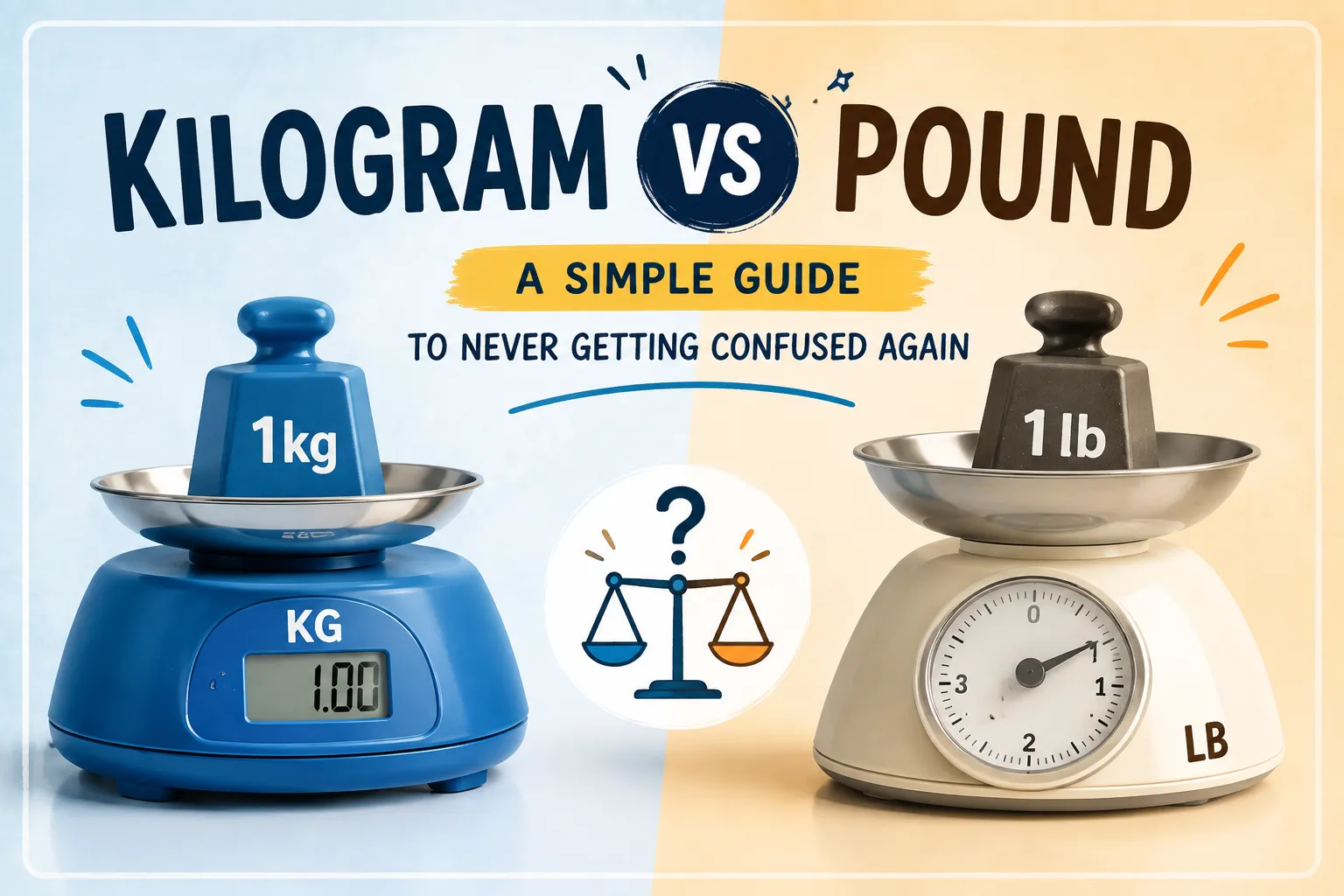
A kilogram is a metric unit of mass equal to about 2.2 pounds. A pound, meanwhile, is an imperial unit of weight used mainly in the United States. So they measure similar things, but they belong to two different systems.
I once tried to follow a British recipe that listed ingredients in grams and kilograms, while my kitchen scale only showed pounds and ounces. I stood there, phone in hand, converting numbers like I was solving a math exam.
That mix up taught me something important. Most people know both units exist, but very few actually understand how they relate to each other.
Recipes, luggage limits, gym goals, and shipping labels all throw these two units at us constantly. Getting them confused can mean overpacking a suitcase, or worse, completely ruining a dish.
This guide makes the difference simple, clear, and easy to remember for good.
Kilogram vs Pound – Quick Answer
A kilogram is the base unit of mass in the metric system, and most countries worldwide use it. A pound, however, is a unit of weight in the imperial system, used mainly in the United States.
One kilogram equals roughly 2.2 pounds. So a 10 kilogram bag weighs about 22 pounds, a difference worth knowing before you step on an airport scale.
The Origin and Background of Kilogram and Pound
The kilogram was created during the French Revolution as part of the new metric system. Its designers wanted to standardize measurements using simple, logical units based on nature and science.
The pound, though, has much older roots. It traces back to ancient Rome, where people used the libra as a unit of weight. That is also why the abbreviation for pound is “lb,” short for libra, not “pd” as many people expect.
Over time, most of the world adopted the metric system and the kilogram. The United States, along with a few other countries, kept the imperial system and the pound as its standard.
Kilogram and Pound Explained – Key Differences
| Term | Meaning | When to Use | Region/Context |
| Kilogram | Metric unit of mass, base unit worldwide | Science, most countries, international trade | Global standard outside the US |
| Pound | Imperial unit of weight | Everyday use, cooking, fitness | Mainly United States, some UK contexts |
Scientific, medical, and international settings rely on kilograms almost everywhere. Pounds, meanwhile, remain common in everyday American life, from body weight to grocery shopping.
Which Unit Should You Use?
- For scientific or international writing → use kilograms, since it is the global scientific standard.
- For everyday American audiences → use pounds, because it matches what most US readers already understand.
- For global or neutral content → use kilograms, since the majority of the world’s population relies on the metric system.
If your audience is mostly American, pounds will feel natural and familiar. If your audience is global or scientific, though, kilograms are the safer, more universal choice.
Common Mistakes with Kilogram and Pound
Mistake 1: Assuming a kilogram and a pound are roughly equal.
- Wrong: “A 5 kilogram bag weighs about 5 pounds.”
- Correct: “A 5 kilogram bag weighs about 11 pounds.”
- Why it happens: People assume metric and imperial units convert one to one, which is rarely true.
Mistake 2: Mixing units within the same document or recipe.
- Wrong: Listing some ingredients in kilograms and others in pounds without conversion.
- Correct: Stick to one unit system throughout, or clearly label both.
- Why it happens: Copying instructions from multiple international sources without standardizing units first.
Mistake 3: Forgetting that kilogram measures mass, not exactly the same as everyday weight.
- Wrong: Treating kilogram and pound as scientifically identical concepts.
- Correct: Understand that kilogram measures mass, while pound traditionally measures weight, though people use both interchangeably in daily life.
- Why it happens: Everyday language rarely distinguishes between mass and weight precisely.
Mistake 4: Using the wrong abbreviation for pound.
- Wrong: Writing “pd” as a shorthand for pound.
- Correct: Use “lb” or “lbs,” based on the Latin word “libra.”
- Why it happens: People assume abbreviations always match the first letters of the English word.
Kilogram and Pound in Real World Examples
Professional email: “Please confirm the shipment weight in kilograms for our international logistics partner.”
News headline: “Airline Cuts Checked Baggage Limit to 20 Kilograms Starting Next Month”
Social media post: “Finally hit my goal weight, down 5 pounds this month! 💪”
Formal document: “The product weighs 2.5 kilograms, equivalent to approximately 5.5 pounds.”
Kilogram and Pound – Data, Trends, and Usage
“Kilogram” dominates search volume globally, since most countries use the metric system daily. “Pound,” meanwhile, sees heavy search volume specifically from the United States, especially around fitness, cooking, and shipping topics.
International trade, science, and travel content lean heavily toward kilograms. Everyday American content, especially fitness and recipes, leans heavily toward pounds instead.
Search intent for both terms mixes informational searches, like unit conversions, with commercial searches, like shipping calculators and fitness tracking tools.
This distinction matters now more than ever, as global ecommerce and international shipping require clear, accurate weight labeling. Without it, costly mistakes and customer confusion follow quickly.
Kilogram vs Pound – Comparison Table
| Term/Variant | Meaning | Region/Context | Best Used When |
| Kilogram | Metric unit of mass | Global standard, science, trade | Writing for international or scientific audiences |
| Pound | Imperial unit of weight | Mainly United States | Writing for everyday American audiences |
| Ounce | Smaller imperial unit | United States, cooking | Measuring small quantities in recipes |
Frequently Asked Questions
Q: What does kilogram mean? A: A kilogram is the base unit of mass in the metric system, roughly equal to 2.2 pounds, and it serves as the global standard in most countries.
Q: What does pound mean? A: A pound is a unit of weight in the imperial system, commonly used in the United States for body weight, groceries, and everyday measurements.
Q: Kilogram vs pound, what’s the exact conversion? A: One kilogram equals approximately 2.2 pounds. To convert kilograms to pounds, multiply the kilogram value by 2.2.
Q: Is pound acceptable in scientific writing? A: Rarely. Scientific and international writing almost always uses kilograms, since it is the recognized global standard unit of mass.
Q: Which unit is more accurate, kilogram or pound? A: Neither is more accurate, since they simply belong to different systems. Kilograms follow the metric system, while pounds follow the imperial system.
Q: Where does the word pound come from? A: It comes from the Latin word “libra,” an ancient Roman unit of weight, which is also why “lb” remains the standard abbreviation today.
Q: Can kilograms and pounds be used together in one document? A: Yes, especially in international contexts, as long as both units are clearly labeled to avoid confusion for different audiences.
Final Thoughts
Kilograms and pounds both measure weight, but they come from completely different systems with different histories. Kilograms rule the metric world, while pounds remain the everyday standard in the United States.
Knowing the roughly 2.2 conversion rate can save you from cooking disasters, shipping mistakes, and confusing luggage weigh ins.
Bookmark this guide so you never second guess kilograms and pounds again.
Read More: Bungalow vs Villa: Which One Actually Fits Your Dream Home?

My name is Ayesha Sadiqah, the writer behind this website. I write in-depth articles on English spelling, word comparisons, grammar, and vocabulary to help learners make better language choices. Every guide is designed to provide accurate, practical, and easy-to-understand information.